



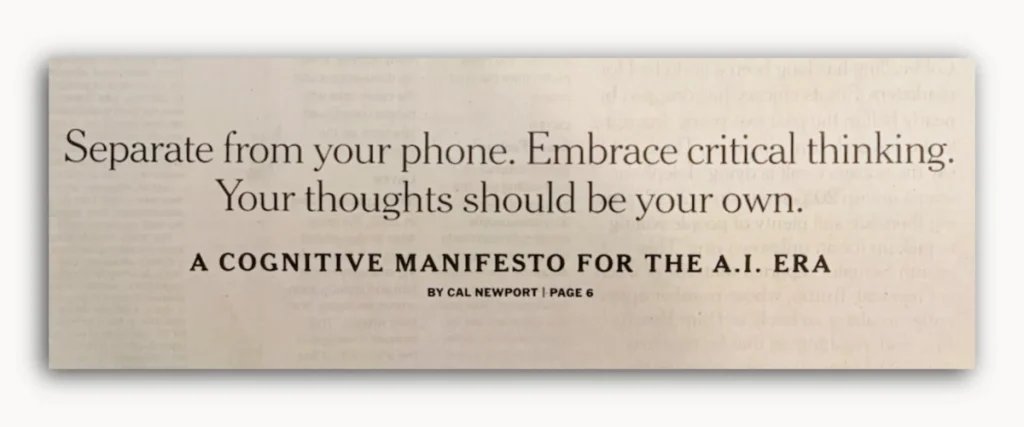
Ten years following the publication of his seminal work, Deep Work: Rules for Focused Success in a Distracted World, Georgetown University computer science professor and bestselling author Cal Newport has issued a stark warning regarding the accelerating erosion of collective cognitive abilities, advocating for a societal "revolution in defense of thinking." In a recent long-form essay published in The New York Times, Newport reflects on the unforeseen trajectory of digital distraction since his book’s 2016 release, concluding that the challenges he identified have not only persisted but have intensified dramatically, threatening humanity’s fundamental capacity for deep thought.
The Genesis of Deep Work and its Unconventional Path to Success
Deep Work, published in January 2016, emerged as Newport’s second mainstream hardcover "idea book," following the 2012 release of So Good They Can’t Ignore You: Why Skills Trump Passion in the Quest for Work You Love. The initial sales performance of So Good They Can’t Ignore You had been modest, leading to tempered expectations for its successor. This lower pressure, however, proved to be a liberating factor for Newport, allowing him to craft Deep Work with an unfiltered intellectual curiosity, exploring the conceptual fringes of issues surrounding distraction that genuinely captivated him.
Newport’s fascination stemmed from a perceived economic paradox: the systematic undervaluation of focused work within many knowledge-based organizations, despite its clear potential for high-value output. He posited this as a significant, unexploited opportunity for individuals and companies willing to counteract this prevailing oversight, drawing an analogy to the data-driven insights of Moneyball applied to the "cubicle class." Beyond the economic imperative, Newport also held a profound philosophical conviction that deep thinking constituted the core of the post-Paleolithic human experience—the wellspring of humanity’s most profound ideas, satisfactions, and even transcendent moments.
This blend of economic pragmatism and philosophical depth distinguished Deep Work from many contemporary books in the productivity genre. Readers accustomed to narratives featuring stressed executives, regurgitated statistics on interruptions, and anodyne lists of practical-yet-unobtrusive tips, presented in a conversational tone with often-manipulated case studies, found Deep Work to be a more intellectually rigorous and intense experience. Newport’s recent re-reading of his own work underscored its idiosyncratic nature, noting the breadth of his references, which spanned far beyond the typical knowledge sector. He quoted philosophers of religion, profiled a blacksmith employing ancient forging techniques, discussed memory champions, and delved into chavruta, the Jewish practice of paired Talmudic or Torah study. Instead of opening with a relatable tale of workplace frustration, the book commenced by examining Carl Jung’s struggles to liberate himself from Sigmund Freud’s intellectual dominance, showcasing a direct engagement with the ideas and sources that resonated most deeply with the author.
This distinctive, research-driven approach resonated powerfully with a growing audience grappling with the nascent challenges of digital distraction. Deep Work swiftly found its footing, going on to sell over two million copies across more than forty-five languages. Its success also provided a retrospective validation for So Good They Can’t Ignore You, which subsequently gained traction, quietly selling over half a million copies and solidifying Newport’s reputation as a leading voice in productivity and career development.
The Evolving Landscape of Distraction: 2016 to Present
The decade since Deep Work‘s publication has witnessed a dramatic escalation in the forces arrayed against sustained focus. In 2016, while concerns about email overload and nascent social media use were present, the full scope of the "attention economy’s" impact was still unfolding. The intervening years have introduced and normalized an array of technologies that have fundamentally reshaped the modern workplace and personal digital lives.
Workplace Intensification: The period post-2016 saw the widespread adoption and entrenchment of instant messaging platforms like Slack and low-friction digital meeting solutions such as Zoom. These tools, while ostensibly designed to enhance collaboration and communication, have inadvertently created an environment of "hyperactive hive mind" communication. Data from various productivity studies indicates that the average knowledge worker faces an interruption every few minutes, often requiring significant time to regain focus. A 2023 study by Statista revealed that employees spend an average of 32% of their workweek in meetings, with many reporting these meetings as unproductive. Furthermore, the expectation of immediate responses on platforms like Slack creates a perpetual state of readiness for interruption, fragmenting attention and making deep, sustained thought increasingly difficult. The constant barrage of notifications, chat messages, and meeting requests has transformed the professional landscape into one characterized by superficial engagement rather than deliberate concentration.
The Rise of the "TikTok-ified Slurry": Outside the professional sphere, the evolution of social media has been even more insidious. In 2016, platforms like Facebook and Instagram were still largely admired, seen as tools for connection and community. However, the subsequent years witnessed the meteoric rise of short-form video content, epitomized by TikTok. These platforms leverage sophisticated algorithms to deliver highly personalized, dopamine-inducing content streams, optimized for maximum engagement and minimal cognitive effort. The result, as Newport describes, is an "addictive TikTok-ified slurry of optimized brain rot." Studies on media consumption indicate a dramatic shortening of average attention spans, with users habituated to rapid content switching and instant gratification. This constant exposure to fragmented, high-stimulus content not only reduces an individual’s capacity for sustained attention but also rewires neural pathways, making the mental effort required for deep work feel increasingly arduous.
The AI Factor: More recently, the advent of sophisticated generative AI tools has introduced another layer of complexity. While offering promises of efficiency and automation, these tools also present a new temptation for "quick-fix shortcuts" to intellectually engaging tasks. Newport argues that AI, by potentially abstracting away the need for complex problem-solving or creative synthesis, risks further eroding the very intellectual muscle that deep work seeks to strengthen. If AI can generate a first draft of an essay, code a basic program, or summarize complex information, the incentive for individuals to engage in the deep, effortful cognitive processes required to master these skills or push intellectual boundaries diminishes. This creates a potential future where humans become mere curators or editors of AI output, rather than originators of profound thought.
Newport’s Dire Assessment: Losing the Ability to Think Deeply
In his recent New York Times essay, published over a weekend, Newport articulated a profoundly pessimistic outlook on these developments. His core concern has shifted dramatically from merely helping people find enough free time for deep work to the alarming prospect that society is "rapidly losing the ability to think deeply at all, regardless of how much space we can find in our schedules for these efforts." This represents a critical escalation of the problem, suggesting a fundamental degradation of cognitive infrastructure rather than merely an external barrier to concentration.
This assessment aligns with a growing body of research from neuroscientists and cognitive psychologists who have documented the measurable impacts of constant digital stimulation on executive function, memory, and sustained attention. Brain imaging studies have shown alterations in brain regions associated with focus and reward processing in heavy internet and social media users. The constant context-switching demanded by modern digital environments trains the brain to be perpetually distracted, making the transition to a state of deep concentration increasingly difficult and even uncomfortable.
Supporting Data and Expert Perspectives on the Cognitive Crisis
The statistics paint a sobering picture of this cognitive decline. A report by RescueTime found that knowledge workers check email or instant messages every 6 minutes, spending less than 45 seconds on average on a single task before switching. Another study indicated that it can take up to 23 minutes and 15 seconds to return to a task after an interruption. The cumulative effect of these micro-interruptions is a significant reduction in overall productivity and a profound increase in cognitive load and stress.
From an economic standpoint, the cost of distraction is immense. A study by the University of California, Irvine, estimated that office distractions cost the U.S. economy nearly $650 billion annually in lost productivity. Beyond mere efficiency, the decline in deep thinking poses a significant threat to innovation, complex problem-solving, and the development of truly transformative ideas—the very activities that drive societal progress and economic growth.
Experts in various fields have echoed Newport’s concerns. Dr. Adam Gazzaley, a neuroscientist at the University of California, San Francisco, has extensively researched the impact of digital media on the brain, warning that constant multitasking and information overload diminish our capacity for sustained attention and critical thinking. Psychologists like Sherry Turkle have long documented the erosion of empathy and introspection in an age of constant connectivity. Even within the tech industry, a growing number of former executives and designers have voiced regret over the addictive nature of the products they helped create, acknowledging their detrimental effects on mental well-being and cognitive function.
The Call to Action: A "Revolution in Defense of Thinking"
Given this bleak prognosis, Newport argues that merely reading Deep Work (or re-reading it, or gifting it) is an insufficient response, albeit a necessary first step. He proposes a far more ambitious and collective undertaking: "a louder response… we launch a revolution in defense of thinking." This call to action transcends individual productivity hacks, advocating for a systemic and cultural shift.
While Newport’s Times piece details multiple concrete actions such a revolution could encompass (though not explicitly listed in the provided source text, they would logically include systemic changes in workplace policies, educational reforms emphasizing sustained attention, and a re-evaluation of personal technology use), the spirit of the revolution is paramount. It represents a conscious, collective decision to reclaim intellectual autonomy from the encroaching forces of distraction.
Newport articulates this sentiment powerfully in his conclusion: "I’m done ceding my brain — the core of all that makes me who I am — to the financial interests of a small number of technology billionaires or the shortsighted conveniences of hyperactive communication styles. It’s time to move past fretting about our slide into the cognitive shallows and decide to actually do something about it." This statement is not merely a personal declaration but a rallying cry for anyone who recognizes the profound value of human cognition and the existential threat posed by its steady erosion.
Broader Implications and the Path Forward
The implications of this cognitive crisis are far-reaching. On an individual level, the inability to engage in deep work leads to diminished job satisfaction, increased stress, and a pervasive sense of intellectual unfulfillment. Creativity suffers, and the capacity for complex problem-solving, essential for navigating an increasingly intricate world, wanes.
Societally, a widespread decline in deep thinking could have profound consequences for innovation, democratic discourse, and the ability to address pressing global challenges. A populace habituated to superficial engagement and algorithmic curation may struggle with critical analysis, nuanced understanding, and the sustained effort required for meaningful civic participation. The potential for a "cognitive divide" looms, where those who intentionally cultivate deep work skills gain an ever-increasing advantage over those who succumb to the default state of perpetual distraction.
Newport’s call for a "revolution" suggests a multi-faceted approach. This would likely involve:
- Policy Changes in Workplaces: Companies re-evaluating their communication norms, implementing "deep work hours," reducing reliance on instant messaging, and redesigning physical and digital workspaces to minimize distraction.
- Educational Reform: Prioritizing the teaching of sustained attention, critical thinking, and complex problem-solving from an early age, potentially reducing screen time in classrooms and fostering environments conducive to focused learning.
- Personal Responsibility and Digital Literacy: Empowering individuals with strategies to manage their digital environments, understand the psychological mechanisms of addictive technologies, and cultivate habits that support deep work. This also involves advocating for ethical design principles in technology that prioritize user well-being over maximal engagement.
- Public Awareness Campaigns: Elevating the discourse around cognitive health and the importance of deep thinking to the level of other public health concerns.
The challenge is formidable, requiring a collective will to push back against powerful economic incentives and deeply ingrained behavioral patterns. However, Newport’s decade-long observation, culminating in this urgent plea, underscores that the stakes are nothing less than the preservation of our fundamental human capacity for meaningful thought and, by extension, our ability to shape a desirable future. The "revolution in defense of thinking" is not just about productivity; it is about reclaiming a vital aspect of human flourishing.