



The innate human tendency to visualize complex ideas for clearer explanation forms the bedrock of powerful educational tools like concept maps. When individuals seek to elucidate a subject, the natural inclination is often to reach for a writing implement, declaring, "Here, let me show you." This instinct highlights the profound role visual representation plays in comprehension and communication, moving beyond mere descriptive language to create a tangible, interconnected framework of understanding. Whether the subject matter is inherently visual, such as a mechanical diagram or a garden layout, or abstract, requiring a structured representation like a process flowchart, visuals serve as potent cognitive aids. Among these, concept maps stand out as highly effective, yet remarkably simple, instruments for knowledge organization and acquisition.
A concept map is fundamentally a graphic organizer, a visual schema designed to represent knowledge by articulating relationships between various concepts. While variations such as "mind maps" or "spider maps" exist, the core mechanism remains consistent: key concepts are encased within "nodes" (typically boxes or bubbles containing words) and interconnected by lines or arrows that visually depict their relationships. This method, devoid of complex technological requirements and quick to implement, belies its significant power in fostering deeper learning. Its effectiveness, however, is maximized when applied with an understanding of underlying cognitive principles.
The Cognitive Science Behind Concept Maps
Dr. Kripa Sundar, a distinguished cognitive scientist specializing in concept mapping research, underscores the immense pedagogical value of this strategy. Her insights are prominently featured in the collaborative work, "Smart Teaching Stronger Learning: Practical Tips from 10 Cognitive Scientists," a book edited by Dr. Pooja Agarwal. This publication convenes ten experts to distill actionable, evidence-based classroom practices, building upon prior discussions on retrieval practice strategies shared by other contributors. Dr. Sundar’s chapter specifically elucidates why concept maps are such potent learning instruments and outlines specific practices for their optimal utilization.
In a recent podcast, Dr. Sundar elaborated on the robust nature of concept maps, describing them as "such a packed strategy." Her article for the American Federation of Teachers (AFT) further reinforces this assertion, citing multiple meta-analyses that consistently support the superior effectiveness of concept maps compared to traditional methods like lectures, discussions, or text summaries. These findings suggest a significant positive impact on learning outcomes, positioning concept mapping as a cornerstone of evidence-based pedagogy.
The efficacy of concept maps can be attributed to their capacity to engage all three critical stages of memory formation: encoding, storage, and retrieval. This aligns with modern cognitive theories that emphasize active processing and the construction of meaning.

- Encoding: The act of actively constructing a concept map requires learners to identify key concepts, analyze their meanings, and determine how they relate to one another. This active processing, often involving summarization and synthesis, leads to deeper semantic encoding, making the information more memorable than passive listening or reading. Students are not just copying information; they are transforming it into a personal mental model.
- Storage: By visually organizing information into a hierarchical or networked structure, concept maps create a robust and interconnected knowledge base. This contrasts with fragmented, linear notes that may lack explicit relational cues. The structured nature of a concept map facilitates the formation of coherent schemas, allowing new information to be integrated more easily into existing knowledge structures. This organized storage enhances the long-term retention of information.
- Retrieval: The visual and relational nature of concept maps acts as a powerful retrieval cue. When recalling information, learners can navigate their mental map, tracing connections and accessing associated concepts. This process strengthens neural pathways and improves the efficiency of information retrieval. Furthermore, the act of reconstructing a concept map from memory serves as a potent form of retrieval practice, which is itself a highly effective learning strategy.
The dual-coding theory, proposed by Allan Paivio, further supports the effectiveness of concept maps. This theory posits that information is better remembered if it is encoded both verbally and visually. Concept maps inherently leverage this principle by combining textual labels (verbal) with spatial arrangement and connecting lines (visual), creating richer, more redundant representations in memory. This multi-modal encoding makes information more accessible and less prone to forgetting.
Historical Context and Evolution
The roots of concept mapping can be traced back to the work of Joseph D. Novak at Cornell University in the 1970s. Novak developed concept mapping as a tool to represent the emerging scientific knowledge of students, particularly in the context of science education. His work was largely based on David Ausubel’s assimilation theory, which emphasizes that meaningful learning occurs when new concepts are linked to existing knowledge in a non-arbitrary and substantive way. Ausubel argued that the most important single factor influencing learning is what the learner already knows. Concept maps provide a concrete method for learners to articulate and refine their existing cognitive structures, facilitating the assimilation of new information.
Initially used primarily in research and higher education, concept mapping gradually gained traction across various educational levels and disciplines. Its simplicity and adaptability allowed it to be implemented with minimal resources, fostering its widespread adoption. In an era increasingly focused on active learning and critical thinking, concept maps emerged as a powerful counterpoint to rote memorization, encouraging students to analyze, synthesize, and evaluate information rather than merely absorb it.
Best Practices for Maximizing Concept Map Effectiveness
While the fundamental design of a concept map is straightforward, Dr. Sundar emphasizes that certain principles enhance their utility as learning tools. Adhering to these best practices can transform a simple diagram into a profoundly effective instrument for knowledge construction and assessment.
Clarity of Motivation: The "Why" Behind the Map
As with any instructional strategy, the initial and most crucial question is "why." Dr. Sundar stresses the importance of clearly defining the purpose of using a concept map. "Why are you choosing a concept map for what you’re trying to do?" she asks. Concept maps are versatile; they can serve as individual learning aids, collaborative group activities, whole-class exercises, note-taking tools, or even authentic assessments. Identifying the specific pedagogical goal — whether it’s to introduce a new unit, facilitate review, diagnose misconceptions, or evaluate comprehensive understanding — will dictate the map’s scope, complexity, and the process of its creation. Without a clear objective, the activity risks becoming a superficial exercise rather than a deeply meaningful learning experience.
The Power of a Guiding Question
To prevent cognitive overload and ensure focus, Dr. Sundar strongly advocates for the use of a "guiding question." This question acts as a central organizing principle, narrowing the scope of the concept map and helping learners prioritize which concepts to include and how to connect them. A well-formulated guiding question helps students identify the core relationships they need to explore, making the mapping process less daunting and more productive.
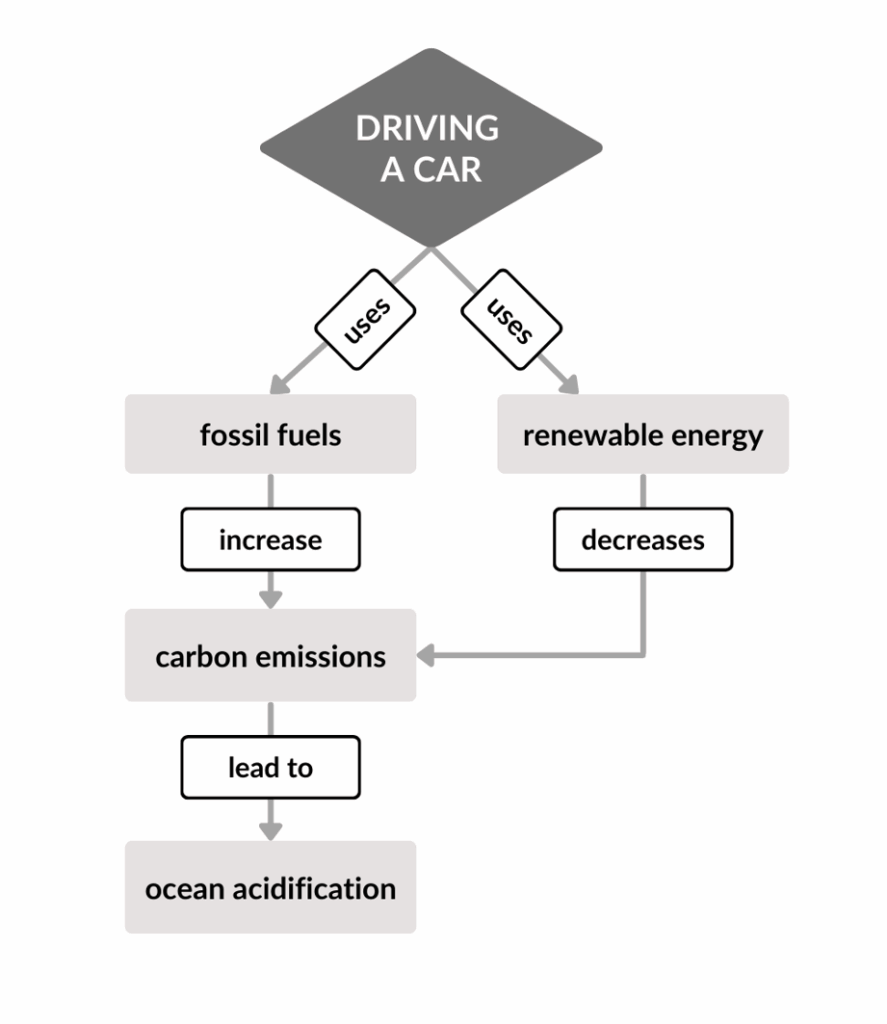
Consider Dr. Sundar’s illustrative examples concerning ocean acidification. A guiding question like "What is the relationship between driving a car and ocean acidification?" yields a relatively contained and focused map. This map might trace the path from fossil fuel combustion to carbon dioxide emissions, atmospheric carbon absorption by oceans, and subsequent acidification. In contrast, a broader question such as "What is the relationship between human activities and ocean acidification?" necessitates a far more extensive and complex map. This map would encompass a wider array of human impacts, including industrial emissions, deforestation, agricultural runoff, and their multifaceted contributions to oceanic chemical changes. The guiding question thus serves as a critical filter, dictating the depth and breadth of the knowledge representation.
Utilizing Explicit Linking Words
A hallmark of effective concept mapping, often overlooked, is the inclusion of "linking words" or "linking phrases" on the lines connecting nodes. These aren’t merely directional arrows; they are labels that articulate the specific nature of the relationship between two concepts (e.g., "causes," "is a type of," "leads to," "requires," "is composed of"). While Dr. Sundar acknowledges that adding these linking words "is a pain in the beep," she asserts that this additional effort significantly enhances the map’s robustness as a learning tool.
The necessity of formulating linking words compels learners to move beyond simple association to deeper relational understanding. It forces them to explicitly articulate how one concept influences or relates to another, thereby engaging in higher-order thinking skills such as analysis and synthesis. This process actively strengthens the semantic network in the learner’s mind, creating a more coherent and retrievable knowledge structure. Without linking words, the map might merely represent a collection of terms; with them, it becomes a dynamic representation of interconnected ideas and processes.
Practical Applications in the Classroom
Concept maps are highly adaptable and can be integrated into various pedagogical contexts, serving distinct purposes across the learning cycle.
Expert Maps for Scaffolding Learning
Teachers can create "expert maps" to provide students with a visual overview of key concepts and their relationships within a unit of study. These maps serve as powerful reference tools, offering a "big picture" perspective from the outset. Dr. Sundar emphasizes that expert maps are a "wonderful way to show people, look, over the next 16 weeks, we’re going to talk about all of these things. It’s going to feel random at points, but here’s how they all connect." This initial global view helps students contextualize individual lessons and understand how discrete pieces of information contribute to a larger understanding.

However, Dr. Sundar cautions against "concept map shock," which can occur when students are overwhelmed by too much information presented at once. To mitigate this, teachers can progressively reveal layers of complexity. An initial expert map might display only the major concepts and their primary relationships, with finer details introduced as the unit unfolds. This scaffolding approach allows students to gradually build their understanding without feeling inundated, maintaining engagement and preventing discouragement. Expert maps can also be used to activate prior knowledge at the beginning of a lesson or to consolidate learning at the end, providing a visual summary.
Concept Mapping as an Active Note-Taking Strategy
Traditional linear note-taking often results in passive transcription rather than active processing. Concept mapping offers a more efficient and cognitively demanding alternative, encouraging students to synthesize, summarize, and identify relationships as they encounter new information. Dr. Sundar notes that while linear writing can lead to verbosity, a concept map allows for "capturing more information in just a few words and diagrams." The visual nature bypasses the need for lengthy prose, focusing instead on the essential connections.
One practical approach is to provide students with a curated list of key terms. Periodically, students can be tasked with constructing a concept map using these terms, demonstrating their understanding of how these concepts interrelate. This active engagement during note-taking transforms a typically passive activity into a dynamic learning process, fostering deeper comprehension and retention. Students become active constructors of knowledge rather than mere recipients.
Formative Assessment for Diagnostic Insight
Concept maps are exceptionally valuable as formative assessment tools. By requiring students to construct or complete a concept map, educators gain immediate and profound insight into their understanding of content. Unlike multiple-choice questions or simple recall tasks, concept maps reveal the structure of a student’s knowledge, highlighting not only what they know but also how they connect (or misconnect) ideas.
An effective strategy involves providing students with a partially completed concept map and asking them to fill in the missing nodes or linking words. This allows teachers to pinpoint specific areas of confusion or misconception. Alternatively, having students create a concept map from scratch on a given topic provides a comprehensive diagnostic tool, revealing their overall conceptual framework. This form of assessment is particularly powerful because it requires students to elaborate on their understanding, providing rich data for instructional adjustments and targeted feedback. Peer assessment of concept maps can also be a valuable activity, encouraging students to critically evaluate and refine their understanding through collaborative learning.
Broader Implications and Future Directions
The integration of concept mapping into educational practices holds significant implications for curriculum design, teacher professional development, and the cultivation of critical thinking skills.
Curriculum Design: Systematically incorporating concept mapping into curriculum design can foster a more coherent and interconnected learning experience. Educators can design units with explicit opportunities for students to build, refine, and connect concept maps, ensuring that the development of relational understanding is a central learning objective. This moves beyond isolated facts to a holistic understanding of subject matter.
Teacher Professional Development: Effective implementation of concept maps requires teachers to not only understand the technique but also to model it proficiently and guide students through its complexities. Professional development programs can equip educators with the necessary skills to design effective guiding questions, provide clear instructions for linking words, and interpret student-generated maps for diagnostic purposes.
Student Autonomy and Critical Thinking: Concept mapping empowers students to take greater ownership of their learning. By actively constructing their knowledge representations, students develop metacognitive skills, becoming more aware of their own learning processes and identifying gaps in their understanding. This fosters critical thinking as they analyze, synthesize, and evaluate information to build coherent conceptual frameworks.
Digital Tools and Accessibility: While the core strength of concept mapping lies in its simplicity, digital tools can enhance its application. Software like CmapTools, MindMeister, or XMind offers features for easy editing, collaboration, and sharing of concept maps. These digital platforms can make the process more dynamic, especially for complex maps or collaborative projects, and can improve accessibility for students with certain learning needs. However, the fundamental cognitive benefits remain whether the map is drawn by hand or created digitally.
Challenges and Considerations: Despite its proven benefits, implementing concept mapping is not without challenges. Initial student resistance due to the perceived difficulty or the departure from familiar note-taking methods can occur. The time investment required to teach and practice effective concept mapping can also be a barrier in crowded curricula. Therefore, clear instruction, consistent practice, and explicit feedback are crucial for successful integration.
In conclusion, concept maps represent a powerful, evidence-based strategy rooted in cognitive science that profoundly enhances learning. By engaging the full memory formation process—encoding, storage, and retrieval—and by encouraging active processing through structured visual representation, these tools move beyond surface-level memorization to cultivate deep, relational understanding. When applied with clear motivation, focused guiding questions, and explicit linking words, concept maps become indispensable instruments for educators seeking to foster genuine comprehension and lifelong learning. The ongoing research in cognitive science continues to validate and refine these practices, cementing concept maps as a cornerstone of effective pedagogy in the 21st century.