

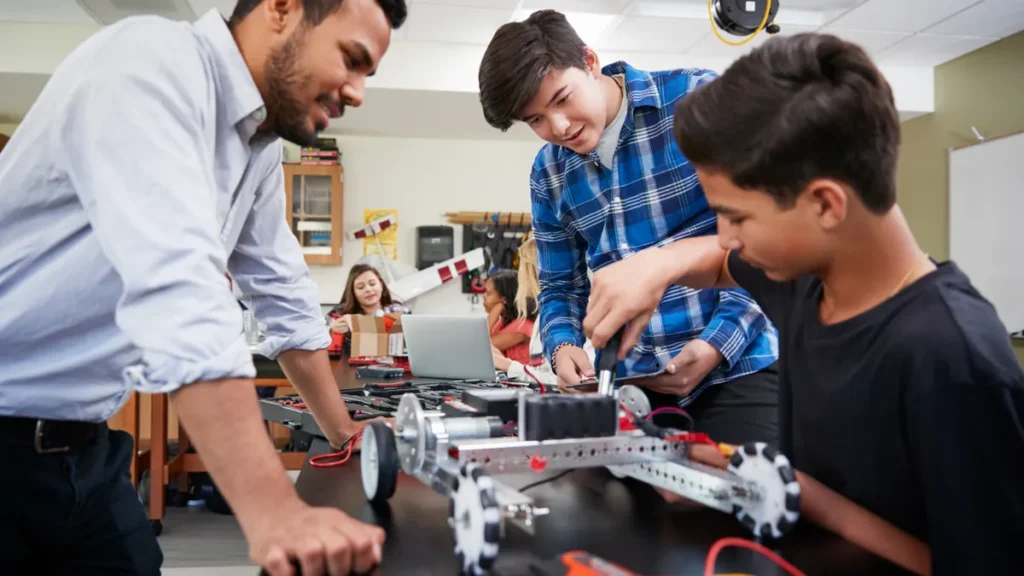


A transformative shift is underway in mathematics education, spearheaded by innovative educators like Chris Luzniak, who advocates for embedding debate into the core of math instruction. Challenging the long-held perception of mathematics as a discipline solely focused on singular correct answers, this approach aims to cultivate deeper critical thinking, robust communication skills, and a more nuanced understanding of mathematical concepts. The initiative seeks to bridge the gap between students’ passive reception of facts and their active, analytical engagement with complex problems, mirroring the intellectual rigor observed in competitive debate environments.
The Evolving Landscape of Mathematics Pedagogy
For decades, traditional mathematics instruction often prioritized computational fluency and algorithmic memorization. Students were typically presented with problems, taught a specific method for solving them, and then expected to reproduce that method to arrive at a definitive answer. This "answer-driven" pedagogy, while efficient for teaching basic operations, frequently left students disengaged, failing to foster a deep conceptual understanding or the ability to articulate their reasoning. The consequence was often a widespread perception of math as a rigid, intimidating subject, leading to prevalent "math anxiety" among learners who feared making errors.
However, modern educational standards, such as those set by the National Council of Teachers of Mathematics (NCTM) and the Common Core State Standards (CCSS), have increasingly emphasized conceptual understanding, problem-solving, and mathematical communication. These frameworks call for students not just to do math, but to understand it, to explain their thinking, and to justify their conclusions. Despite these progressive standards, many classrooms continue to struggle with genuinely implementing practices that encourage robust student discourse and critical argumentation, often due to ingrained habits, large class sizes, or a lack of specific pedagogical tools.
The Inherent Argumentation in Mathematics
At its philosophical core, mathematics is fundamentally an argumentative discipline. The concept of a mathematical proof, for instance, is nothing less than a meticulously constructed argument, presenting a logical sequence of steps to demonstrate the truth of a statement. Yet, in the typical math classroom, the opportunity for students to engage in such argumentation is often overlooked. The focus frequently remains on the final numerical or symbolic result, rather than the intellectual journey and the logical scaffolding that underpins it.
Chris Luzniak, a veteran math educator, experienced this disparity firsthand. Early in his teaching career, he observed a stark contrast between his math students’ quiet, answer-focused demeanor and the vibrant, analytical discussions of his speech and debate team students. The latter group delved into research, brainstormed ideas collaboratively, critically evaluated arguments, and challenged each other’s thinking with an intensity absent in his math classes. This observation spurred his decade-long exploration into integrating the dynamic world of debate into the seemingly static realm of mathematics. His central hypothesis was that if students could debate social issues or historical events, they could certainly debate mathematical concepts.
Empirical Evidence: Benefits of Debate in Education
The integration of debate into any subject, including mathematics, offers a myriad of documented benefits for student development. The National Speech & Debate Association (NSDA) provides extensive research and anecdotal evidence highlighting the positive impact of debate participation. Studies cited by the NSDA indicate that students involved in debate consistently show higher SAT math and reading scores, improved confidence, and elevated graduation rates. These gains are attributable to the multifaceted skills debate nurtures:
- Critical Thinking and Analytical Reasoning: Debaters learn to dissect complex problems, identify underlying assumptions, and evaluate the logical validity of claims. This directly translates to mathematical problem-solving, where students must analyze given information, formulate strategies, and critique potential solutions.
- Communication Skills: Both verbal and written communication are honed through debate. Students learn to articulate their thoughts clearly, concisely, and persuasively. This is crucial in mathematics for explaining solution processes, justifying reasoning, and collaborating effectively with peers.
- Research and Evidence-Based Reasoning: Debate requires students to gather and synthesize evidence to support their arguments. In a math context, this means understanding why certain formulas work, how theorems are derived, and when specific methods are applicable, moving beyond rote application.
- Active Listening and Empathy: To construct effective counter-arguments, debaters must actively listen and understand opposing viewpoints. This fosters a classroom environment where students genuinely engage with each other’s ideas, leading to more collaborative learning and a reduced tendency to dismiss alternative approaches.
- Confidence and Self-Efficacy: Public speaking and defending one’s ideas in a structured setting significantly boost students’ confidence. This is particularly valuable in mathematics, where a fear of being "wrong" often silences students. Debate encourages intellectual risk-taking and resilience in the face of challenge.
Beyond these specific skills, research in cognitive science and educational psychology supports the idea that active learning strategies, which include discourse and argumentation, lead to deeper learning and better retention than passive lecture-based methods. When students are required to explain, justify, and defend their mathematical thinking, they construct a more robust and interconnected understanding of the subject matter.
From "What Is?" to "What Is Best?": Crafting Debatable Math Questions
One of the primary hurdles for educators considering debate in math is the perception that math problems typically have only one correct answer, leaving little room for discussion. Luzniak argues that any mathematical moment can be made debatable by shifting the focus from the answer itself to the reasoning and methods involved. This transformation often involves incorporating "superlatives" or open-ended prompts that invite opinion and justification.
Instead of asking, "What is 3 x 4?", a teacher might pose, "What is the coolest way to represent 3 x 4?" This immediately opens the door to discussions about arrays, repeated addition, number lines, or real-world scenarios, each with its own merits. Similarly, instead of "What is the area of this triangle?", one could ask, "Which of the numbers in the picture are the most important for finding the area?" This prompts students to distinguish between necessary and extraneous information, a critical skill in problem-solving.
Other examples of transforming traditional questions:
- Instead of: "Solve for x (e.g., 4x + 8 = x + 5)."
Try: "What should be the first step in solving for our variable?" (This encourages discussion on algebraic properties, efficiency, and personal preferences, all of which are valid starting points.) - Instead of: "Find the intersection of these two lines."
Try: "What is the best method for solving this system of equations?" (Comparing graphing, substitution, and elimination leads to a deeper understanding of each method’s strengths and weaknesses.)
Some existing math curricula already include debate-friendly activities, such as "Always, Sometimes, Never" statements or "Which One Doesn’t Belong?" questions. These prompts naturally elicit diverse perspectives and require students to justify their choices. By consistently reframing questions in this manner, educators signal that the process of thinking, questioning, and justifying is as valuable, if not more so, than merely arriving at the correct numerical outcome.
Implementing Debate Routines in the Classroom
Luzniak’s approach emphasizes starting small and building skills incrementally. He suggests incorporating short, structured debate routines as warm-ups, gradually expanding their complexity.
1. The Warm-Up Debate (5-10 minutes):
- Prompt Selection: Begin with a low-stakes, engaging debatable question. Initially, this might be a non-academic topic (e.g., "What is the best pizza topping?") to build comfort. Quickly transition to content-specific math questions (e.g., "What is the best way to start graphing a line?"). The inherent appeal of sharing an opinion often draws in even the most reluctant speakers.
- Structured Argumentation: Introduce a simple, powerful sentence frame: "My claim is , and my warrant is ." This framework, rooted in the Toulmin model of argumentation, provides students with a clear structure for stating their position (claim) and providing evidence or reasoning (warrant). For example, "My claim is that chocolate is the best ice cream flavor, and my warrant is that the rich flavor combined with its creamy texture creates the perfect dessert experience." Posters displaying this frame can serve as visual aids. This structure significantly lowers the barrier to entry, making debate accessible even for those new to public speaking.
- Preparation and Rehearsal: Provide a brief moment for students to prepare their arguments. This could involve a quick "turn and talk" with a partner or jotting down their thoughts on an index card. This rehearsal time is crucial for students to organize their ideas and gain confidence before speaking to the whole class.
- Sharing and Initial Discourse: Invite a few students to share their claims and warrants. Initially, the focus is purely on articulating an argument. As students become more comfortable, the teacher can encourage direct responses to peers, fostering a natural progression towards more interactive debate.
2. Progression and Expansion:
- Once the basic routine is established, debate can be woven into various aspects of the math class. Students can write formal arguments as part of homework or assessments, justifying their solutions or preferred methods.
- Partner debates or small group discussions can delve deeper into complex problems, allowing more students to participate actively.
- For specific units, teachers can organize more formal team debates, assigning roles and requiring students to research and present comprehensive arguments, culminating in a project grade. This mimics the structure of competitive debate, enhancing students’ research and collaborative skills.
Tips for Successful Implementation

Educators adopting this methodology share common advice for success:
- Start Small: Do not attempt a full-blown debate immediately. Begin with brief, informal activities and gradually increase complexity.
- Be Patient: Developing robust argumentation skills takes time. Celebrate small victories and focus on consistent practice.
- Emphasize Process Over Product: Explicitly communicate that the goal is not just the "right" answer, but the quality of thinking, reasoning, and communication. Value well-reasoned arguments, even if they lead to an incorrect numerical answer initially.
- Provide Clear Instructions: Students need explicit guidance on expectations, sentence frames, and the structure of the debate. Clarity reduces anxiety and encourages participation.
- Cultivate a Supportive Environment: Foster a classroom culture where intellectual risk-taking is encouraged, mistakes are seen as learning opportunities, and respectful disagreement is valued.
Broader Societal Implications: Beyond the Math Classroom
The urgency for integrating debate into education extends far beyond improving math scores. In an increasingly polarized world, where public discourse often devolves into echo chambers and uncritical acceptance of information, the ability to construct, present, and critically evaluate arguments is a vital civic skill. Students who learn to articulate their reasoning, listen actively to opposing viewpoints, and revise their thinking based on new evidence are better equipped to navigate complex societal issues.
By centering the argument rather than solely the answer in mathematics, educators can help students appreciate the nuance and complexity inherent in many real-world problems. Math, like society, is rarely purely black and white. It involves interpretation, model selection, assumption-making, and the justification of choices. When students engage in mathematical debate, they learn to see these "gray areas," to understand that there can be multiple valid approaches, and to recognize the elegance in diverse perspectives. This prepares them not only for advanced academic pursuits and STEM careers but also for informed participation in a democratic society that demands thoughtful engagement and civil discourse.
The work of Chris Luzniak and other pioneering educators demonstrates that integrating debate into mathematics is not merely a pedagogical innovation; it is a critical investment in developing a generation of critical thinkers, articulate communicators, and engaged citizens prepared to tackle the multifaceted challenges of the 21st century.







