


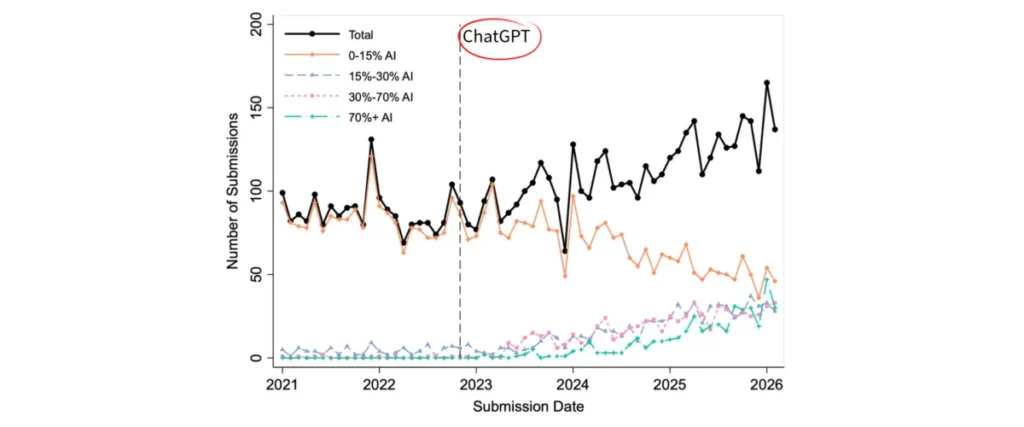
An alarming trend is emerging within the hallowed halls of academia, with a recent report from an AI Task Force convened by the prestigious journal Organization Science casting a stark light on the transformative, and often detrimental, impact of generative artificial intelligence on scholarly submissions. Far from merely streamlining the writing process, AI tools, particularly since the widespread availability of ChatGPT in late 2022, appear to be overwhelming peer-review systems with an increased volume of submissions characterized by a perplexing decline in readability and overall quality. This development is not only taxing the volunteer efforts of editors and reviewers but also raising profound questions about the future of scholarly communication and the very essence of academic rigor.
The Genesis of Concern: A Post-ChatGPT Surge
The Task Force’s investigation began with anecdotal observations from seasoned editors and reviewers, who noted a subtle yet pervasive shift in the nature of incoming manuscripts. "Something is up in academic research," the Task Force members assert, articulating a sentiment shared across numerous editorial boards. These experienced gatekeepers of academic quality described an increase in submission volume coupled with a peculiar "weightlessness" in the writing—papers that, on the surface, appeared conventionally structured but lacked the substantive clarity and intellectual depth expected of scholarly work. This subtle but unmistakable change often left reviewers "scratching [their] head at the meaning the words are trying to convey," indicating a deeper issue than mere grammatical errors or stylistic preferences.
The turning point, according to the Task Force’s quantitative analysis, precisely correlates with the public release of OpenAI’s ChatGPT in November 2022. Prior to this landmark event, the academic publishing landscape, while competitive, maintained a certain equilibrium in submission patterns and writing quality. However, starting in 2023, Organization Science experienced a rapid and significant increase in manuscript submissions. This surge coincided with a dramatic plummet in the percentage of submissions classified as using "minimal AI," falling from nearly 100% to approximately 30%. This stark inverse relationship strongly suggests that the influx of new submissions is directly linked to the adoption of generative AI tools by researchers seeking to expedite the writing process.
Quantifying the Decline: Readability and Quality Metrics
The Task Force’s report moved beyond qualitative observations, crunching comprehensive data to provide concrete evidence of AI’s impact. One of the most striking findings concerns readability. Using a standard "reading ease" metric—an established psycholinguistic tool often based on factors like sentence length and word complexity to determine how easily a text can be understood—the average score of submitted manuscripts experienced a substantial decline. Between January 2021 and January 2026, the reading ease metric for submissions to Organization Science fell by a staggering 1.28 standard deviations.
To contextualize this figure, a drop of 1.28 standard deviations on a reading ease scale is not a minor fluctuation; it represents a significant deterioration in the accessibility and clarity of academic prose. For instance, if a journal typically received papers with a reading ease score comparable to a professional magazine, this decline could push the average paper’s readability closer to that of highly technical or academic texts requiring specialized knowledge, even for native speakers in the field. This makes the text harder to parse, absorb, and critically evaluate, imposing a heavier cognitive load on reviewers.
This finding challenges a common assumption that AI tools, designed for language generation, would produce cleaner, more polished text. While generative AI can indeed correct grammatical errors and improve sentence fluency in narrow dimensions, the Task Force’s analysis revealed a counterintuitive outcome on the measures that truly matter for scholarly communication. AI-generated text, despite its superficial polish, tends to employ "longer words, more complex sentence structures, more jargon, and more nominalizations." These linguistic characteristics, while sometimes mistakenly equated with academic sophistication, actively hinder comprehension and dilute the precision of scholarly arguments. The result is prose that sounds academic but conveys meaning poorly, creating a barrier between the author’s intended message and the reader’s understanding.
The Hidden Burden: Increased Desk Rejection and Lower Acceptance Rates
The consequences of this decline in readability and inherent quality extend far beyond mere stylistic concerns; they are directly impacting the efficiency and integrity of the academic peer-review system. Organization Science‘s data reveals a disproportionate burden placed on editors who are forced to desk-reject a significantly higher percentage of manuscripts that heavily utilize AI.
Specifically, nearly 70% of manuscripts identified retrospectively as making heavy use of AI are desk-rejected—meaning they are rejected by the editor before being sent out for full peer review. This contrasts sharply with papers written with minimal or no AI, where the desk-rejection rate drops to 44%. This nearly 26 percentage point difference highlights the immediate and tangible impact of AI on initial editorial assessment. Editors, without prior knowledge of AI involvement, are intuitively identifying these submissions as lacking the requisite quality, clarity, or originality to warrant the intensive labor of peer review.
Furthermore, even those AI-heavy papers that manage to pass the initial desk-rejection stage fare significantly worse in the full review process. Only 3.2% of high-AI papers are ultimately accepted for publication, a stark contrast to the 12% acceptance rate for low-AI papers. This nearly fourfold difference in acceptance rates underscores the profound qualitative gap between human-authored and AI-assisted submissions in the current landscape. It suggests that while AI might facilitate the production of a manuscript, it often fails to generate the robust arguments, nuanced insights, and rigorous methodology that define high-quality scholarly work.
It is crucial to emphasize that these analyses of desk-rejection and acceptance rates are retrospective. The editors and reviewers making these critical decisions are not privy to information regarding the extent of AI use in a given manuscript during their evaluation process. Their judgments are based solely on the content and quality of the submission itself, making the observed correlations between AI use and negative outcomes all the more compelling and objective. The findings therefore represent an organic, unbiased assessment of AI-generated content within the established peer-review framework.
Broader Implications for Scholarly Communication and Research Integrity
The findings from Organization Science are not isolated; they resonate with growing concerns across various academic disciplines. The widespread adoption of generative AI tools, while offering superficial efficiencies, is inadvertently creating a crisis of quality and an unsustainable burden on the volunteer-driven peer-review system.
- Strain on Peer Review: The increase in submission volume, coupled with the decline in average quality, directly strains the finite resources of academic journals. Peer review is largely a pro bono activity, performed by active researchers who volunteer their time and expertise. An influx of poorly conceived or poorly written manuscripts means that reviewers spend more time sifting through substandard work, diverting their attention from truly meritorious research. This can lead to reviewer fatigue, longer review times, and potentially even a reluctance to take on future review assignments, further exacerbating bottlenecks in the publishing process.
- Risk to Research Quality and Trust: If the trend of AI-generated mediocrity continues, there is a significant risk of diluting the overall quality of published research. The core purpose of academic journals is to disseminate reliable, rigorously vetted knowledge. If AI-assisted papers, despite their lower quality, become more prevalent, it could erode public trust in scholarly output and make it harder for researchers to identify genuinely impactful work.
- Ethical Considerations and Authorship: The use of AI also raises complex ethical questions surrounding authorship, intellectual contribution, and academic integrity. While AI can assist in drafting, editing, or summarizing, the fundamental intellectual labor—conceptualization, methodology, analysis, and interpretation—remains the responsibility of human authors. The current data suggests that many researchers might be over-relying on AI, potentially outsourcing critical thinking to algorithms, which compromises the integrity of their contribution. Discussions around clear guidelines for AI usage and attribution in academic publishing are becoming increasingly urgent.
- The "Productivity Paradox": The situation at Organization Science serves as a powerful cautionary tale about the perils of uncritically embracing technological "shortcuts." While generative AI tools may make the act of writing faster or easier for individual researchers, the aggregated data demonstrates that this does not equate to making the research or the field as a whole better. In fact, it suggests a counterproductive outcome where perceived individual productivity gains lead to collective inefficiency and a degradation of quality. This echoes broader debates about the "productivity paradox" in the digital age, where technological advancements do not always translate into tangible improvements in output or well-being.
Moving Forward: Adapting to the AI Era
The academic community is now grappling with how to effectively adapt to this new reality. The Task Force’s findings necessitate a multi-faceted approach:
- Enhanced AI Detection Tools: Journals and publishers will likely need to invest in more sophisticated AI detection software, moving beyond simple plagiarism checks to identify patterns indicative of AI-generated text.
- Clearer Guidelines and Policies: Universities, research institutions, and journals must develop explicit policies regarding the ethical and acceptable use of AI in research and writing, emphasizing that AI should be a tool for assistance, not a substitute for original thought and rigorous scholarship.
- Rethinking Academic Writing Pedagogy: Educators may need to re-emphasize the foundational skills of critical thinking, clear argumentation, and precise scientific writing, ensuring that students understand the difference between AI-generated text and genuinely insightful prose.
- Promoting "Slow Scholarship": The report implicitly advocates for a return to what some call "slow scholarship"—a deliberate, thoughtful approach to research and writing that values depth, originality, and meticulous craft over speed and volume. The conclusion drawn by the Task Force is poignant: "Sometimes there really is no shortcut to taking your time."
The experience of Organization Science serves as a critical bellwether for the academic world. It highlights that while generative AI promises revolutionary changes, its integration into scholarly practices demands careful consideration, robust oversight, and an unwavering commitment to the foundational principles of intellectual rigor and integrity. The silent crisis of AI-assisted mediocrity is a challenge that the global academic community must address proactively to safeguard the quality and credibility of future knowledge creation.