



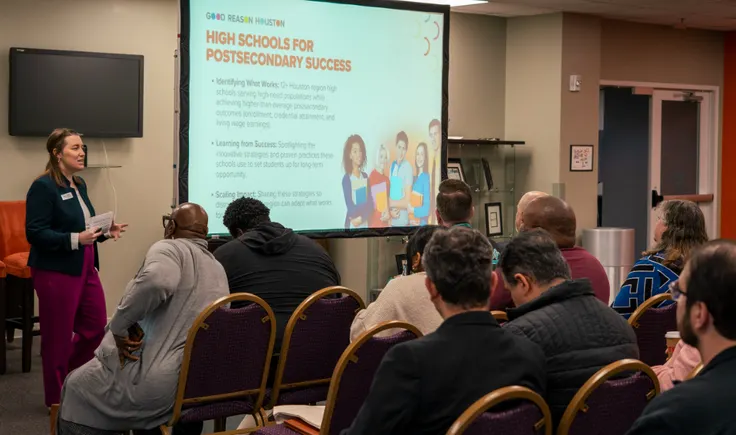
Houston, Texas – The journey from high school graduation to a fulfilling career or further education is a critical transition for students, yet many, like Ashley Marroquin, a recent senior from Houston, find themselves navigating this complex landscape with insufficient guidance. Marroquin’s candid sharing during a recent community webinar on college and career readiness highlighted a widespread challenge: while most students in Houston earn their diplomas, a significant gap exists in their preparedness for postsecondary success and the workforce. This disconnect, underscored by alarming statistics, is prompting a renewed focus on systemic reforms within the city’s education sector.
Research from the education nonprofit Good Reason Houston reveals that despite a nearly 90% high school graduation rate in the city, only about one in five graduates secure a living wage within six years of leaving high school. This stark reality has galvanized organizations like Good Reason Houston and EdTrust in Texas to advocate for a fundamental shift in how K-12 education prepares students for life beyond the classroom.
"Our kids deserve better than that," stated Courtney Isaak Pichon, CEO of Good Reason Houston, during the aforementioned webinar. "If we want different outcomes, we have to align what students experience from pre-K through graduation with what it will actually take to succeed in a future workforce." The organizations have identified five key strategies that district leaders can implement to bridge this critical gap.
The Advising Deficit: From Fragmented Support to Comprehensive Guidance
A cornerstone of postsecondary readiness is robust and individualized advising. However, current systems often fall short. Advising is frequently episodic, concentrated solely in high school, and hampered by high counselor-to-student ratios. In Houston, as in many districts nationwide, students like Ashley Marroquin often encounter fragmented support when attempting to navigate multifaceted processes such as financial aid applications, scholarship searches, and understanding diverse postsecondary pathways, which now encompass not only traditional four-year colleges but also vocational training, apprenticeships, and credentialing programs.
The complexity of these pathways demands sustained, individualized guidance, which is often lacking. Good Reason Houston and EdTrust in Texas advocate for the redesign of advising systems to match this complexity. This includes building comprehensive career exploration and advising models that begin early, ideally in middle school, and continue throughout high school. Such models should equip counselors with the resources and training to provide personalized support, integrate career exploration into the curriculum, and establish strong partnerships with postsecondary institutions and employers. Furthermore, these systems must address the needs of families, who often report a desire to support their children but face barriers due to language differences or the sheer complexity of the educational system. Clear, consistent, and accessible information is paramount to empowering families to become active partners in their children’s academic and career planning. Without a coherent advising strategy, even well-intentioned educational opportunities risk remaining underutilized, leaving promising students without the support they need to thrive.
Rethinking Access: From Enrollment to Active Participation in Advanced Coursework
While expanding access to advanced coursework has been a recognized priority for many school systems, the next crucial step is ensuring students not only enroll but also persist and succeed in these challenging academic environments. Texas has made strides in this area, notably with the statewide requirement for automatic enrollment of qualified students in advanced math courses in middle school, aiming to increase the number of students completing Algebra I by eighth grade. This initiative, which began to take effect in recent academic years, represents a proactive approach to building a stronger foundation in mathematics, a key predictor of postsecondary success.
However, structural barriers continue to limit participation in other advanced courses, such as Advanced Placement (AP) and dual credit programs, as well as core subjects outside of math. Unclear placement processes and an over-reliance on self-selection often mean that many students who meet readiness benchmarks are never formally placed into these opportunities. The research suggests that a powerful lever for increasing participation is automatic enrollment based on demonstrated readiness, coupled with clear opt-out provisions. This approach, which is not necessarily limited to middle school math, can significantly reduce friction, normalize high expectations across the student body, and ensure that students are not held back by administrative hurdles or a lack of self-advocacy. The positive implications are substantial: studies consistently show that students who complete multiple advanced courses are significantly more likely to earn a postsecondary credential, thereby improving both access to and completion of higher education.
Bridging the Gap: Aligning Education Pathways with Labor Market Demands
Career and Technical Education (CTE) has witnessed significant expansion in recent years, yet its alignment with the demands of the regional labor market remains a persistent challenge. In many areas, students are enrolled in CTE pathways that do not directly translate into high-wage, high-demand careers. Simultaneously, employers frequently report difficulties in finding qualified local talent, a clear indication of a systemic misalignment between educational offerings and workforce needs.
Leading districts are proactively addressing this disconnect by forging deeper collaborations with local industries. This involves conducting regular labor market analyses to identify current and future workforce needs, and then actively designing and updating CTE programs to meet those demands. Furthermore, it necessitates building strong partnerships with businesses to create authentic work-based learning experiences, such as internships, apprenticeships, and mentorship programs, which provide students with invaluable real-world skills and exposure to potential career fields. The goal is to ensure that students are not just learning vocational skills, but are being trained for jobs that offer economic mobility and contribute to the regional economy. This strategic alignment can transform CTE from a supplementary offering into a powerful engine for economic development and individual prosperity.
Integrating Readiness Metrics into Core Accountability and Budgeting
A significant impediment to progress in postsecondary readiness is the persistent disconnect between stated educational priorities and the operational systems that drive them. Districts that are demonstrating meaningful gains are those that have successfully embedded college and career readiness metrics into their core accountability frameworks and budgeting decisions. This integration means that indicators such as credential attainment, postsecondary enrollment rates, and financial aid completion are elevated alongside traditional academic performance metrics.
By making these readiness indicators central to accountability, districts signal their commitment to preparing students for life after graduation. This often requires a reallocation of resources and a re-evaluation of budget priorities to ensure that investments are directed towards programs and support systems that directly contribute to postsecondary success. Transparency is also a critical component. When districts clearly communicate their college and career readiness goals and publicly report on their progress, it fosters greater trust with families and creates internal alignment around the outcomes that truly matter. This commitment to measurable outcomes ensures that efforts are not merely symbolic but are driving tangible improvements in student preparedness and future opportunities.
Creating Feedback Loops: Reinvesting Success to Build System Capacity
Texas possesses a funding stream directly tied to college and career readiness outcomes. However, the state currently mandates that only 55% of this funding be reinvested in postsecondary preparation. The discretion afforded to districts in how they utilize these funds can either accelerate progress or dilute their impact. High-performing systems are distinguished by their intentional reinvestment in the core drivers of success: expanding advising capacity, enhancing advanced coursework offerings, and developing high-quality CTE pathways. This proactive reinvestment, often exceeding state requirements, creates a virtuous cycle where initial successes fuel further capacity building and improved outcomes.
By strategically channeling resources back into these critical areas, districts can build a more robust and responsive support infrastructure for students. This might involve hiring additional counselors, providing professional development for teachers on advanced course instruction, or investing in up-to-date technology and equipment for CTE programs. This approach ensures that the momentum generated by early achievements is sustained and amplified, leading to continuous improvement and a more comprehensive system of support for all students.
Moving from Completion to Coherence: A Strategic Imperative
The districts that are making the most significant strides in preparing students for postsecondary success are not simply implementing isolated initiatives. Instead, they are weaving these elements into a coherent and integrated strategy. This strategy is anchored in a clear definition of success, which is then used to build backward, ensuring that every aspect of the K-12 experience is designed to achieve desired student outcomes. This shift from merely ensuring high school completion to fostering genuine preparedness for the complexities of the modern world is a critical undertaking.
Currently, Texas policymakers are actively examining how to strengthen postsecondary readiness by more closely linking accountability measures to long-term outcomes, such as credential attainment and wages earned by graduates. This ongoing legislative and policy discourse reinforces the urgent need for proactive and strategic planning at the district level. As Courtney Isaak Pichon aptly summarized, "In an era where there are more options for families than ever, school systems really need to make sure they’re offering students a safe, rigorous, relevant learning environment that’s going to actually prepare them to lead meaningful lives beyond high school graduation." The path forward for Houston and other urban districts lies in embracing this holistic approach, ensuring that every student is not just prepared to graduate, but is equipped to thrive.