





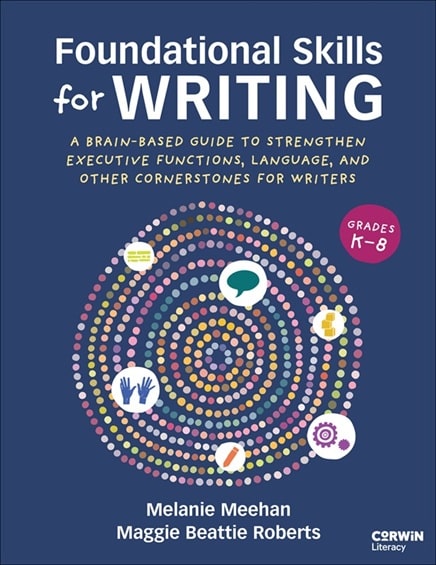
Despite the intensified focus on literacy within educational discourse over recent years, a significant omission has become increasingly apparent: the relative neglect of writing instruction. While debates surrounding phonics, fluency, and reading comprehension continue to dominate discussions, the fundamental role of writing, intrinsically linked to reading, often remains in the periphery. This critical imbalance is now being directly addressed by education specialists Melanie Meehan, a former curriculum coordinator and founder of an in-person writing center, and Maggie Roberts, a literacy consultant and veteran middle school teacher. Their new collaborative work, "Foundational Skills for Writing: A Brain-Based Guide to Strengthen Executive Functions, Language, and Other Cornerstones for Writers," seeks to reposition writing as a central pillar of literacy education by dissecting the intricate cognitive processes involved in effective written communication and offering practical, brain-informed pedagogical strategies.
Published earlier this month, the book emerges at a crucial juncture in education. The "Science of Reading" movement has brought renewed attention to evidence-based practices for reading acquisition, particularly phonological awareness and phonics. While this focus has yielded positive shifts in early reading instruction, writing, its indispensable counterpart, has not received commensurate attention. Research consistently indicates that strong writing skills are not only vital for academic success across all subjects but also for critical thinking, communication in the professional world, and active participation in a democratic society. National assessments, such as the National Assessment of Educational Progress (NAEP), have frequently highlighted persistent gaps in writing proficiency among students across various grade levels, underscoring the urgent need for more effective and explicit writing instruction. Meehan and Roberts contend that this proficiency gap is often rooted in an underdeveloped understanding of the foundational cognitive demands writing places on the brain.

The authors’ work is grounded in an exploration of the neurological underpinnings of writing. They meticulously break down the complex act of writing into three primary skill categories, each demanding specific cognitive resources. The first category, transcription skills, encompasses the mechanics of putting thoughts onto paper, including handwriting, keyboarding proficiency, accurate spelling, and the development of both large and small motor skills necessary for these tasks. When these skills are not automatized, they consume valuable cognitive energy, diverting it from higher-order thinking processes like idea generation and organization.
The second category is oral language, recognizing that strong speaking and listening skills are direct precursors to robust writing. This includes the ability to construct coherent sentences orally, articulate ideas clearly, and engage in effective verbal communication. Children who struggle with oral language often face compounded difficulties when asked to translate their thoughts into written form, highlighting the need to nurture these verbal foundations.
Finally, the book emphasizes executive functioning, a set of crucial cognitive processes that govern self-regulation and goal-directed behavior. Key executive functions pertinent to writing include working memory (the ability to hold and manipulate information mentally), cognitive flexibility (the capacity to adapt thinking, consider multiple perspectives, and shift strategies), and inhibitory control (the power to resist distractions and irrelevant thoughts). These functions are indispensable for planning, organizing, revising, and sustaining attention throughout the demanding process of writing. By understanding these foundational components, Meehan and Roberts provide educators with a diagnostic lens to identify specific areas where students might be struggling and offer targeted interventions.
To translate these complex insights into actionable classroom practices, Meehan and Roberts introduce a collection of flexible, brief activities they term "Minute Moves." These strategies are designed to be easily integrated into daily routines, serving as warm-ups, transitions, or short, focused practice sessions. The core philosophy behind "Minute Moves" is to help students automatize foundational skills, thereby reducing the cognitive load and freeing up mental resources for the more complex aspects of writing. This approach aligns with cognitive science principles, which suggest that explicit, repeated practice of sub-skills can lead to automaticity, making the overall task of writing more manageable and less taxing for students.
Mastering Morphemes: Spelling Strategies for Deeper Understanding
The authors propose three "Minute Moves" specifically targeting spelling, shifting the focus from rote memorization to a deeper, more conceptual understanding of word structure:

-
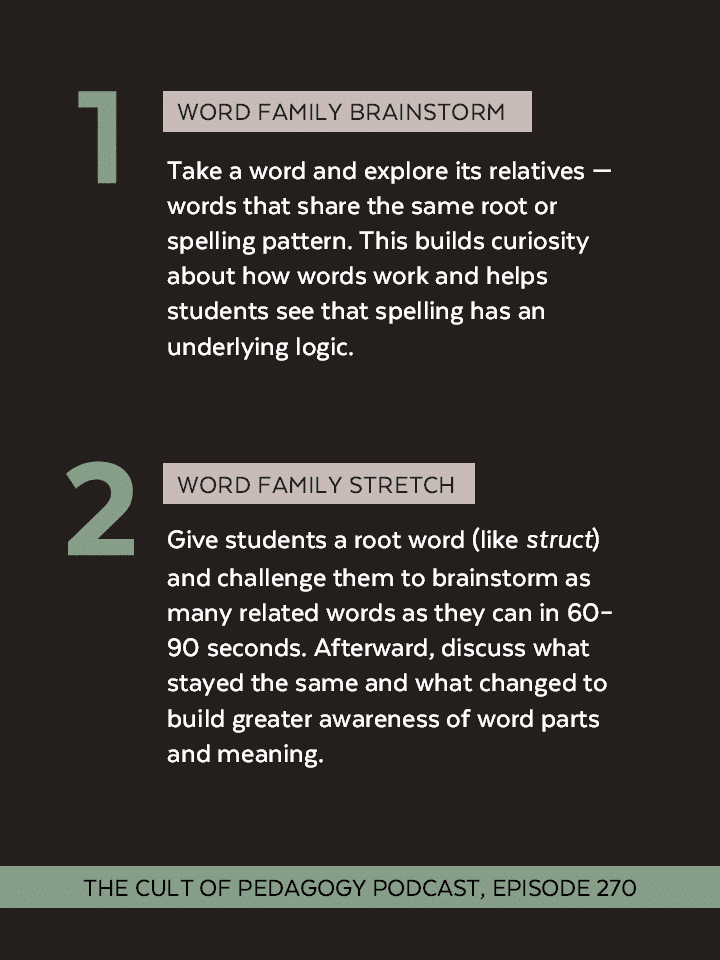
Word Family Brainstorm: Inspired by spelling researcher Rebecca Treiman, this activity encourages students to explore the etymological relationships between words. Instead of treating homophones like "two," "to," and "too" in isolation, students might investigate the connection between "two" (the number) and words such as "twin," "twine," or "twenty," uncovering the "TW" pattern related to "twoness." This approach fosters curiosity and helps students discern patterns that govern spelling, making seemingly arbitrary spellings more logical. For example, connecting "decision" to "decide," and then to "incision," "concise," and even "scissors," all tracing back to a Latin root meaning "to cut," profoundly demystifies the spelling of these words. The goal is to cultivate a "word curious" mindset, where students actively seek out and identify morphological connections.
-
Word Family Stretch: This closely related activity builds on the concept of morphological awareness. Teachers provide a root word, such as "struct" (meaning "to build"), and challenge students to brainstorm as many related words as possible within a short timeframe (e.g., 60-90 seconds). Examples include "structure," "destruction," "construct," "structural," and "instruct." The crucial follow-up is a debriefing session where students analyze what remained consistent and what changed in terms of spelling and meaning when prefixes or suffixes were added. This discussion reinforces the concept that word parts carry meaning, and these patterns are prevalent across academic vocabulary. Roberts further distinguishes between "bound roots" (like "struct," which cannot stand alone) and "free roots" (like "form," which can exist independently but also forms "reform," "transform," etc.), deepening students’ grasp of linguistic principles.
-
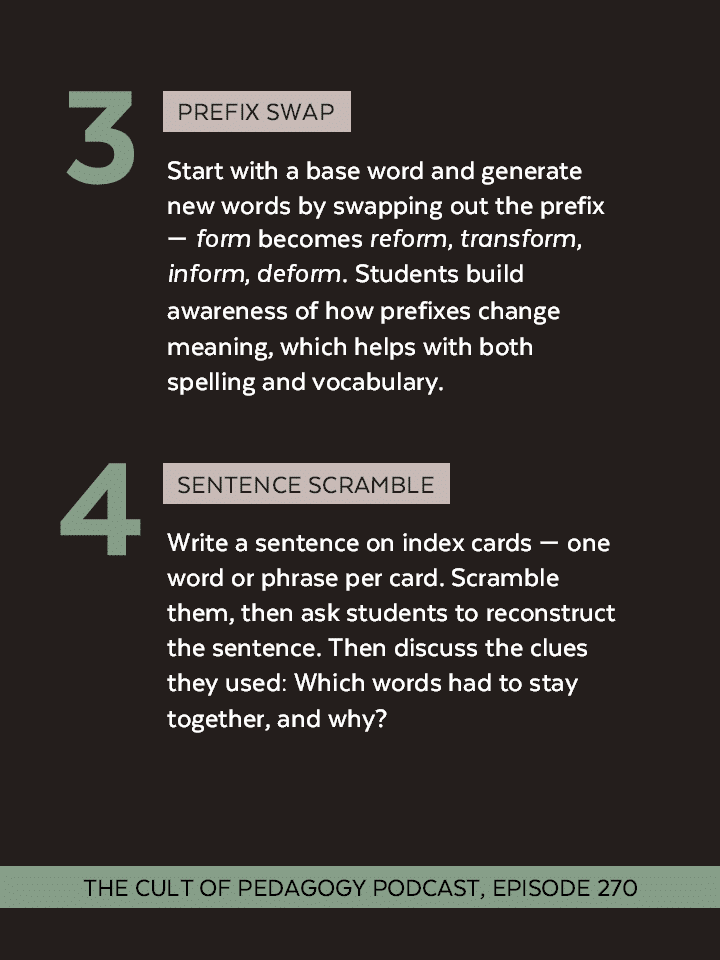
Prefix Swap: Directly leveraging the previous two strategies, this "Minute Move" focuses specifically on the impact of prefixes. Students are given a base word, such as "form," and asked to generate variations by exchanging prefixes: "reform," "transform," "inform," "deform." The activity prompts students to observe how each prefix alters the word’s meaning, thereby enhancing their vocabulary and understanding of word construction. This strategy is particularly effective for multilingual learners, who often possess a foundational understanding of Latin or Greek roots and prefixes from their native languages, allowing them to quickly grasp the meaning of complex English words like "benevolent" (good) and "malevolent" (bad) through their shared "bene" and "mal" roots. Collectively, these spelling activities are designed to build robust neurological pathways, enabling students to retrieve and apply spelling knowledge more automatically.

Building Blocks of Expression: Enhancing Sentence Construction
The book also provides practical strategies for improving sentence-level writing, moving students from basic sentence structures to more complex and nuanced expressions:
-
Sentence Scramble: This activity involves deconstructing a sentence into its constituent words or phrases, typically written on individual index cards. Students are then tasked with reassembling the sentence. The tactile nature of physical cards allows for experimentation and manipulation. Following the reconstruction, a critical debrief encourages students to articulate their reasoning: "How did you determine the correct order? What clues did you use? Which words had to remain together?" The complexity can be increased by removing punctuation, introducing a superfluous word, or challenging students to expand the sentence. Roberts emphasizes that this exercise helps students develop an "internalized understanding of sentence patterns and sentence construction," which they can then transfer to their own original writing.
-
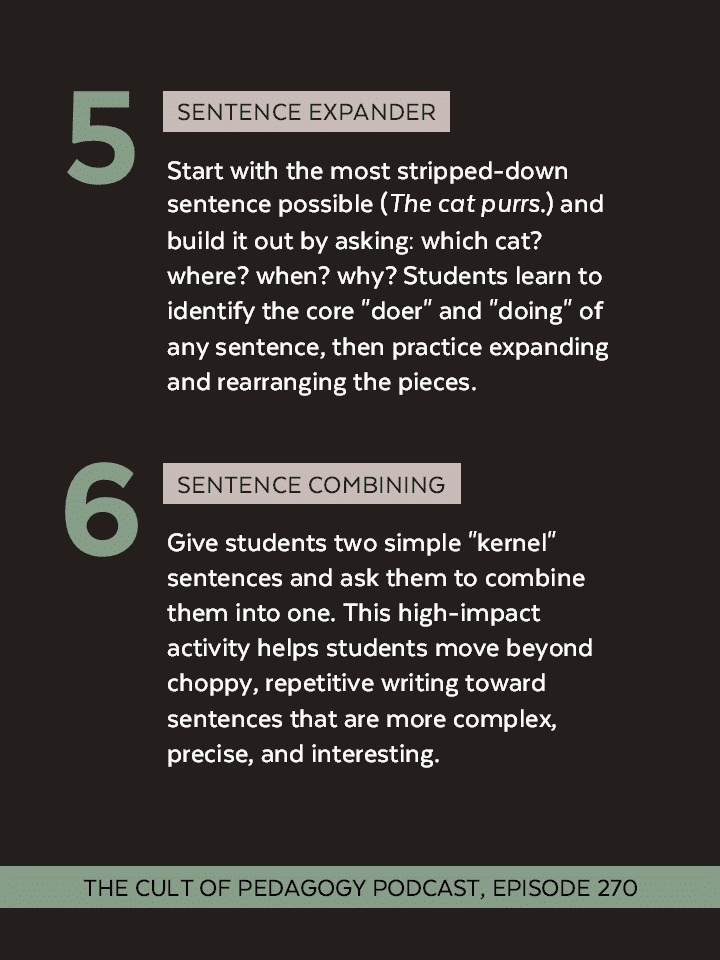
Sentence Expander: Beginning with a simple "kernel sentence" like "The cat purrs," this strategy guides students in collaboratively enriching it through a series of probing questions: "Which cat? What color? Where? When? Why?" Meehan advocates for using more accessible terms like "doer" and "doing" instead of "subject" and "predicate" to help younger students grasp the core elements of a sentence. Once students can reliably identify these core components, they can better understand why sentences become difficult to follow when the "doer" and "doing" are separated by excessive detail. After expanding the sentence (e.g., "The fluffy orange cat is sleeping soundly on the plush couch in the afternoon because he is utterly exhausted"), students experiment with rearranging phrases to create stylistic variations, fostering an understanding of sentence fluidity and complexity.
-
Sentence Combining: Roberts highlights sentence combining as a "high-impact, quick way for kids to graduate from writing a series of simple sentences to ones that are more syntactically complex, interesting, and precise." Students are given two short, rudimentary sentences, such as "My cat is orange" and "My cat is big," and asked to merge them into a single, more sophisticated sentence (e.g., "My big orange cat…"). For novices, scaffolding can involve underlining the words to be "harvested" and integrated. As proficiency grows, students can combine three or more sentences, experimenting with different conjunctions (e.g., "because," "and," "but") to alter meaning and introduce logical relationships. This practice directly trains students to transform choppy writing into fluid, mature prose, a skill that readily transfers to their independent compositions.
Cultivating Cognitive Agility: Executive Functioning in Writing
The book also provides "Minute Moves" designed to bolster executive functions, particularly cognitive flexibility, which is crucial for dynamic and responsive writing:
-
What’s Another Way?: This exercise directly targets cognitive flexibility – the capacity to shift perspectives, consider alternatives, and adapt one’s thinking. Students are given a sentence and challenged to rewrite it in multiple ways. This might involve restructuring the sentence by starting with a dependent clause instead of an independent one, replacing a noun with a pronoun, or intentionally shortening it for impact. Meehan stresses that effective writing is not solely about producing longer, more intricate sentences; sometimes, conciseness is the most powerful choice. The ability to deliberately vary sentence length and structure demonstrates advanced writing craft. Importantly, Meehan notes that explicitly naming "cognitive flexibility" as the skill being practiced empowers students, particularly those who have previously struggled with writing, by reframing their efforts as engaging in sophisticated cognitive work.
-
New Angle: This "Minute Move" extends cognitive flexibility from the sentence level to the narrative level. Students are asked to retell a familiar scene from a shared class text, a book they are reading, or a short film, but from an alternative character’s perspective. Roberts vividly illustrates this with a memory of a ninth-grade cafeteria food fight, explaining how the narrative drastically changes when told through the eyes of a teacher caught in the crossfire. Adopting a different viewpoint necessitates holding multiple perspectives simultaneously, making conscious choices about voice, selecting relevant details, and interpreting events through a new lens. Meehan frequently employs short animated videos, such as Pixar’s "Snack Attack," which presents the same event from two distinct points of view. In one tutoring session, she and a student each wrote a character’s perspective, then swapped and continued writing from the other’s viewpoint. This competitive yet collaborative exercise not only enhanced the student’s writing skills but also fostered a deeper understanding of empathy and diverse perspectives—a crucial skill extending far beyond the writing classroom, impacting critical thinking and civic engagement.
Broader Implications for Pedagogy and Student Development
The "Foundational Skills for Writing" framework and its "Minute Moves" have significant implications for contemporary educational practices. By dissecting writing into its cognitive components, Meehan and Roberts provide a roadmap for educators to move beyond generic "write more" mandates and instead offer targeted, skill-specific interventions. This approach supports a shift towards more explicit instruction in writing, mirroring the evidence-based practices advocated by the "Science of Reading." For teachers, the book offers concrete strategies that are easy to implement, requiring minimal preparation and fitting seamlessly into existing curricula. This could alleviate some of the pressure teachers often feel regarding writing instruction, particularly those who may not have received extensive training in this area.
Moreover, the emphasis on executive functions highlights the interconnectedness of cognitive development and academic performance. By explicitly teaching strategies that build working memory, cognitive flexibility, and inhibitory control, educators are not just improving writing; they are strengthening foundational cognitive abilities that benefit learning across all subjects. This holistic approach recognizes that many students’ writing struggles are not due to a lack of effort or intelligence, but rather underdeveloped underlying skills that can be systematically nurtured.
Educators and curriculum developers are increasingly seeking practical, research-informed resources to address the persistent challenges in writing instruction. The pedagogical community has often expressed a need for approaches that bridge theory and practice, providing actionable steps that can be implemented in diverse classroom settings. Meehan and Roberts’ work provides such a bridge, offering a clear, structured method for demystifying the writing process and making it accessible for all learners. The inferred reception from the educational sector would likely be positive, acknowledging the timely and comprehensive nature of their contribution.
In conclusion, "Foundational Skills for Writing" represents a vital contribution to the ongoing dialogue about literacy education. By bringing writing instruction to the forefront and offering a brain-based framework supported by practical "Minute Moves," Melanie Meehan and Maggie Roberts provide educators with the tools to cultivate not just proficient writers, but also more agile thinkers and empathetic individuals. Their work underscores that effective writing instruction is not merely an academic exercise but a fundamental investment in students’ cognitive development, their academic trajectory, and their capacity to navigate a complex world. The widespread adoption of such intentional, skill-building strategies holds the promise of empowering the next generation with the comprehensive literacy skills essential for future success.