



The demanding landscape of the teaching profession, characterized by relentless administrative tasks, complex student management, and continuous communication, often presents an unseen gauntlet for neurodivergent educators. For many, the inherent requirements of executive functioning—meticulous planning, consistent organization, and rapid task-switching—can transform seemingly routine responsibilities into formidable obstacles, contributing to disproportionately high levels of stress and burnout. This realization has catalyzed a crucial conversation within educational circles, spotlighting the unique contributions of teachers with ADHD, autism, dyslexia, and other forms of cognitive diversity, while simultaneously advocating for systemic reforms that foster truly inclusive and supportive school environments.
The Evolving Understanding of Neurodiversity and the "Lost Generation"
The concept of neurodiversity, which posits that variations in brain function are natural and valuable, has gained significant traction in recent years. However, this understanding is a relatively modern development. For educators currently in their 30s, 40s, and 50s, their formative years and early professional lives unfolded in an era where discussions around neurodivergence were largely nascent or narrowly defined. In the 1980s and 1990s, conditions like ADHD were frequently associated with hyperactive boys, while autism was often understood through a restrictive lens, primarily diagnosed in early childhood and linked to pronounced social and communication differences. Consequently, individuals whose neurodivergent traits manifested differently—such as girls, high-achievers who masked their struggles, or those whose challenges were internal rather than outwardly disruptive—were routinely overlooked by diagnostic frameworks.
This historical context has given rise to what some term the "lost generation" of neurodivergent adults. For many teachers within this demographic, the journey to self-understanding often begins much later in life. This might be triggered by their own children receiving a diagnosis, or through the burgeoning accessibility of information via social media and podcasts that illuminate the diverse presentations of ADHD, autism, and related profiles. The moment of recognition can be profoundly impactful, bringing a complex mix of relief, as lifelong patterns of overwhelm and inconsistency suddenly gain a coherent explanation, and grief, for decades spent in self-blame, battling internal struggles, and expending immense energy to conform to neurotypical expectations. This reinterpretation of one’s personal and professional narrative can be both liberating, offering a new framework for self-acceptance, and destabilizing, challenging ingrained self-perceptions and professional identities.

The Demands of the Teaching Profession: A Mismatch for Many
The teaching profession, while immensely rewarding, is notoriously demanding, placing immense pressure on executive functions. A typical school day requires an educator to:
- Plan and Adapt: Develop lesson plans, differentiate instruction for diverse learners, and spontaneously adjust to classroom dynamics.
- Manage Logistics: Track student progress, manage behavior, coordinate with support staff, and adhere to various deadlines for paperwork and assessments.
- Multitask Constantly: Juggle instruction, classroom management, student questions, and administrative tasks simultaneously.
- Navigate Sensory Environments: Tolerate constant noise, visual stimuli, and social interactions within often chaotic settings.
- Maintain Emotional Regulation: Manage personal stress while supporting students’ emotional needs.
For neurodivergent teachers, particularly those with ADHD, these demands can be profoundly taxing. Challenges with working memory, attention regulation, time management, and task initiation—common executive function differences—can make the daily grind feel like an uphill battle. The continuous mental juggling and improvisation required can lead to chronic mental fatigue, a phenomenon distinct from typical work exhaustion. Furthermore, individuals with sensory processing differences, common in autistic individuals, may find the constant noise, bright fluorescent lights, and unpredictable social interactions of a school environment overwhelmingly draining, leading to sensory overload and burnout. Data from various studies indicate that teacher burnout rates are alarmingly high, with some reports suggesting over 50% of teachers consider leaving the profession within their first five years. While specific statistics for neurodivergent teachers are still emerging, it is logically inferred that these systemic mismatches exacerbate burnout risk within this cohort.
The Invaluable Strengths of Neurodivergent Educators
Despite these systemic hurdles, neurodivergent teachers are frequently among the most innovative, empathetic, and dedicated professionals in education. Their unique cognitive profiles often translate into distinct advantages that enrich the learning environment and benefit students:
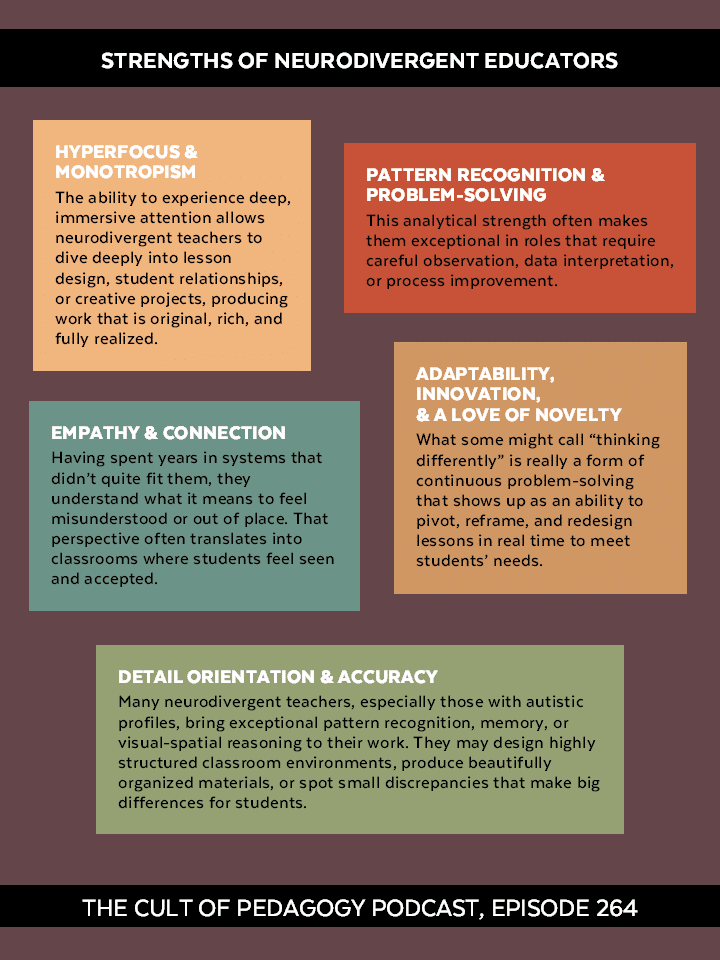
- Innovative Thinking & Creativity: Neurodivergent brains often excel in divergent thinking, leading to creative problem-solving, novel teaching methodologies, and the development of engaging, out-of-the-box lesson plans that capture students’ imaginations.
- Deep Empathy & Authenticity: Having navigated educational systems with different processing styles, neurodivergent teachers often possess a profound empathy for students who struggle or learn differently. This fosters a classroom culture of acceptance and understanding, making them powerful advocates for neurodiverse students.
- Pattern Recognition & Detail Orientation: Individuals with certain neurodivergent profiles, particularly those on the autism spectrum, may demonstrate exceptional abilities in recognizing patterns, noticing subtle details, and developing highly structured and predictable learning environments that benefit all students, especially those who thrive on routine.
- Hyperfocus & Passion: When engaged in subjects or tasks that align with their interests, neurodivergent individuals can exhibit intense periods of hyperfocus, leading to deep subject matter expertise and an infectious enthusiasm that inspires students.
- Authentic Modeling of Self-Advocacy: By openly discussing their own learning styles, coping mechanisms, and needs (where safe to do so), neurodivergent teachers model critical self-awareness and self-advocacy skills for their students, demonstrating that there isn’t one "right" way to learn or be successful.
These strengths are not merely anecdotal; growing research in organizational psychology and diversity management suggests that neurodiverse teams often outperform neurotypical teams in areas like innovation, productivity, and problem-solving, especially when provided with appropriate support structures. Applied to education, this indicates that valuing and accommodating neurodivergent educators can lead to richer, more dynamic learning experiences for all students.
Systemic Barriers and the Need for Institutional Change
The inherent strengths of neurodivergent educators often exist in tension with school systems fundamentally designed for a neuronormative majority. The rigidity of traditional school structures, coupled with a lack of understanding regarding neurodivergent needs, can inadvertently create environments that deplete these educators:
- Inflexible Schedules and Transitions: Constant, abrupt transitions between tasks, classes, and administrative duties can be highly disruptive for brains that thrive on sustained focus or require more time to context-switch.
- Sensory Overload: The typical classroom and school environment—fluorescent lights, constant noise, crowded hallways, strong smells—can be overwhelming for individuals with sensory sensitivities, leading to fatigue and reduced cognitive capacity.
- Administrative Burden: The sheer volume of paperwork, data entry, and compliance tasks, often with tight deadlines, heavily taxes executive functioning, potentially leading to missed deadlines or feelings of inadequacy.
- Social & Communication Expectations: Navigating complex staff meetings, parent conferences, and informal social dynamics can be exhausting for those who find social cues challenging or require more processing time.
- Lack of Understanding and Stigma: A prevailing culture that equates "having it together" with professionalism can create an environment where neurodivergent teachers fear disclosing their needs, lest it be misinterpreted as incompetence or a lack of commitment. This fear often leads to masking, an energy-intensive process of suppressing natural behaviors to appear neurotypical.
Educational bodies and teacher unions are increasingly acknowledging these systemic pressures. Organizations like the National Education Association (NEA) and the American Federation of Teachers (AFT) have begun to include discussions on teacher well-being and diversity, although specific policies tailored to neurodivergent educators are still evolving. The consensus emerging is that the issue is not with the neurodivergent teachers themselves, but with the systems that fail to accommodate their diverse ways of working and thinking.
Empowering Strategies for Neurodivergent Educators: Personal Adaptation
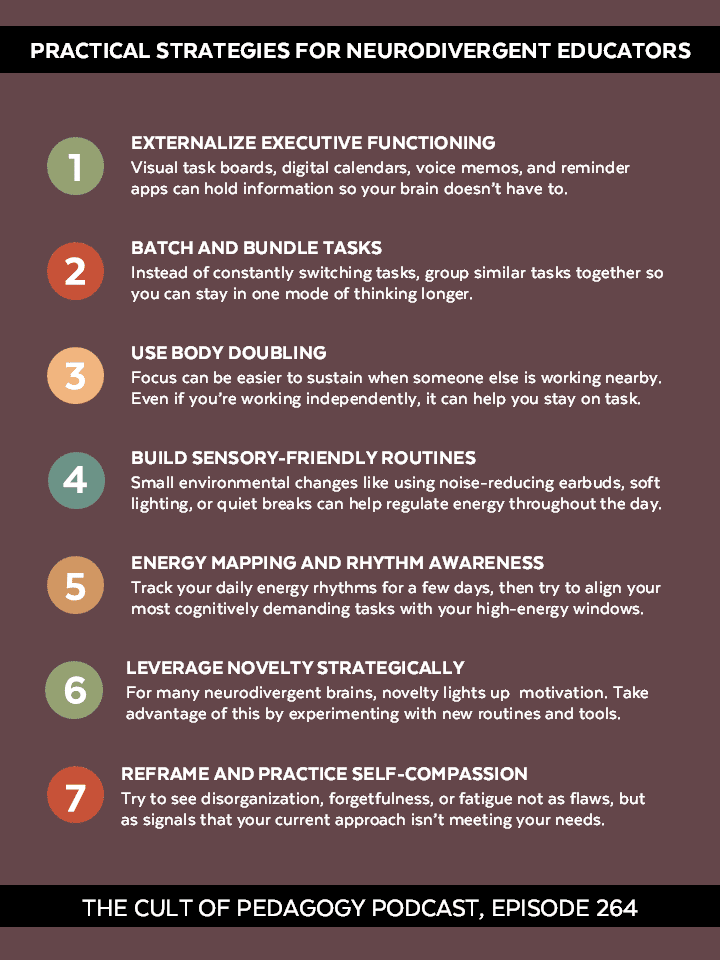
While systemic change is paramount, neurodivergent educators can also employ personalized strategies to navigate existing structures, preserve their energy, and maximize their effectiveness. These are not about "fixing" neurodivergence, but about optimizing personal workflow and self-care within a demanding profession:
- Externalize Executive Functioning: Offload mental tasks onto reliable external systems. Utilize visual planners, digital calendars (e.g., Google Calendar, Outlook Calendar), reminder apps (e.g., Todoist, Trello), or even voice memos to capture ideas and appointments. Automation tools like IFTTT (If This Then That) can streamline routine digital tasks, freeing up cognitive load.
- Batch and Bundle Tasks: Minimize cognitive "gear-shifting" by grouping similar tasks. Dedicate specific blocks of time for grading, email responses, lesson planning for the week, or administrative paperwork. This allows the brain to stay in one mode of thinking longer, reducing mental fatigue.
- Utilize Body Doubling: The presence of another person working nearby can significantly improve focus and task initiation for many neurodivergent individuals. This could involve co-planning sessions with a trusted colleague, virtual co-working groups, or even simply working in a shared space with another focused individual.
- Cultivate Sensory-Friendly Routines: Proactively manage sensory input. Employ noise-canceling headphones or earplugs during planning periods, adjust classroom lighting (favoring natural light or lamps over harsh fluorescents), and incorporate scheduled sensory breaks (e.g., stepping outside for a few minutes, engaging in a grounding exercise).
- Energy Mapping and Rhythm Awareness: Track personal energy and focus levels throughout the day and week. Identify peak performance times for cognitively demanding tasks (e.g., lesson planning, providing detailed feedback) and allocate less intense activities to lower-energy periods. This personalized scheduling can prevent burnout and maximize productivity.
- Leverage Novelty Strategically: For brains that thrive on new stimuli, introduce novelty intentionally. Experiment with new teaching tools, rotate classroom seating arrangements, or explore different lesson formats when motivation wanes. The key is to use novelty as a stimulant, not a constant distraction, returning to established routines for grounding.
- Practice Radical Self-Compassion: Recognize that struggles are often a symptom of a systemic mismatch, not personal failure. Reframe challenges as information about unmet needs. Cultivate self-compassion, allowing for experimentation and imperfection, and understand that sustainable teaching prioritizes well-being over an impossible standard of "perfection."
Institutional Responsibilities: Building Inclusive School Environments
For lasting change, schools and administrators must move beyond individual adaptations to implement systemic support structures. This is not about lowering standards but creating equitable access to the profession for all talented educators:
- Promote Neurodiversity Awareness and Training: Provide mandatory professional development for all staff, including administrators, on neurodiversity. This training should cover common neurodivergent profiles, their strengths, potential challenges, and practical strategies for support.
- Offer Flexible Work Arrangements: Explore options such as modified schedules, flexible planning times, quiet workspaces, or remote work opportunities for certain administrative tasks. Flexibility can significantly reduce sensory overload and executive function demands.
- Streamline Administrative Processes: Regularly review and simplify administrative tasks and paperwork. Utilize digital tools for efficiency and reduce redundant data entry. Provide clear, concise instructions and accessible templates.
- Create Sensory-Friendly Spaces: Designate quiet zones for staff, offer options for lighting control in classrooms, and consider noise-dampening solutions in common areas.
- Foster a Culture of Psychological Safety: Actively encourage an environment where teachers feel safe to disclose their neurodivergence and request accommodations without fear of judgment or professional repercussions. This requires visible leadership commitment to inclusivity.
- Provide Mentorship and Peer Support Networks: Establish programs where neurodivergent teachers can connect with mentors or peer groups who understand their experiences, offering a space for shared strategies and emotional support.
- Focus on Strengths-Based Evaluation: Shift performance evaluations to emphasize outcomes and unique contributions rather than rigid adherence to neuronormative processes. Recognize and celebrate the diverse talents neurodivergent teachers bring.
Broader Implications for Education and Society
When schools actively support neurodivergent educators, the benefits extend far beyond individual teachers. A more inclusive environment contributes significantly to:
- Teacher Retention: By reducing burnout and creating sustainable working conditions, schools can retain experienced and dedicated educators, mitigating the national teacher shortage crisis.
- Enhanced Student Outcomes: Teachers who feel supported and can leverage their authentic strengths are better equipped to connect with and inspire students. Moreover, neurodivergent teachers often serve as invaluable role models for neurodiverse students, demonstrating diverse pathways to success and belonging.
- A Richer Learning Environment: Classrooms led by neurodivergent teachers often become spaces where difference is not just tolerated but celebrated as a natural part of human variation. Students learn empathy, adaptability, and the value of diverse perspectives.
- Systemic Transformation: Embracing neurodiversity in the workforce pushes the entire educational system to question and redesign outdated structures, ultimately leading to more equitable and effective practices for all staff and students.
The dialogue surrounding neurodivergent educators is evolving from one of individual struggle to a collective call for systemic change. It is no longer about asking neurodivergent individuals to "fit in" to an inflexible system, but about designing systems that are inherently flexible, clear, and inclusive. By recognizing the immense value of cognitive diversity and implementing meaningful accommodations, schools can not only empower their neurodivergent teachers but also cultivate educational environments where every individual, regardless of their neurological profile, can thrive, contribute fully, and truly belong.