



Microsoft has announced the general availability of its Discovery platform, positioning the service as a robust, production-ready environment designed for scientists and researchers eager to integrate agentic artificial intelligence into their workflows. This significant launch, revealed at Build 2026, underscores Microsoft’s broader strategic commitment to embedding advanced AI capabilities across its entire product portfolio, signaling a new era for scientific and industrial innovation. The platform is meticulously engineered to orchestrate complex research processes, including sophisticated data analysis, innovative hypothesis generation, rigorous experimentation, and comprehensive knowledge management, all facilitated by a suite of specialized AI agents. Concurrently, Microsoft has unveiled a preview of the Microsoft Discovery app, a localized desktop experience aimed at making agentic AI accessible to individual researchers, students, academic laboratories, and scientific teams who may not yet require a full enterprise-scale deployment.
The Dawn of Agentic AI in Science: A Strategic Imperative for Microsoft
The scientific community today faces unprecedented challenges and opportunities. Researchers contend with an explosion of data, fragmented information across diverse sources, and increasingly complex interdisciplinary problems that demand novel approaches. Traditional research cycles, often characterized by manual data correlation, time-consuming literature reviews, and iterative experimentation, can be slow, costly, and prone to human cognitive biases. It is within this landscape that agentic AI emerges as a transformative force. Unlike conventional AI systems that primarily perform specific tasks based on predefined inputs, agentic AI systems possess the ability to reason, plan, learn, use tools, and execute multi-step processes autonomously to achieve defined goals. This paradigm shift empowers AI to act as a proactive research partner rather than merely a reactive tool.
Microsoft’s foray into agentic AI for scientific discovery is not an isolated endeavor but a cornerstone of its overarching AI strategy, championed by CEO Satya Nadella. Over the past several years, Microsoft has invested heavily in large language models (LLMs) and their applications, from Azure OpenAI Service to GitHub Copilot and Copilot for Microsoft 365. The evolution to agentic AI represents a natural progression, moving from providing powerful language understanding and generation to enabling intelligent, autonomous action. By embedding these capabilities into a platform specifically tailored for scientific R&D, Microsoft aims to unlock efficiencies and accelerate breakthroughs across various scientific disciplines, from materials science to drug discovery and sustainable energy. The global R&D expenditure, which exceeded $2.5 trillion in 2023 and continues to grow, represents a massive market ripe for such technological disruption, promising substantial returns on investment through accelerated innovation and reduced development costs.

Deep Dive into the Microsoft Discovery Platform: Unpacking its Core Capabilities
At the heart of the Microsoft Discovery platform lies the Microsoft Discovery Engine, a sophisticated, graph-based knowledge engine designed to serve as the central nervous system for scientific inquiry. This engine is crucial for connecting disparate data points and enabling AI agents to reason effectively across vast and intricate datasets. It seamlessly integrates proprietary research data—such as experimental results, internal reports, and institutional knowledge bases—with external scientific information drawn from public databases, academic journals, and open-source repositories. This comprehensive data integration allows AI agents to identify complex relationships, evaluate competing findings from diverse sources, and support the highly iterative nature of scientific research.
The platform’s agentic capabilities extend far beyond simple data retrieval. These specialized AI agents are engineered to:
- Plan: Devise strategic research pathways and experimental designs based on defined objectives.
- Reason: Analyze evidence, infer conclusions, and generate testable hypotheses, often identifying non-obvious connections.
- Use Tools: Integrate with and operate various scientific instruments, simulation software, and data analysis packages, mimicking a human researcher’s ability to utilize laboratory equipment or computational tools.
- Work Through Multistep Processes: Automate and manage complex research workflows that involve multiple stages of data collection, analysis, interpretation, and validation.
This approach directly addresses the core loop of scientific work: moving from initial evidence to formulated hypotheses, then through rigorous execution of experiments, detailed analysis of results, and subsequent iterative refinement. Microsoft describes the general availability release as a "production-ready platform" precisely because it offers the scalability, reliability, and security necessary for high-stakes R&D environments in both academia and industry.
For enterprise IT departments and large research organizations, governance is paramount. Microsoft Discovery has been developed with robust governance frameworks in mind. The platform is designed to connect to an organization’s institutional knowledge, domain-specific data, and simulation tools, while simultaneously integrating external scientific information. Critically, it ensures that all outputs are reviewable and workflows are reproducible, addressing key requirements for scientific rigor, regulatory compliance, and intellectual property protection. Microsoft has emphasized that the platform is designed to keep "human judgment" firmly at the center of all research decisions, ensuring that AI serves as an augmentative partner rather than an autonomous decision-maker, fostering trust and accountability within the research process.
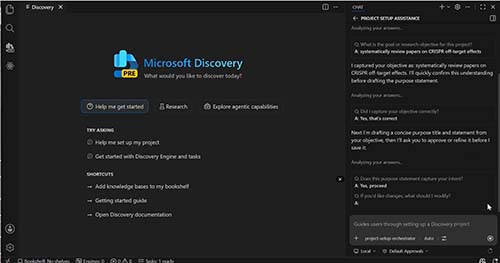
Democratizing Scientific AI: The Microsoft Discovery App
Recognizing that not all research teams possess the resources or immediate need for a full enterprise-level deployment, Microsoft has strategically launched a preview of the Microsoft Discovery app. This local desktop experience is specifically tailored to lower the barrier to entry for individual researchers, students, academic labs, and smaller scientific teams. The app allows these users to explore the transformative potential of agentic AI without the complexities associated with large-scale infrastructure integration.
Accessible for download from GitHub and usable with a GitHub Copilot account, the Discovery app offers a hands-on introduction to key functionalities. Users can leverage the app to streamline literature reviews, generate novel hypotheses, perform scientific reasoning tasks, and engage in iterative experimentation. This preview version acts as a sandbox, enabling smaller groups to experiment with agentic AI capabilities, validate its utility for their specific research questions, and build proficiency before potentially transitioning their work to the broader, more integrated Microsoft Discovery platform. This tiered approach is crucial for fostering widespread adoption and ensuring that advanced AI tools are not exclusively confined to well-funded, large-scale institutions. The app’s availability in preview also allows Microsoft to gather valuable user feedback, refine features, and ensure the final release is optimally aligned with the diverse needs of the scientific community.
Early Adopters Paving the Way: Diverse Use Cases and Testimonials
The effectiveness of Microsoft Discovery is already being demonstrated through several compelling early use cases across leading research institutions and industry partners, showcasing the platform’s versatility and impact:
-
Yale Engineering has leveraged the Discovery Engine in groundbreaking work related to small molecule design for grid-scale aqueous organic redox flow batteries. Professor David Kwabi, an associate professor at Yale, highlighted the synergy between human-led experimentation and AI’s unparalleled ability to explore vast chemical design spaces. This collaboration allows researchers to rapidly sift through millions of potential molecular structures, identifying promising candidates far more efficiently than traditional methods, thereby accelerating the development of next-generation energy storage solutions critical for renewable energy integration.
-
The Pacific Northwest National Laboratory (PNNL) is actively integrating Microsoft Discovery into its energy storage and biosystems engineering programs. A notable application involves the development of self-driving scientific workflows that seamlessly connect AI agents with sophisticated laboratory automation systems. This innovative approach minimizes human intervention in repetitive experimental tasks, enhances precision, and allows for continuous, autonomous optimization of experimental parameters, pushing the boundaries of automated scientific discovery.
-
In the biotechnology sector, Ginkgo Bioworks, a leading organism engineering company, is collaborating with Microsoft to advance biological discovery. Specialized AI agents developed within the Discovery platform are tasked with analyzing massive biological datasets, generating testable hypotheses about biological functions, and designing complex experiments to validate these hypotheses. This capability is vital for accelerating the development of new therapeutics, sustainable chemicals, and advanced biomaterials.
Beyond academic and bio-scientific applications, Microsoft Discovery is also making significant inroads into commercial and industrial sectors:
-
BHP, one of the world’s largest mining companies, is utilizing Discovery to study advanced copper leaching methods. By applying agentic AI to analyze complex geological data, metallurgical processes, and environmental factors, BHP aims to optimize extraction efficiencies, reduce environmental impact, and identify novel, more sustainable mining techniques.

-
Syensqo, a global specialty materials company, is deploying agentic AI in its research tied to next-generation heat transfer fluids crucial for semiconductor manufacturing. As semiconductor technology advances, managing heat dissipation becomes increasingly critical. Discovery helps Syensqo accelerate the identification and optimization of materials with superior thermal properties, contributing to more efficient and powerful electronic devices.
-
GSK, a global pharmaceutical giant, is exploring Microsoft Discovery for various drug development workflows. This includes accelerating target identification, optimizing drug compound design, predicting efficacy and toxicity, and streamlining preclinical research phases. The potential to compress the notoriously long and expensive drug development timeline offers immense value, potentially bringing life-saving medicines to market faster.
These diverse applications underscore the platform’s adaptability and its potential to significantly impact industries where research cycles are inherently expensive, data-intensive, and subject to stringent regulatory or scientific review.
Market Landscape and Broader Implications: Shaping the Future of R&D
The launch of Microsoft Discovery positions the company firmly in the burgeoning market of AI for scientific research, a segment projected for rapid growth. While Microsoft is a major player, it operates within a competitive landscape that includes specialized AI startups focusing on specific scientific domains (e.g., AI for drug discovery, materials design), as well as other tech giants like Google, which also invest heavily in AI for scientific applications (e.g., DeepMind’s AlphaFold for protein folding). Microsoft’s differentiation lies in its comprehensive platform approach, integrating its robust Azure cloud infrastructure, extensive developer tools like GitHub, and enterprise-grade security and governance features, all underpinned by its broad agentic AI strategy.

The implications of such a platform are profound:
- Accelerated Discovery: By automating repetitive tasks, sifting through vast amounts of data, and generating novel hypotheses, Discovery can dramatically shorten research timelines, leading to faster breakthroughs and reduced time-to-market for new products and therapies.
- Cost Reduction: Optimizing experimental designs, predicting outcomes, and minimizing failed experiments can lead to significant cost savings in R&D, which traditionally incurs substantial expenses.
- Democratization of Advanced Research: The Discovery app, in particular, lowers the barrier to entry, enabling smaller labs and individual researchers to access powerful AI tools previously exclusive to large institutions, fostering a more inclusive and innovative research ecosystem.
- Enhanced Human-AI Collaboration: The platform emphasizes "human judgment at the center," suggesting a future where scientists are augmented by AI, freed from mundane tasks to focus on higher-level problem-solving, creative thinking, and interpreting complex results. This collaborative model positions AI as a powerful assistant rather than a replacement.
- Ethical Considerations and Responsible AI: As with any powerful AI technology, the deployment of agentic AI in science necessitates careful consideration of ethical implications. Microsoft’s emphasis on reviewable outputs and human oversight is crucial for addressing concerns related to data privacy, algorithmic bias, intellectual property, and ensuring the responsible conduct of scientific research. The platform’s ability to maintain reproducibility of workflows is also critical for validating AI-generated insights and ensuring scientific integrity.
The integration of agentic AI into scientific research through platforms like Microsoft Discovery marks a pivotal moment. It promises to transform how discoveries are made, enabling scientists to tackle grand challenges with unprecedented speed and precision.
A New Era of Discovery
Microsoft Discovery’s general availability and the concurrent preview of its desktop app represent a significant stride in the application of agentic AI to some of humanity’s most complex challenges. By providing a production-ready platform that harmonizes advanced AI capabilities with rigorous scientific methodology and robust governance, Microsoft is not merely offering a new tool; it is proposing a new paradigm for scientific inquiry. The vision is clear: to empower researchers to move beyond current limitations, accelerate the pace of innovation, and ultimately usher in a new era of scientific discovery that benefits society at large. For more detailed information on the platform and to explore the preview app, interested parties are directed to the official Microsoft blog announcement. While preview features are subject to change, the foundation for transformative scientific advancement is now firmly established.