



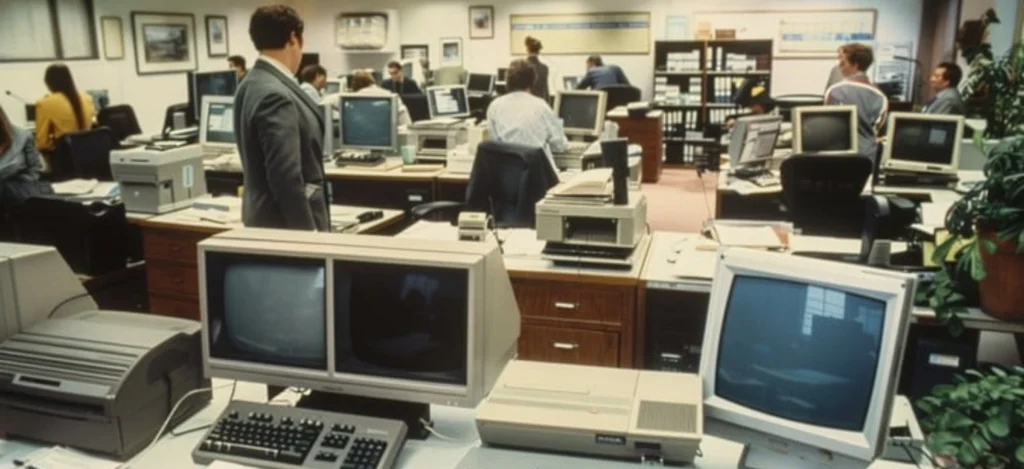
For decades, technological innovation has been heralded as the undisputed engine of economic growth and human progress, promising to streamline operations, amplify output, and free up human potential. Few recent advancements embodied this promise more profoundly than the personal computer (PC). With the advent of user-friendly software – spreadsheets for financial modeling, word processors for document creation, databases for information management, presentation software for communication, and email for instantaneous correspondence – the potential for a monumental leap in productivity seemed limitless. These tools were designed to vastly simplify common professional tasks, making them appear poised to deliver an unprecedented "slam dunk" for efficiency across industries.
However, as the history of technology often reveals, the reality of integrating revolutionary tools into the existing fabric of work proved considerably more intricate than initial projections suggested. The anticipated, immediate, and dramatic surge in productivity following the widespread adoption of personal computers did not materialize as quickly or as unequivocally as many had expected, leading to what economists famously termed the "productivity paradox." This phenomenon, first widely discussed in the 1980s, highlighted a curious disconnect: despite massive investments in information technology (IT), national productivity statistics did not show a corresponding acceleration. This historical precedent offers a crucial lens through which to examine the current excitement surrounding artificial intelligence (AI) and its potential impact on the modern workforce.
The Dawn of the Digital Age and the Productivity Paradox
The personal computer began its ascent in the late 1970s and early 1980s, evolving rapidly from niche devices for hobbyists and scientists to indispensable tools in offices and homes. Companies invested heavily in hardware and software, believing these machines would revolutionize operations. Early adopters envisioned a future where repetitive tasks were automated, information flowed seamlessly, and decision-making was enhanced by readily available data. Indeed, many individual tasks became demonstrably easier and faster. Typing a document, performing complex calculations, or sending a memo were transformed from laborious, time-consuming endeavors into swift digital processes.
Yet, despite this clear micro-level efficiency, aggregate macroeconomic data told a different story. Throughout the 1970s and 1980s, and even into the early 1990s, U.S. labor productivity growth rates, particularly in the services sector where IT investment was most concentrated, remained stubbornly low compared to the post-World War II boom years. This observation prompted Nobel laureate economist Robert Solow to famously quip in 1987, "You can see the computer age everywhere but in the productivity statistics." This statement perfectly encapsulated the prevailing sentiment of frustration and bewilderment among economists and business leaders.
Unpacking the PC Productivity Paradox: A Chronology of Understanding
The journey to understand the PC productivity paradox unfolded over several stages:
- Early 1980s: The Introduction of PCs: IBM PC’s launch in 1981 marked a turning point, making computing accessible to businesses. Initial investments were significant, but immediate, broad economic impacts were elusive.
- Mid-1980s to Early 1990s: Height of the Paradox: As PCs became ubiquitous, and software like Lotus 1-2-3 and WordPerfect permeated workplaces, productivity growth remained sluggish. Economists began to rigorously study this disconnect, proposing various explanations.
- Late 1990s: The Internet Boom and a Productivity Resurgence: A significant shift occurred in the latter half of the 1990s. Labor productivity growth rates in the U.S. accelerated dramatically, reaching levels not seen since the 1960s. This surge was largely attributed to the maturation of IT, particularly the internet and enterprise resource planning (ERP) systems, which allowed businesses to re-engineer processes and achieve network effects. This period suggested that the benefits of IT were not immediate but required time for organizational adaptation and complementary investments.
- Early 2000s Onward: Sustained but Uneven Impact: While IT continued to drive some productivity gains, particularly in manufacturing and retail, the initial burst of the late 1990s proved difficult to sustain across all sectors. The rise of new digital tools, including email and collaboration platforms, brought new efficiencies but also unforeseen complexities.
Supporting Data and Economic Explanations
Several theories emerged to explain the initial paradox, many of which remain pertinent today:
- Measurement Challenges: A primary argument posited that traditional economic metrics struggled to capture the qualitative improvements brought by computers. How does one quantify the value of better-written reports, faster communication, or increased flexibility? Services, in particular, are difficult to measure in terms of output. For instance, the output of a lawyer or a consultant, while enhanced by computers, isn’t easily reduced to a simple numerical measure of productivity.
- Learning Curves and Implementation Lags: New technologies often require significant time for users to learn, adapt, and integrate them effectively into existing workflows. Organizations also need to redesign processes, invest in training, and sometimes even restructure their entire operations to fully leverage the capabilities of new tools. This "time to diffusion" can span years or even decades. Economist Erik Brynjolfsson and others highlighted that IT’s true impact often comes from "organizational capital" – new business processes, management practices, and skills – which takes time and investment to develop.
- Reorganization Costs: Adopting new technology isn’t just about plugging in a device; it necessitates fundamental changes in how work is done. This involves significant upfront costs in terms of re-training employees, overhauling legacy systems, and often experiencing a temporary dip in productivity as workers adjust to new methods.
- Misallocation of Resources and Distractions: Not all IT investments were productive. Early on, some companies invested in technology without a clear strategy, leading to underutilized systems. Furthermore, the very tools designed for productivity, like email, also introduced new forms of overhead and distraction. As articulated in a 2021 WIRED op-ed and further explored in the New York Times bestselling book A World Without Email, communication tools like email and Slack, while facilitating rapid information exchange, also contribute to an overwhelming deluge of messages, context switching, and "collaborative overload." This can fragment attention and diminish deep work, effectively creating a "productivity paradox within a paradox" where the tools themselves become sources of inefficiency.
- Distributional Effects: While some firms or sectors saw significant gains, others did not, leading to an uneven aggregate impact. This heterogeneity in adoption and effective utilization meant that the overall national statistics might mask significant progress in specific areas.
The AI Moment: Echoes of the Past
Today, as artificial intelligence transitions from academic research to practical applications, the discourse around its potential impact on productivity mirrors the early days of personal computing. Generative AI tools, advanced analytics, and automation platforms promise to streamline countless professional activities, from drafting reports and generating code to analyzing complex datasets and personalizing customer interactions. It is natural to assume that this technology, which clearly makes certain common professional activities easier and faster, will inherently lead to a substantial and immediate increase in overall productivity across economies.
However, drawing parallels from the desktop computing era, it is imperative to approach this assumption with a healthy dose of critical evaluation. The history of technological integration teaches us that the path from innovation to widespread, measurable productivity gains is rarely simple or linear.
Statements and Reactions from Related Parties on AI’s Potential
The advent of AI has generated a spectrum of reactions from various stakeholders:
- Economists: Many economists, while acknowledging AI’s transformative potential, are cautious about predicting immediate, massive productivity spikes. Dr. Brynjolfsson, now at Stanford University, continues to emphasize the importance of "complementary innovations" – new business processes, organizational structures, and skills – that must accompany AI adoption for its full benefits to be realized. Others, like Daron Acemoglu of MIT, point to the risk of "so-so technologies" that automate tasks without genuinely enhancing overall productivity or creating new, higher-value ones, potentially leading to job displacement without corresponding economic growth.
- Tech Leaders: Companies at the forefront of AI development, such as Google, Microsoft, and OpenAI, express immense optimism, highlighting AI’s ability to automate mundane tasks, augment human capabilities, and unlock new scientific discoveries. They forecast significant efficiency gains and the creation of entirely new industries. However, even these leaders often temper expectations with calls for responsible development, ethical considerations, and a recognition of the long journey required for societal adaptation.
- Business Analysts and Consultants: Firms like McKinsey and Gartner have published extensive reports detailing AI’s potential to add trillions of dollars to the global economy. They often advise clients on strategic AI adoption, emphasizing the need for clear use cases, robust data governance, and significant investment in workforce training. They acknowledge that implementation challenges, including integration with legacy systems and cultural resistance, are significant hurdles.
- Labor Experts and Policy Makers: Concerns about job displacement, the need for reskilling initiatives, and the equitable distribution of AI’s benefits are paramount for labor organizations and governments. While AI could eliminate some jobs, it is also expected to create new ones, shifting the nature of work. Policy discussions revolve around education reform, social safety nets, and regulatory frameworks to guide AI development and ensure its benefits are broadly shared.
Broader Impact and Implications for the AI Era
The current AI moment presents a unique opportunity, but also a complex challenge. Much like early PCs, AI is not a technological genie that can be easily returned to its bottle. Its untapped convenience and power are too compelling to be ignored. However, as businesses and societies grapple with how to effectively integrate these tools, the lessons from the personal computer era are invaluable:
- Strategic Implementation is Key: Simply deploying AI tools without a clear strategy for process re-engineering, employee training, and organizational adaptation is unlikely to yield significant productivity dividends. Companies must rethink their entire operational models, not just bolt AI onto existing ones.
- Focus on Augmentation, Not Just Automation: While AI can automate tasks, its greatest potential lies in augmenting human capabilities, allowing professionals to focus on higher-value, more creative, and strategic work. This requires careful design of human-AI collaboration.
- The "Productivity Paradox" May Reappear: It is entirely plausible that we will experience a new iteration of the productivity paradox in the coming years. Initial investments in AI might not immediately translate into aggregate economic growth due to learning curves, the costs of organizational change, and the difficulty of measuring the output of complex, AI-assisted knowledge work.
- Beware of "Digital Distractions 2.0": Just as email and Slack became sources of both efficiency and distraction, future AI tools could introduce new forms of cognitive load or reliance that inadvertently diminish deep work or critical thinking if not managed judiciously.
- Long-Term vs. Short-Term Gains: The truly transformative impacts of AI, like those of the PC and the internet, are likely to unfold over decades, not months. Patience, sustained investment, and a willingness to experiment and learn will be crucial.
In conclusion, the history of the personal computer’s impact on productivity serves as a powerful reminder that technological innovation, while inherently beneficial, often follows a complex and non-linear path to widespread economic impact. The initial promise of immediate, dramatic productivity gains frequently encounters resistance from organizational inertia, measurement challenges, and the sheer effort required for human and systemic adaptation. As the world stands at the precipice of the AI revolution, we are once again confronted with the exciting prospect of unprecedented efficiency. However, a nuanced understanding of past technological transitions suggests that achieving AI’s full potential will demand more than just technological prowess; it will require visionary leadership, strategic organizational redesign, continuous learning, and a careful consideration of both the immediate conveniences and the broader, long-term implications for how we work and live. In the digital world, productivity doesn’t always match our initial expectations, but with deliberate effort and lessons learned from history, the promise can eventually be realized.