


The field of bio-hybrid robotics has reached a significant milestone as researchers from Nanyang Technological University (NTU) in Singapore have successfully engineered a 3D-printed "diving suit" that allows terrestrial insects to operate underwater for extended periods. This development, published in the journal Nature Communications, transforms the common cockroach into an amphibious cyborg capable of navigating flooded environments that are typically inaccessible to both human rescuers and traditional mechanical robots. By integrating biological resilience with advanced materials science, the team led by Professor Hirotaka Sato has addressed one of the primary limitations of insect-based cyborgs: their dependence on atmospheric oxygen.
For over a decade, scientists have explored the potential of "cyborg insects"—living organisms fitted with electronic backpacks that allow for remote navigation. While these biological machines offer superior mobility and power efficiency compared to micro-scale robots, they have historically been restricted to dry land. The NTU Singapore breakthrough introduces a specialized life-support system that enables these insects to survive and function in oxygen-deprived or fully submerged settings, such as flooded caves, drainage systems, or industrial pipelines.
The Engineering of the Amphibious Life-Support System
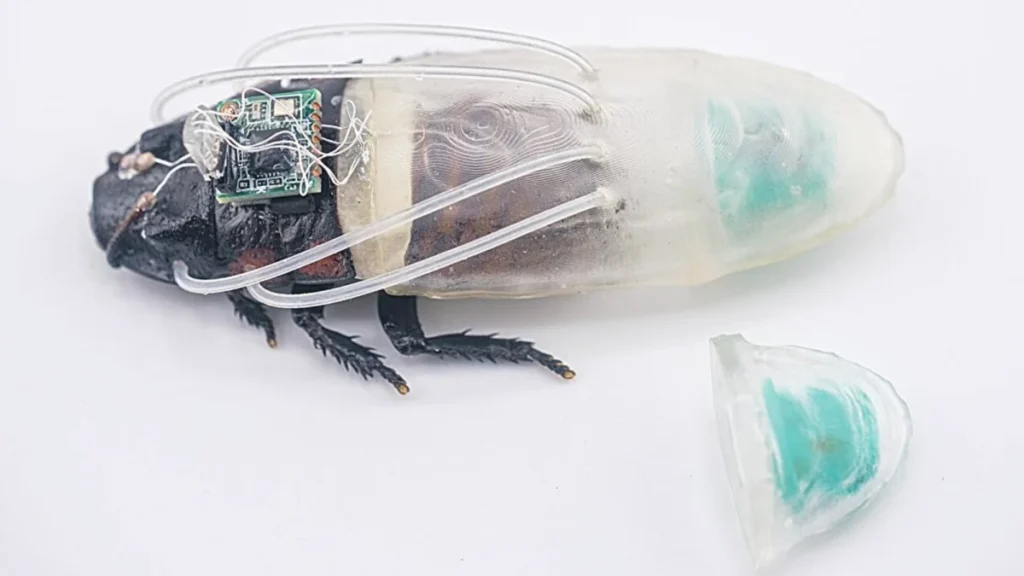
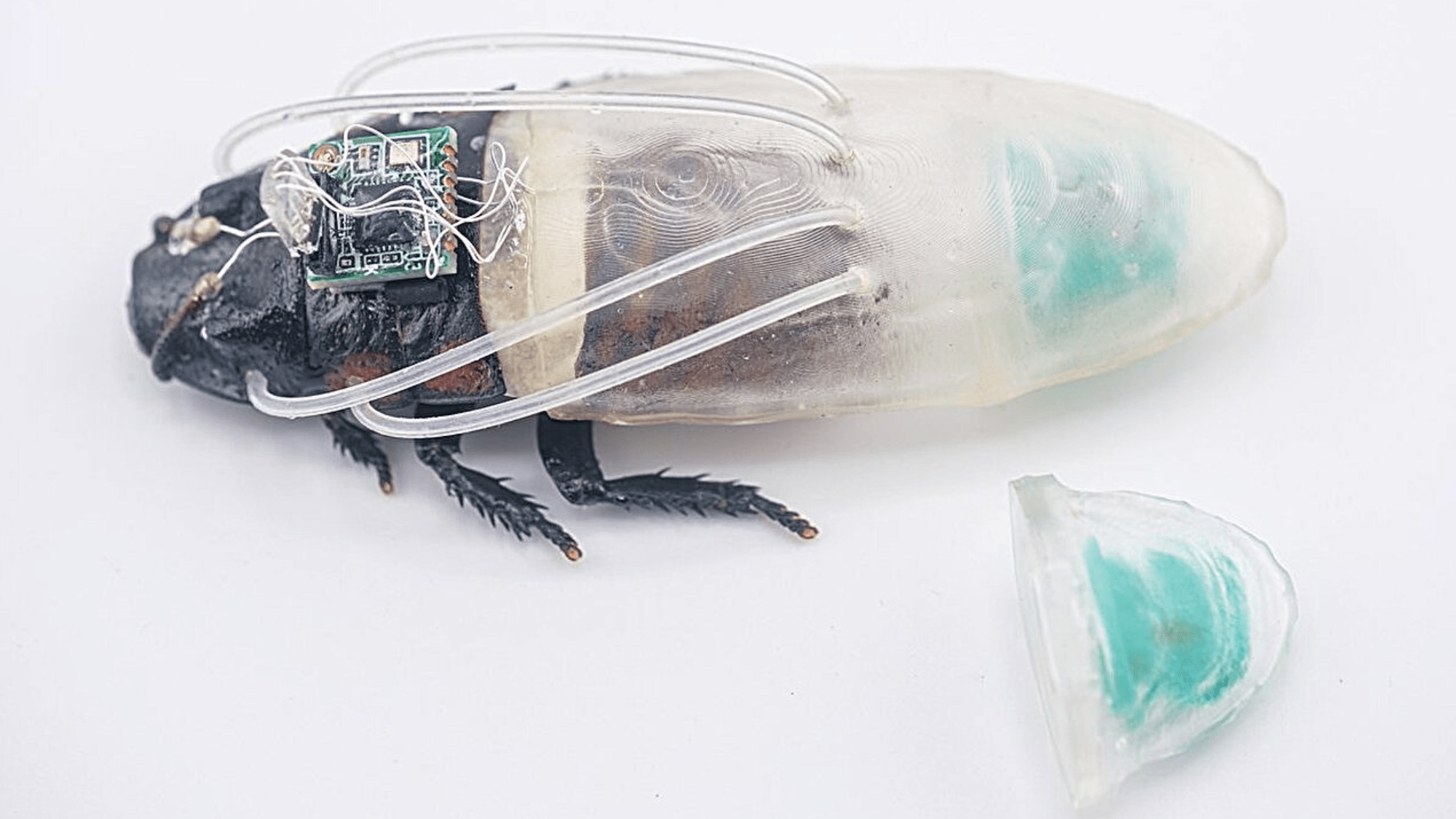
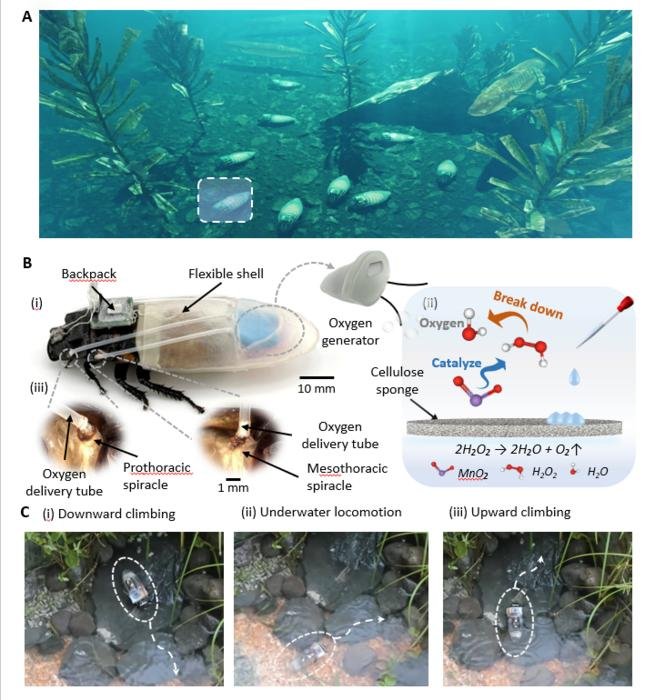
The core of the innovation is a 3D-printed, lightweight backpack measuring approximately 10 by 10 millimeters, roughly the size of a small piece of chewing gum. Despite its diminutive scale, the apparatus houses a sophisticated chemical oxygen generation system. Rather than carrying compressed oxygen tanks, which would be too heavy and bulky for the insect to carry, the researchers utilized a chemical reaction to produce breathable air on demand.
The system employs a sponge coated with manganese dioxide, which acts as a catalyst. When this catalyst comes into contact with a solution of hydrogen peroxide stored within the backpack, it triggers a controlled decomposition process, releasing pure oxygen gas. This oxygen is then funneled through four flexible silicone supply tubes directly to the cockroach’s spiracles—the small openings along the sides of an insect’s abdomen through which it breathes.
By bypassing the need for atmospheric air, the suit creates a localized pressurized environment for the insect’s respiratory system. During laboratory testing, this "scuba gear" for insects allowed the subjects to remain submerged and active for up to three hours. Without the suit, a standard cockroach can only survive underwater for a few minutes before succumbing to hypoxia.
Technical Advantages of Bio-Hybrid Systems over Traditional Robotics
The decision to use living insects rather than fully mechanical robots is rooted in the immense complexity of replicating natural locomotion. Building a robot the size of a cockroach that can climb walls, squeeze through millimeter-wide gaps, and right itself after a fall requires significant computing power and heavy batteries.
In contrast, a cyborg insect utilizes its own biological "hardware" for movement. The insect’s internal metabolism provides the energy for walking and climbing, while its nervous system handles the complex tasks of balance and obstacle avoidance. The human operator only needs to provide high-level directional input. This is achieved by implanting electrodes into the insect’s sensory organs or brain, allowing a remote controller to "nudge" the creature left or right.
"In a rescue scenario, we only need to stimulate the cockroach to turn its direction when it is walking the wrong way or move when it stops unexpectedly," noted researchers familiar with the technology. This synergy allows the cyborg to maintain a high degree of autonomy, navigating uneven terrain and debris with a level of agility that modern robotics has yet to match at this scale.
Experimental Validation and Performance Metrics
To test the efficacy of the diving suit, the NTU team constructed a series of 3D-printed obstacle courses designed to simulate real-world disaster environments. These courses included narrow, transparent tubes partially or fully submerged in water, representing flooded pipes or collapsed building cavities.
The results demonstrated that the amphibious cyborgs could traverse these hazards with remarkable efficiency. The researchers reported that the insects moved at speeds nearly comparable to their terrestrial performance, showing little signs of distress or physical encumbrance from the 3D-printed backpack. The stability of the oxygen flow ensured that the insects remained energetic throughout the three-hour test window, a duration sufficient for most localized search-and-rescue sorties.
However, the researchers clarified the current limitations of the technology. While the suit allows for submersion, it is designed for shallow-water navigation where the insect can still maintain traction on a surface. It is not intended for free-swimming in deep water, as the buoyancy of the backpack and the insect’s natural physiology are optimized for crawling rather than aquatic propulsion.

Chronology of Cyborg Insect Development
The journey toward the amphibious cockroach began in the early 2010s, with various research institutions, including North Carolina State University and Osaka University, experimenting with basic electrical stimulation.
- 2012-2014: Initial proof-of-concept studies showed that Madagascar hissing cockroaches could be steered using wireless transmitters.
- 2017-2019: Researchers integrated sensors, including miniature microphones and thermal cameras, onto the insects to detect human heartbeats and heat signatures under rubble.
- 2021-2023: Focus shifted toward power sustainability, with the development of flexible solar cells that could be mounted on the insect’s back to recharge the control electronics.
- 2024-2025: The NTU Singapore team identified the "oxygen barrier" as the next major hurdle, leading to the development of the 3D-printed diving suit and chemical oxygen generator.
This latest advancement represents the transition from a niche laboratory curiosity to a versatile tool capable of operating in the unpredictable and often water-logged environments found at actual disaster sites.
Broader Implications and Future Applications
The successful deployment of diving suits for insects opens a range of possibilities beyond terrestrial search and rescue. Professor Hirotaka Sato, an expert in Aerospace Engineering at NTU, suggested that the principles used in this study could eventually be applied to other oxygen-deprived environments.
One potential application is the inspection of underwater infrastructure. Currently, inspecting narrow pipes or flooded basement levels in industrial plants requires expensive, specialized tethered drones that often get stuck. A swarm of cyborg cockroaches could provide a low-cost, high-redundancy alternative for mapping these areas.
Furthermore, the research has caught the attention of the aerospace community. The ability to keep a terrestrial organism alive and functional in a low-oxygen environment is a prerequisite for biological exploration in space. While "cockroach cosmonauts" remain a theoretical concept, the NTU study provides a blueprint for how bio-hybrid systems might be used to explore the pressurized modules of space stations or even the surfaces of other planets where traditional oxygen levels are non-existent.
Ethical Considerations and Public Perception
As with any technology involving living organisms, the development of cyborg insects raises ethical questions regarding animal welfare. The researchers at NTU and other institutions have emphasized that the insects are anesthetized during the electrode implantation process and do not possess the same pain-processing mechanisms as mammals.
Furthermore, the autonomy of the insect is preserved; the electronic inputs do not "override" the creature’s life-preserving instincts. If an insect encounters a lethal hazard, it will often resist the electronic command to protect itself. This biological "fail-safe" is one of the reasons the technology is so resilient.
Public perception remains a hurdle, particularly for those with entomophobia (the fear of insects). However, the researchers argue that in a life-or-death situation—such as being trapped in a collapsed building—the utility of the technology far outweighs the discomfort associated with the "creepy-crawly" nature of the rescuers.
Conclusion and Next Steps
The NTU Singapore study marks a definitive step forward in the evolution of search-and-rescue technology. By successfully merging 3D-printing, chemical engineering, and biological systems, the researchers have created a tool that is both highly capable and remarkably cost-effective.
The next phase of research will likely focus on miniaturizing the oxygen generator even further and increasing the duration of the chemical reaction. There is also interest in developing "smart" suits that can automatically detect when the insect is submerged and trigger oxygen release accordingly, conserving the chemical fuel for when it is most needed. As the line between biology and machinery continues to blur, the humble cockroach may soon become one of the most valuable assets in the global disaster-response toolkit.