



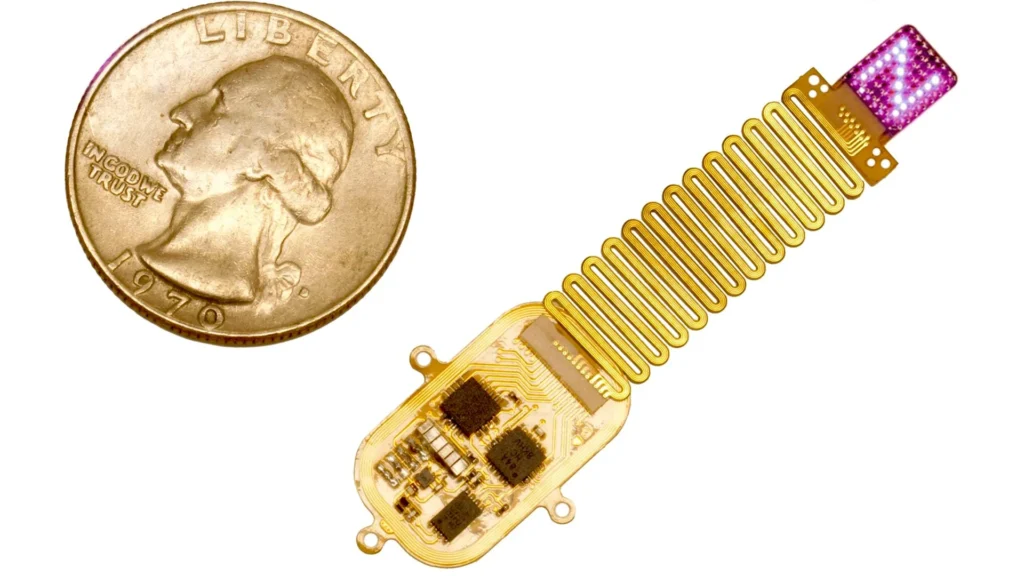
In a monumental leap forward for neurobiology and the burgeoning field of bioelectronics, scientists at Northwestern University have engineered a groundbreaking wireless device capable of transmitting information directly into the brain using precisely controlled light. This innovative technology fundamentally redefines brain-computer interfaces by circumventing the body’s traditional sensory pathways, instead delivering signals straight to targeted neurons within the cortex. The breakthrough, detailed in the December 8 issue of Nature Neuroscience, promises to unlock unprecedented avenues for understanding brain function and restoring lost senses or motor control.
A New Frontier in Brain-Machine Interface Technology
The newly developed device represents a paradigm shift in how humans might one day interact with prosthetic limbs, navigate sensory deficits, or recover from neurological injuries. Designed to be soft and flexible, it is engineered to fit discreetly beneath the scalp, resting gently on the skull. From this non-invasive position, it projects intricate patterns of light through the cranial bone, activating specific groups of neurons across the brain’s cortex. This transcranial approach marks a significant departure from earlier, more invasive brain-computer interface (BCI) technologies that often required direct implantation into brain tissue.
The significance of this development cannot be overstated. For decades, researchers have strived to bridge the gap between biological brains and artificial systems, grappling with challenges related to signal integrity, invasiveness, power supply, and long-term stability. This wireless, light-based system addresses many of these hurdles, offering a powerful, yet minimally intrusive, platform for exploring the brain’s capacity to interpret novel information.
Pioneering Direct Neural Communication
During rigorous testing phases, researchers deployed minute, meticulously timed bursts of light to stimulate designated populations of neurons deep within the brains of mouse models. These specific neurons had been genetically modified to render them responsive to light, a technique central to the field of optogenetics. The results were compelling: the mice rapidly learned to decipher these distinct light patterns as meaningful cues, demonstrating a remarkable ability to process and act upon this synthetic sensory input. Crucially, the animals accomplished this feat without relying on their natural senses of sound, sight, or touch. They utilized the incoming light-based information to make accurate decisions and successfully complete complex behavioral tasks, proving the efficacy of direct neural communication.
The implications of this successful animal model demonstration are vast and far-reaching, heralding a future where a wide spectrum of medical applications could be revolutionized. Potential uses span from providing critical sensory feedback for advanced prosthetic limbs, allowing users to "feel" their artificial extensions, to delivering artificial inputs for next-generation hearing or vision prostheses that bypass damaged sensory organs entirely. Beyond sensory restoration, the technology could facilitate the precise control of robotic limbs, significantly enhance rehabilitation protocols for patients recovering from debilitating injuries or strokes by directly stimulating neural pathways, and even offer innovative, non-pharmacological approaches to modifying chronic pain perception.
The Evolution of Optogenetics and Brain-Computer Interfaces
To fully appreciate the magnitude of this Northwestern breakthrough, it is essential to understand the historical context of optogenetics and the broader field of brain-computer interfaces. Optogenetics, a revolutionary neuroscientific technique developed in the early 2000s, combines genetic engineering with optics to precisely control the activity of individual neurons in living tissue. By introducing light-sensitive proteins (opsins) into specific neurons, scientists can then use light to turn these neurons on or off with unprecedented spatial and temporal resolution. While incredibly powerful, traditional optogenetics often relied on optical fibers implanted directly into the brain, restricting animal movement and posing challenges for long-term, chronic studies in freely behaving subjects.
The pursuit of brain-computer interfaces, devices that allow for direct communication pathways between the brain and an external device, dates back decades. Early concepts explored rudimentary ways to record brain signals for controlling cursors or simple robotics. Over time, these efforts evolved to include both invasive BCIs, which involve electrodes surgically implanted into the brain (e.g., Utah arrays, Neuralink), and non-invasive BCIs, which measure brain activity from outside the skull (e.g., EEG-based systems). While invasive BCIs offer higher signal resolution, they carry risks of infection, tissue damage, and signal degradation over time. Non-invasive methods are safer but typically offer lower spatial resolution and are more susceptible to noise. The Northwestern device elegantly navigates this trade-off by offering high-resolution optogenetic control in a minimally invasive, wireless format.
Building on Past Success: From Single-LED to Multi-Array Systems
This latest achievement from the Northwestern team is not an isolated discovery but rather the culmination of years of pioneering research. It significantly advances their own previous work, which garnered international attention in 2021. In that earlier breakthrough, the same research group reported the development of the first fully implantable, programmable, wireless, and battery-free device capable of controlling neurons with light. That initial system utilized a single micro-LED probe to influence specific social behaviors in mice. Critically, unlike traditional optogenetics which necessitated cumbersome fiberoptic wires that severely restricted movement, their wireless design allowed mice to behave entirely normally within their social environments. This represented a crucial step towards realistic, long-term studies of brain function in naturalistic settings.
The new device elevates this foundational capability to an entirely new level, enabling far more sophisticated and nuanced communication with the brain. Instead of merely stimulating a single, confined region, the updated system integrates an array of up to 64 independently programmable micro-LEDs. Each individual light emitter, remarkably, is as diminutive as a single strand of human hair and can be controlled in real time. This unprecedented level of control allows researchers to deliver intricate sequences of light patterns that closely mimic the distributed activity patterns naturally produced by the brain during genuine sensory experiences. The human cortex, after all, functions through broad networks of interconnected neurons rather than isolated ones. By adopting this multi-site, patterned approach, the technology accurately mirrors the complex, dynamic way the cortex normally processes information and orchestrates perception.
"In the first paper, we used a single micro-LED," explained Mingzheng Wu, a postdoctoral researcher and the study’s first author. "Now we’re using an array of 64 micro-LEDs to control the pattern of cortical activity. The number of patterns we can generate with various combinations of LEDs — frequency, intensity, and temporal sequence — is nearly infinite." This exponential increase in programmable complexity is what allows the device to create "entirely new signals" that the brain must learn to interpret, much like learning a new language.
Engineering Innovation: A Minimally Invasive, Wireless Design
The development of this sophisticated device demanded an ambitious rethinking of conventional approaches to neural stimulation. As John A. Rogers, a preeminent figure in bioelectronics and the head of the technology development aspect of the study, articulated, "Developing this device required rethinking how to deliver patterned stimulation to the brain in a format that is both minimally invasive and fully implantable." The engineering feat lies in integrating a soft, conformable array of these minuscule micro-LEDs with a wirelessly powered control module. This entire system operates completely beneath the skin, eliminating external wires or bulky hardware, and crucially, without any measurable effect on the natural behaviors of the animals.
Despite its enhanced capabilities, the physical footprint of the device remains remarkably small. It is approximately the size of a postage stamp and thinner than a standard credit card. This compact form factor is critical for long-term implantation and minimal disruption to daily life. A key innovation in this design is its non-penetrating nature. Rather than requiring a probe to be inserted directly into brain tissue, the new version gently conforms to the surface of the skull and projects light through the bone. This transcranial approach significantly reduces surgical invasiveness and the associated risks.
"Red light penetrates tissues quite well," explained Northwestern neurobiologist Yevgenia Kozorovitskiy, who spearheaded the experimental portion of the study. "It reaches deep enough to activate neurons through the skull." This property of red light, combined with the power of optogenetics, allows for deep brain stimulation without the need for physically breaching the dura mater, the tough membrane surrounding the brain.
Decoding Artificial Perception: Mouse Model Experiments
To thoroughly evaluate the system’s ability to transmit meaningful information, the research team meticulously designed a series of experiments using their genetically engineered mouse models. These animals possessed light-responsive neurons specifically within their cortex. The core of the experimental design involved training the mice to associate a particular pattern of light stimulation with a reward, typically a liquid treat dispensed at a specific port within a custom-built testing chamber.
During these experiments, the implant delivered a defined pattern of light across four distinct cortical regions. This process was akin to "tapping a coded message directly into the brain," as described by the researchers. The mice demonstrated an impressive capacity to learn and identify this target light pattern amidst a multitude of alternative, irrelevant stimulation patterns. When they successfully detected the correct artificial signal, they consistently navigated to the appropriate port to receive their reward.
"By consistently selecting the correct port, the animal showed that it received the message," Wu affirmed. "They can’t use language to tell us what they sense, so they communicate through their behavior." This behavioral evidence provided irrefutable proof that the mice were not only receiving the light signals but were actively interpreting them as meaningful information and integrating them into their decision-making processes.
The Promise of "New Signals" for Sensory Restoration
The potential for this technology to fundamentally alter the landscape of sensory restoration is profound. "Our brains are constantly turning electrical activity into experiences, and this technology gives us a way to tap into that process directly," Kozorovitskiy remarked. "This platform lets us create entirely new signals and see how the brain learns to use them. It brings us just a little bit closer to restoring lost senses after injuries or disease while offering a window into the basic principles that allow us to perceive the world."
The ability to create "entirely new signals" opens up fascinating avenues for neuroprosthetics. Imagine a person with a prosthetic hand not only being able to move it but also receiving direct neural feedback that conveys the sensation of texture, pressure, or temperature. For individuals suffering from hearing or vision loss, this device could bypass damaged sensory organs, delivering artificial but interpretable information directly to the brain, potentially enabling a new form of "seeing" or "hearing." With approximately 1.5 million people in the U.S. living with limb loss, over 48 million with hearing impairment, and millions more affected by vision loss or stroke-related disabilities, the potential societal impact of such a technology is immense.
Rogers further emphasized the dual utility of the device: "It represents a significant step forward in building devices that can interface with the brain without the need for burdensome wires or bulky external hardware. It’s valuable both in the immediate term for basic neuroscience research and in the longer term for addressing health challenges in humans." This highlights the device’s role not just as a therapeutic tool but also as an unparalleled research instrument for probing the fundamental mechanisms of perception, learning, and neural plasticity.
Broader Horizons: Medical and Research Implications
Beyond the immediate applications discussed, the long-term implications of this wireless optogenetic platform are extensive. In the realm of rehabilitation, precise neural stimulation could accelerate recovery from stroke or traumatic brain injury by reinforcing specific neural pathways or facilitating motor relearning. For chronic pain, which affects an estimated 50 million adults in the U.S., the ability to directly modulate pain perception without systemic medications offers a transformative, non-addictive alternative. Furthermore, while not explicitly mentioned in the article, the control over neural activity afforded by this technology could eventually be explored for treating neurological disorders such as Parkinson’s disease, epilepsy, or even certain psychiatric conditions, where aberrant neural circuits play a significant role.
The research community stands to gain immensely. This device provides an unprecedented tool for studying how the brain processes information, learns new associations, and adapts to novel sensory inputs. It allows for the systematic exploration of cortical mapping, plasticity, and the intricate neural codes that underpin cognition and behavior. Understanding how the brain integrates and interprets these artificial signals can shed light on how it naturally constructs our perception of reality.
Navigating the Future: Ethical Considerations and Development Pathways
Now that the team has definitively demonstrated the brain’s capacity to interpret patterned light stimulation as meaningful information, their next steps involve exploring increasingly sophisticated patterns. They aim to determine the maximum number of distinct signals the brain can reliably learn and differentiate. Future iterations of the device are envisioned to incorporate an even greater number of LEDs, with smaller spacing between them to achieve finer spatial resolution. Larger arrays covering more extensive cortical areas and the use of light wavelengths capable of penetrating deeper into brain tissue are also on the development roadmap.
As with any powerful neurotechnology, the development of direct brain interfaces raises important ethical considerations. While the immediate applications are focused on therapeutic benefits and basic research, the long-term implications of "artificial perception" and direct neural control warrant careful societal dialogue. Questions surrounding data privacy, cognitive enhancement, identity, and the potential for misuse will undoubtedly become more prominent as these technologies mature. It is crucial that the scientific community, ethicists, policymakers, and the public engage in proactive discussions to ensure responsible development and deployment.
The study, titled "Patterned wireless transcranial optogenetics generates artificial perception," received substantial support from a consortium of prestigious institutions and foundations, underscoring its recognized importance. Funding was provided by the Querrey Simpson Institute for Bioelectronics, NINDS/BRAIN Initiative, National Institute of Mental Health, One Mind Nick LeDeit Rising Star Research Award, Kavli Exploration Award, Shaw Family Pioneer Award, Simons Foundation, Alfred P. Sloan Foundation, and the Christina Enroth-Cugell and David Cugell Fellowship. This broad backing highlights the collaborative and multidisciplinary nature of this cutting-edge research, which promises to redefine the boundaries of neurobiology and human-machine interaction.