



In a symbolic gesture bridging the gap between national heritage and celestial exploration, NASA has released a stunning new collection of astronomical images and sonifications rendered in a patriotic palette of red, white, and blue. This initiative, spearheaded by the Chandra X-ray Observatory in collaboration with the James Webb Space Telescope (JWST), serves as a prelude to the United States’ semiquincentennial—the 250th anniversary of the nation’s founding. By visualizing distant nebulae, star clusters, and galaxies through this specific color filter, NASA researchers aim to highlight the "wonders of the universe" that the agency has explored over decades of scientific mission work.
The release features four distinct cosmic subjects, each representing a different stage of stellar evolution and galactic structure. Beyond the visual appeal, the project includes sophisticated "sonifications," a process that translates digital astronomical data into audible frequencies. This multi-sensory approach allows the public to experience the high-energy environment of the cosmos not just through sight, but through sound, mapping the brightness and position of celestial objects to musical pitches and instrumental tones.
A New Perspective on Cassiopeia A
At the forefront of the collection is Cassiopeia A, a supernova remnant located approximately 11,000 light-years from Earth. This celestial object is the remains of a massive star that exploded roughly 340 years ago, from the perspective of an observer on Earth. The new visualization utilizes a combination of X-ray data from the Chandra X-ray Observatory and infrared data from the James Webb Space Telescope.
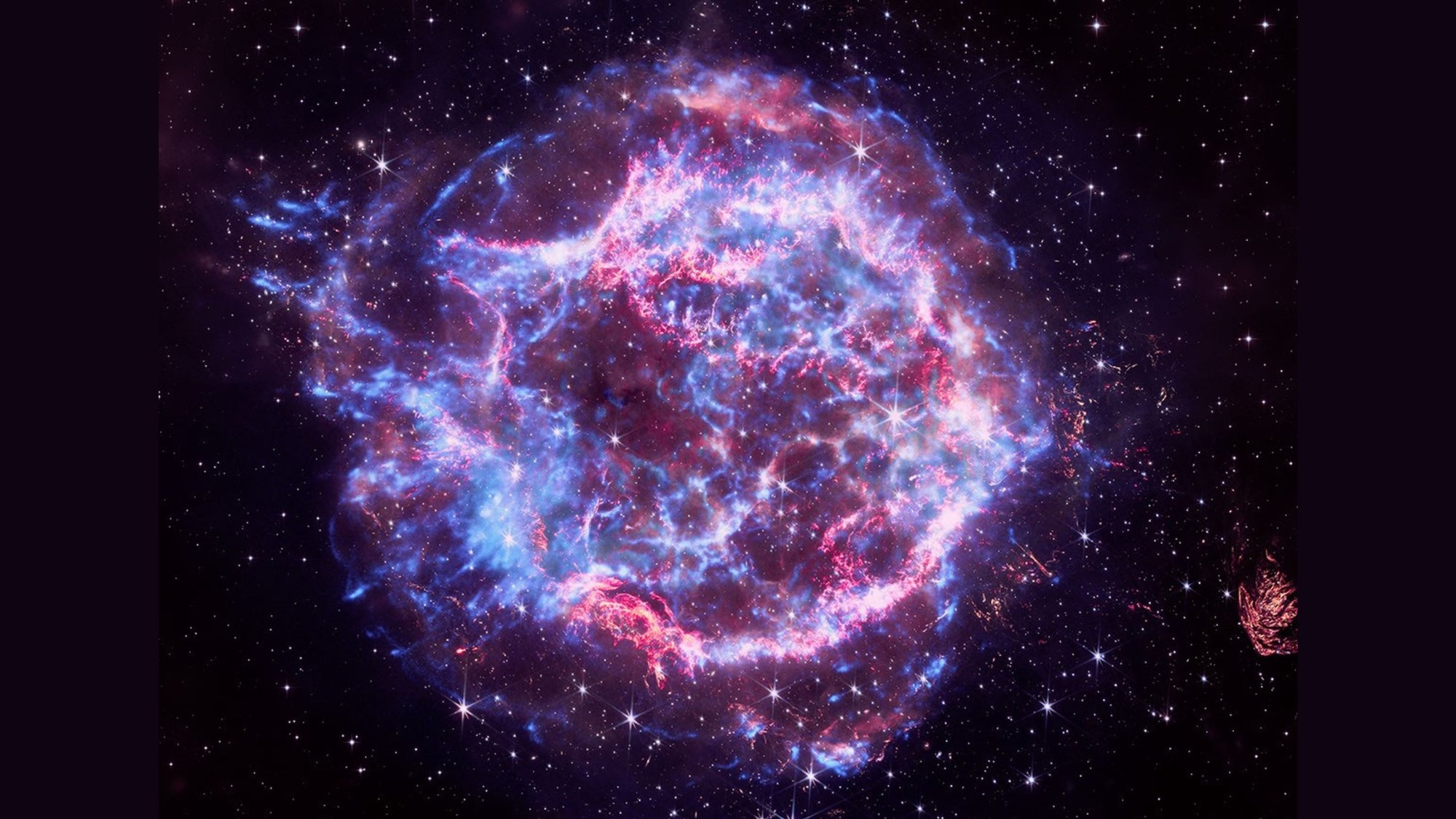
In this rendering, the high-energy X-rays detected by Chandra are assigned hues of blue and purple. These colors represent the expansive blast wave and the superheated remains of the star, which include heavy elements vital for life, such as calcium, iron, and oxygen. The intense temperatures in these regions reach millions of degrees, emitting radiation that is invisible to the human eye but detectable by Chandra’s specialized instrumentation.
Complementing the X-ray data is the infrared perspective provided by the JWST, represented in shades of red and white. These wavelengths capture the "cool" components of the remnant—primarily cosmic dust and gas that have been pushed outward by the explosion. The resulting image resembles an "electrified donut," where marbled veins of stellar debris crisscross the void, illustrating the violent yet creative nature of supernovas, which seed the universe with the building blocks of future planets and stars.
The Massive Star Factory: NGC 3603
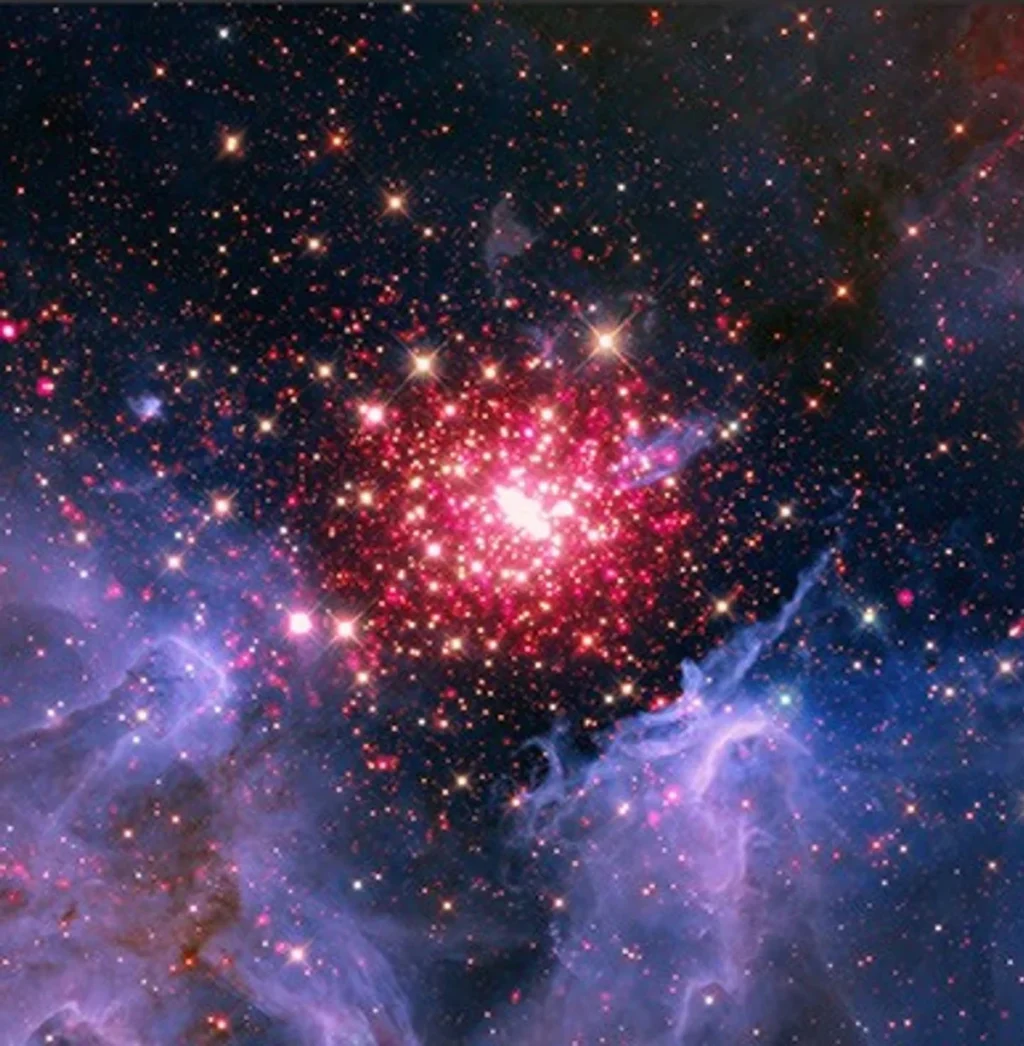
The second highlight of the release is NGC 3603, a giant nebula and star cluster situated roughly 20,000 light-years away in the Carina spiral arm of the Milky Way galaxy. NGC 3603 is often cited by astronomers as one of the most significant "star-forming regions" in our galaxy. It contains a massive, compact cluster of young, hot stars that are among the most luminous and massive known to science.
In the patriotic-themed image, the central cluster of stars appears as a dense, brilliant white and red core, radiating energy that carves out vast cavities in the surrounding gas. The blue clouds visible at the edges of the frame represent cooler gas and dust, visualized through a combination of optical and X-ray data.
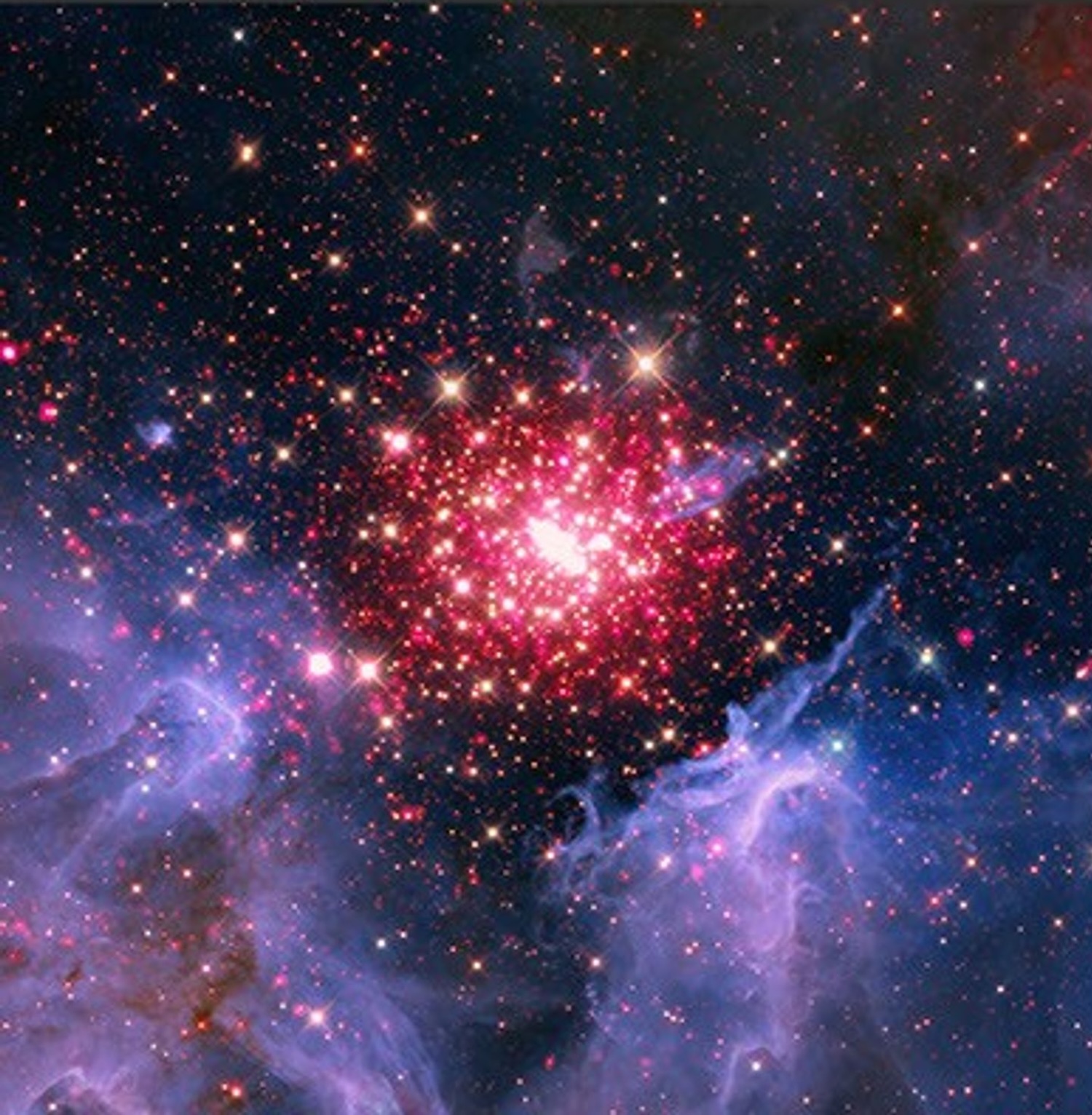
The sonification of NGC 3603 offers a unique auditory experience. Researchers mapped the brightness of individual stars to piano notes. In this translation, the most luminous stars produce higher, more frequent notes, while the softer, nebulous gas creates a sustained atmospheric drone. This allows listeners to "hear" the density of the star cluster, with the cacophony of notes peaking as the "scan" passes through the crowded center of the nebula.
The Architecture of Messier 94
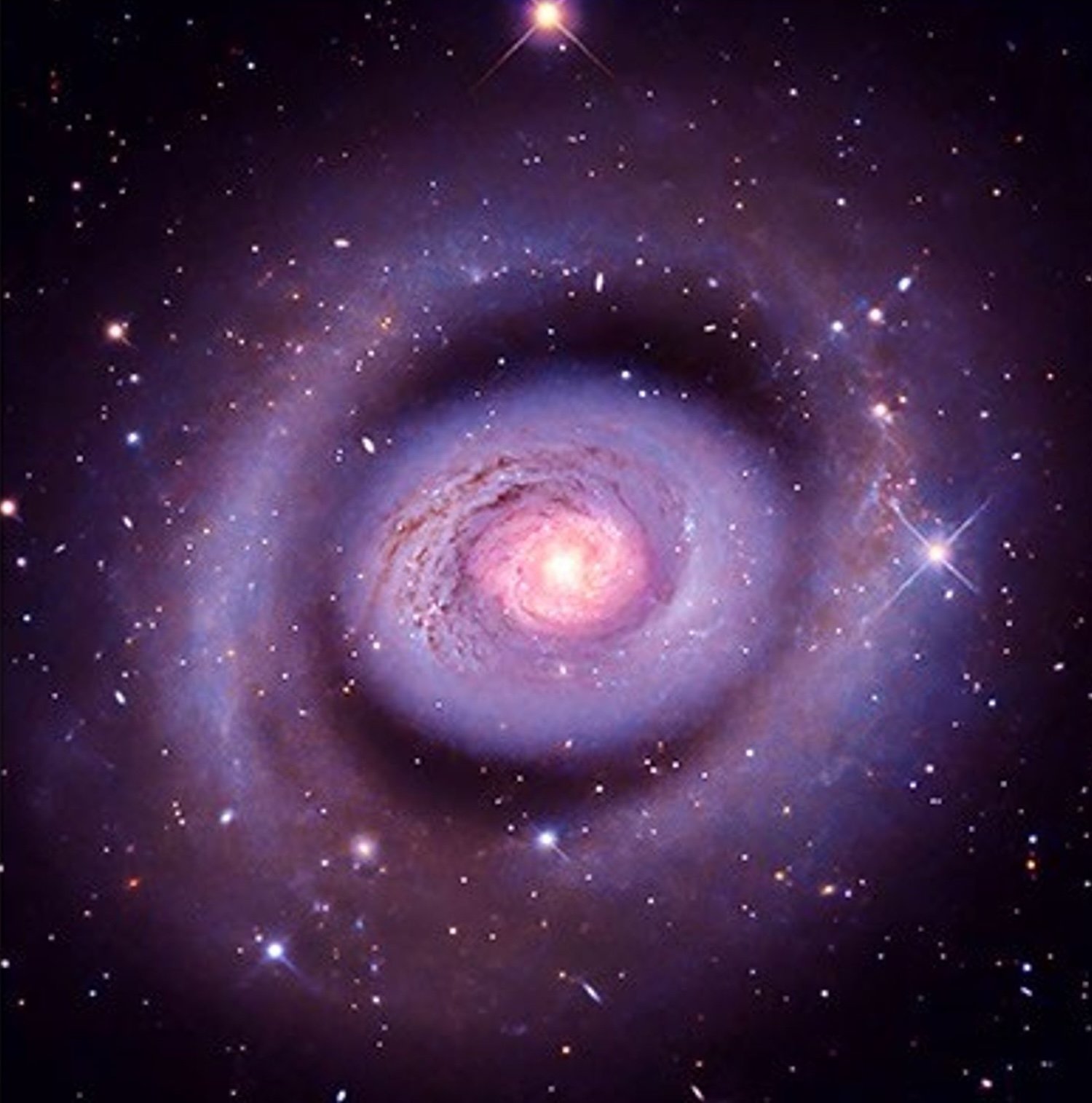
Moving further into deep space, the collection features Messier 94 (also known as NGC 4736), a spiral galaxy located approximately 16 million light-years from Earth in the constellation Canes Venatici. Messier 94 is renowned for its striking "starburst ring"—a brilliant, circular region of intense star formation that surrounds the galaxy’s nucleus.
The red, white, and blue visualization emphasizes the concentric rings of the galaxy. The inner starburst ring glows with a rosy-white intensity, indicating the presence of thousands of young, newborn stars. The outer regions of the galaxy are depicted in pale violet and blue, representing older stellar populations and more diffuse gas.
For the sonification of Messier 94, NASA utilized a glass marimba to represent point sources of light, such as neutron stars and stellar-mass black holes. The pitch of the marimba notes is determined by the vertical position of the objects within the galaxy’s disk, while the volume corresponds to their X-ray brightness. The result is a rhythmic, ethereal soundscape that underscores the organized complexity of galactic structures.
The Science and Technology of Multi-Wavelength Observation
The creation of these images is not merely an artistic exercise; it is a demonstration of the power of multi-wavelength astronomy. Because the universe emits radiation across the entire electromagnetic spectrum, no single telescope can capture the full story of a celestial object.
Chandra, launched in 1999, is designed to detect X-ray emissions from extremely hot regions of the universe. X-rays are produced when matter is heated to millions of degrees or when particles are accelerated to high speeds by intense magnetic fields. This makes Chandra the premier tool for studying black holes, quasars, and the aftermath of supernova explosions.
In contrast, the James Webb Space Telescope, which began its mission in 2022, operates primarily in the infrared spectrum. Infrared light can penetrate thick clouds of cosmic dust that block visible light, allowing astronomers to see into the "nurseries" where stars are born. By overlaying Chandra’s high-energy data with Webb’s infrared data, scientists can construct a comprehensive model of how energy and matter interact in space.
The decision to use a red, white, and blue color scheme for this release serves a dual purpose. While it honors the upcoming 250th anniversary of the United States, it also adheres to the scientific principle of "representative color." In astronomical imaging, colors are often assigned to specific wavelengths to make invisible data perceptible. In this case, the blue typically represents the highest energy (X-rays), white represents mid-range frequencies, and red represents lower-energy infrared or radio data.

Historical Context and Agency Implications
The release of these images comes at a pivotal moment for NASA’s astrophysics division. The Chandra X-ray Observatory, a member of NASA’s original "Great Observatories" program alongside the Hubble Space Telescope, has exceeded its original five-year mission life by more than two decades. However, the observatory has recently faced significant budgetary scrutiny.
Advocates for the "Save Chandra" movement argue that the observatory remains an irreplaceable asset, as there are currently no other X-ray telescopes with its level of angular resolution. This commemorative release serves as a reminder of the observatory’s ongoing contributions to science and its role in the "Golden Age of Astronomy."
The semiquincentennial celebration (U.S. 250th) provides a platform for NASA to showcase the return on investment for taxpayer-funded space exploration. Since its inception in 1958, NASA has been a cornerstone of American innovation, and the agency’s leadership often highlights how space discovery fosters international collaboration and inspires the next generation of scientists and engineers.
Broader Impact and Educational Value
The inclusion of sonifications in this release highlights NASA’s commitment to accessibility. By converting visual data into sound, the agency ensures that individuals who are blind or low-vision can engage with the latest discoveries in astrophysics. Furthermore, sonification provides a new analytical tool for researchers, as the human ear is often better than the eye at detecting subtle patterns or anomalies in complex datasets.

"These sonifications and images are more than just beautiful artifacts," a spokesperson from the Chandra X-ray Center (CXC) noted in a statement related to the release. "They are a bridge between the rigorous data we collect and the public’s imagination. By using a familiar theme like the red, white, and blue of the American flag, we invite everyone to see themselves as part of this grand journey of discovery."
As the United States approaches its 250th anniversary in 2026, NASA plans to continue its "Cosmic Celebration" with further releases and public events. These initiatives aim to contextualize the history of the nation within the much larger history of the universe. The data provided by Chandra and Webb not only answers fundamental questions about where we came from but also sets the stage for future missions, such as the Nancy Grace Roman Space Telescope and the Habitable Worlds Observatory, which will continue the search for life and the study of the dark universe.
In the final analysis, the red, white, and blue universe revealed by NASA is a testament to human curiosity and technological prowess. Whether through the crackling "icing" of Cassiopeia A or the rhythmic marimba of Messier 94, these cosmic portraits offer a moment of reflection on the vastness of the frontier that lies beyond the atmosphere—a frontier that remains a central focus of American and global exploration.