


The pervasive narrative surrounding artificial intelligence (AI) and its potential impact on the global workforce has undergone a significant recalibration. For years, leading figures in the AI industry propagated a vision of widespread job displacement, drawing parallels to the industrial revolutions that rendered human physical labor redundant. However, recent statements from these very same executives suggest a profound shift in perspective, moving away from a "jobs apocalypse" scenario towards a more nuanced understanding of AI as a transformative, rather than purely eliminative, force in the labor market.
The Initial Forecast: A Looming "Jobs Apocalypse"
In the nascent stages of the generative AI boom, the rhetoric from prominent AI company leaders often leaned towards alarmist predictions of widespread unemployment, particularly within the white-collar sector. The comparison to industrial automation was a recurring theme, suggesting that just as machines supplanted manual labor, AI would soon make "brain work" obsolete.
Dario Amodei, CEO of Anthropic, a major player in AI development, repeatedly articulated concerns that AI-powered tools could automate a significant portion—potentially half—of entry-level white-collar positions. His projections underscored a prevailing anxiety that AI was poised to decimate administrative, analytical, and creative roles traditionally thought to be immune to automation. Similarly, Mustafa Suleyman, the CEO of Microsoft AI, delivered an even more audacious forecast in February of the previous year, predicting that AI would achieve "human-level performance on most if not all professional tasks" within a remarkably short timeframe of twelve to eighteen months. Such pronouncements fueled public fear and intensified discussions about the future of work, prompting widespread speculation about universal basic income, retraining initiatives, and the potential for unprecedented societal upheaval. These predictions resonated with historical anxieties surrounding technological advancement, harking back to Luddite movements and the disruptive shifts brought about by steam power, electricity, and early computing.
A Pivotal Shift in Discourse: Retractions and Reassessments
Despite these initial dire warnings, a notable shift in the discourse from these same industry leaders has become increasingly apparent. This pivot marks a critical juncture in understanding AI’s real-world implications, moving from theoretical doomsday scenarios to observations based on actual deployment.
One of the most striking retractions came from Sam Altman, CEO of OpenAI, the company behind ChatGPT. While appearing at a conference in Australia, Altman candidly admitted to being "delighted" to have been wrong about the prospect of an AI-induced "jobs apocalypse." His statement, delivered two weeks prior to a recent analysis, signaled a significant departure from the earlier, more pessimistic outlook. This sentiment was echoed by Dario Amodei, who, despite his previous predictions of extensive job automation, has begun to articulate a revised understanding. Amodei now posits that AI is less likely to replace entire jobs and more likely to replace large parts of existing jobs. This distinction is crucial, suggesting that AI will fundamentally alter job roles and responsibilities rather than simply eliminating them outright. The implication is a transformation of work, where human employees leverage AI tools to augment their capabilities, rather than being supplanted by them. This nuanced perspective introduces the idea of "co-pilots" and "assistants" within professional workflows, where AI handles routine or data-intensive tasks, freeing up human workers for higher-level strategic thinking, creativity, and interpersonal interactions.
Beyond Automation: A New Analogy Emerges
If the analogy of industrial automation, with its implications of wholesale job replacement, is proving inadequate, what alternative framework better describes AI’s actual impact? Emerging observations from businesses actively integrating AI suggest a different paradigm: one where AI functions as a versatile tool for incremental improvement and problem-solving, rather than a monolithic job-killer.
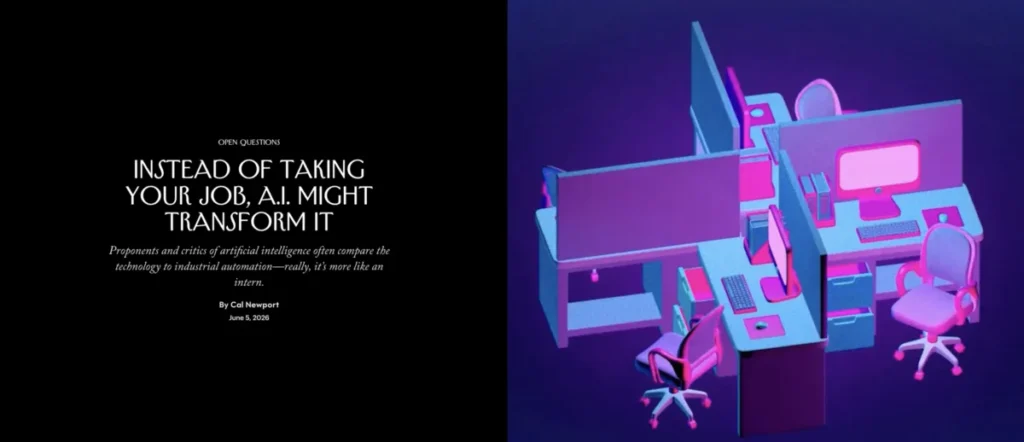
Cal Newport, a prominent author and academic, highlights this evolving understanding in his recent article for The New Yorker, titled "Instead of Taking Your Job, A.I. Might Transform It." Newport draws an insightful parallel from his own high school experience, programming custom web-based applications for a management consulting firm. These "quick-and-dirty" tools, while not polished software, effectively solved specific internal problems, such as managing timesheets or tracking IT inventory. They didn’t replace consultants; they made their operations smoother and more efficient.
Newport’s interviews with small business owners extensively utilizing AI reveal a striking similarity. These entrepreneurs are not deploying AI to replace human workers en masse. Instead, they are using AI to "vibe code" or rapidly create bespoke tools that simplify various operational bottlenecks. This might involve AI-driven tools for generating initial marketing copy, summarizing complex documents, automating customer service FAQs, or optimizing logistical planning. The essence is about hacking together solutions to specific, annoying problems, much like Newport’s teenage coding efforts. These applications are designed to assist, accelerate, and augment existing human efforts, allowing employees to focus on more complex, strategic, or creative tasks. This model suggests a shift towards what could be termed "augmented intelligence," where AI acts as an extension of human capabilities, enhancing productivity and enabling deeper engagement with core professional responsibilities.
The "Freestyle Work" Paradigm and Economic Implications
This emerging pattern of AI deployment points towards a concept that Newport terms "freestyle work." In this model, individuals and teams leverage AI as a dynamic, adaptable assistant to navigate and optimize their professional tasks. It implies a significant degree of agency for the human worker, who directs the AI and integrates its outputs into their workflow, rather than being dictated by it. This is a departure from traditional automation, which often involves rigid, predefined processes. "Freestyle work" emphasizes creativity in problem-solving, where AI provides the raw material, insights, or initial drafts, and the human intellect refines, strategizes, and executes.
From an economic standpoint, this transformation, rather than replacement, has several critical implications. Firstly, it suggests a potential for significant productivity gains. By automating repetitive or information-heavy tasks, AI can free up human workers to engage in higher-value activities, leading to increased output per worker. This aligns with the "Jevons Paradox," a concept mentioned in discussions around AI’s impact, which suggests that increased efficiency in resource use can lead to an overall increase in resource consumption, rather than a decrease. Applied to labor, increased AI efficiency might lead to a demand for more, or different kinds of, human labor to capitalize on new opportunities unlocked by AI.
Secondly, this shift could foster the creation of entirely new job categories and industries. Just as the internet created roles unimaginable decades prior, the ability to rapidly deploy AI-powered "hacks" could enable novel business models and services. Consider the emergence of "AI prompt engineers" or "AI integration specialists" as nascent roles. The World Economic Forum’s "Future of Jobs Report" consistently highlights both job displacement and significant job creation spurred by technological advancements, emphasizing that net employment often remains stable or grows, albeit with a dramatically altered skill landscape.
Thirdly, the economic impact is likely to be unevenly distributed. Businesses and individuals who quickly adopt and effectively integrate AI tools are likely to see substantial competitive advantages and productivity boosts. Conversely, those who lag might face challenges in keeping up. This underscores the importance of equitable access to AI education and tools.
Impact on the Workforce and Skill Development
The transformation of job roles, rather than their wholesale elimination, places a renewed emphasis on skill development and adaptability within the workforce. The "soft skills" often deemed uniquely human—critical thinking, creativity, emotional intelligence, complex problem-solving, and collaboration—are likely to become even more valuable. As AI handles data processing and routine analysis, humans will need to interpret AI outputs, make strategic decisions, and communicate effectively.
The need for "upskilling" and "reskilling" becomes paramount. Educational institutions and employers will face increasing pressure to provide training programs that equip workers with the competencies needed to work alongside AI. This includes not only technical literacy (understanding how AI works and how to use it) but also the ability to define problems for AI, evaluate its outputs critically, and integrate AI-generated insights into broader strategies. Labor organizations, while initially concerned about displacement, are increasingly focusing on advocating for training initiatives and ensuring that the benefits of AI-driven productivity gains are shared equitably across the workforce, potentially through higher wages or improved working conditions.
Furthermore, the shift implies a greater focus on continuous learning throughout a career. The pace of AI development means that skills relevant today may need to be updated or augmented in just a few years. This demands a flexible and proactive approach to professional development from both individuals and organizations.
Policy Implications and Societal Considerations
The evolving understanding of AI’s impact also has significant implications for policymakers and societal planning. Governments will need to consider how to support workers through transitions, whether through revamped unemployment benefits that include training components, incentives for companies to invest in employee upskilling, or investments in digital infrastructure to ensure broad access to AI tools.
Discussions around universal basic income (UBI), while perhaps less urgent in a transformation scenario than a displacement one, may still hold relevance in addressing potential disparities or supporting individuals whose roles are significantly altered. Moreover, ethical considerations surrounding AI, such as algorithmic bias, data privacy, and the responsible deployment of these powerful tools, will require robust regulatory frameworks. Ensuring that AI serves to enhance human well-being and productivity, rather than exacerbate inequalities, will be a critical challenge.
The shift in AI leaders’ rhetoric from dire predictions of a "jobs apocalypse" to a more nuanced view of transformation represents a maturing understanding of this complex technology. While AI is undeniably beginning to profoundly impact the knowledge sector, its effects appear to be less about outright replacement and more about augmenting human capabilities, driving productivity, and redefining the nature of work. The future workforce is likely to be one where humans and AI collaborate, where adaptability and continuous learning are key, and where the human capacity for creativity, critical thinking, and interpersonal connection remains indispensable. The early fear of a hollowed-out workforce is giving way to a more hopeful, albeit challenging, vision of deeper human efforts, supported and enriched by intelligent machines.