



Microsoft has officially announced the general availability of the Study and Learn Agent within Microsoft 365 Copilot, marking a significant strategic pivot in how artificial intelligence is integrated into the global educational landscape. This new tool, now accessible to all education customers at no additional cost, is specifically engineered to transition AI from a passive "answer engine" into an active, pedagogical coach. By focusing on the cognitive processes of the student rather than the mere generation of output, Microsoft aims to address one of the most pressing concerns in modern academia: the potential for AI to facilitate academic dishonesty or bypass critical thinking. The agent is available for students aged 13 and older, provided that institutional IT administrators enable the necessary permissions within the Microsoft 365 environment.
The Paradigm Shift from Answer-Generation to Active Learning
Since the public debut of generative AI in late 2022, educational institutions have grappled with a fundamental tension. While students have rapidly adopted AI tools to assist with homework and exam preparation, many of these platforms were designed for general productivity or creative writing rather than academic rigor. These "black box" tools often prioritize speed and direct answers, which can inadvertently lead to a decline in student comprehension and retention. In response, many school districts and universities initially implemented total bans on AI access, a move that proved difficult to enforce as students continued to use these tools on personal devices.
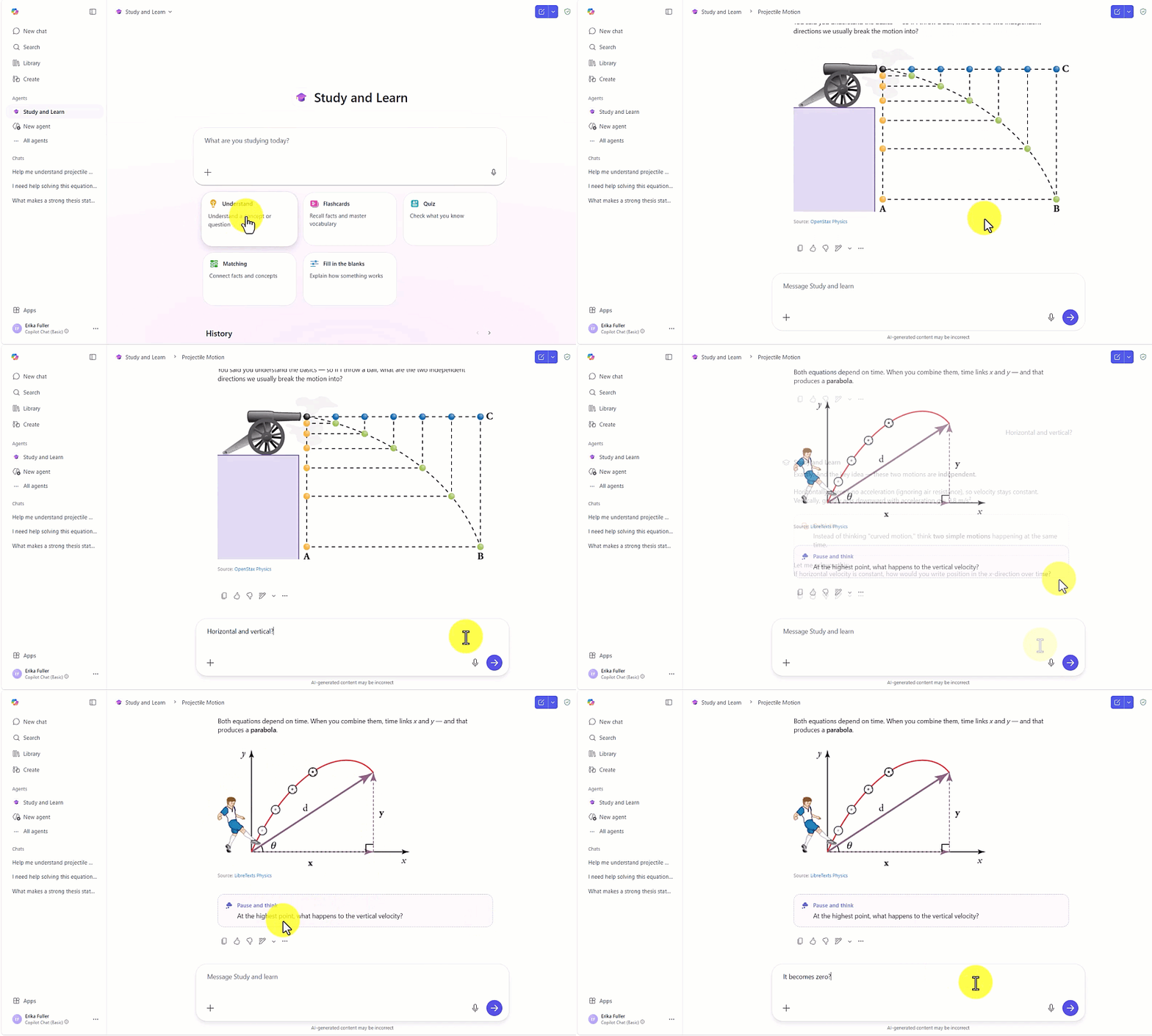
The Study and Learn Agent represents a direct response to this dilemma. Unlike standard chatbots that provide a finished essay or a solved mathematical equation upon request, the Study and Learn Agent is built on the principle that "the learner does the thinking." It is designed to function as a tutor that guides students through the process of discovery. For example, if a student presents a complex physics problem, the agent does not simply provide the final numerical value; instead, it asks the student to identify the relevant formulas or explain the physical laws at play, offering "scaffolding" or hints only when the student becomes stuck. This interactive methodology ensures that the AI serves as a supplement to the educational experience rather than a replacement for it.
A Chronology of Microsoft’s Educational AI Development
The release of the Study and Learn Agent is the culmination of a multi-year development cycle aimed at tailoring large language models (LLMs) for specialized sectors.
- Late 2022 – Early 2023: The initial surge of generative AI led Microsoft to integrate OpenAI’s GPT models into its search and productivity suites. During this phase, the focus was primarily on enterprise productivity and search accuracy.
- Late 2023: Recognizing the unique needs of the classroom, Microsoft began piloting "Copilot for Education." Initial feedback from educators highlighted the need for guardrails that would prevent students from using AI to complete assignments without engaging with the material.
- Early 2024: Microsoft introduced the "Teach Agent" and "Study and Learn" concepts in private preview. These tools were tested in various K-12 and higher education environments to refine their conversational logic.
- May 2024 – Present: The Study and Learn Agent moves to general availability. This rollout includes specific administrative controls for K-12 accounts, where Copilot Chat is turned off by default, requiring intentional activation by IT staff to ensure institutional compliance and safety.
The Science of Learning: Four Research-Based Pillars
The architecture of the Study and Learn Agent is not merely a product of software engineering; it is deeply rooted in established learning science. Microsoft’s development team collaborated with educational psychologists to ensure the AI’s interactions align with proven pedagogical strategies. The experience is grounded in four primary research-based principles:

Scaffolding
Scaffolding involves providing temporary support to students as they develop new skills. The Study and Learn Agent employs this by breaking down complex, multi-step projects into manageable parts. As the student demonstrates mastery over a specific sub-task, the agent gradually reduces its level of intervention, fostering independent problem-solving.
Self-Explanation
Research indicates that students who explain their reasoning aloud or in writing achieve a deeper understanding of the subject matter. The agent prompts students to articulate their logic, asking questions like, "Why did you choose that specific step in this equation?" or "How does this historical event relate to the thesis of your essay?"
Retrieval Practice
Instead of allowing students to passively re-read textbooks, the agent encourages retrieval practice—the act of recalling information from memory. Through the instant generation of flashcards and practice quizzes, the tool forces the brain to work harder to retrieve data, which significantly improves long-term retention.
Spaced Repetition
The agent is designed to help students manage their study schedules over time. By encouraging students to revisit difficult concepts at increasing intervals, the tool leverages the "spacing effect," a psychological phenomenon where information is more easily recalled if study sessions are spread out rather than "crammed" into a single block.
Technical Implementation and Administrative Oversight
For school leaders and IT administrators, the deployment of AI involves significant concerns regarding data privacy, security, and age-appropriateness. Microsoft has addressed these concerns by integrating the Study and Learn Agent directly into the existing Microsoft 365 Education ecosystem. This means that all interactions are governed by enterprise-grade data protection policies.
For K-12 institutions, the "off-by-default" status is a critical feature. IT administrators must use the Microsoft Entra ID (formerly Azure Active Directory) to grant permissions. Once enabled, students do not need to navigate to a separate website or create a new account; the Study and Learn Agent appears as a dedicated tab within the Copilot interface on both web and desktop applications.

Furthermore, Microsoft has emphasized that the data generated during these study sessions is not used to train the underlying public AI models. This "walled garden" approach ensures that student data remains private and that the institution retains control over the digital environment.
Industry Reactions and Broader Implications
The reaction from the educational technology (EdTech) community has been one of cautious optimism. Industry analysts suggest that by providing a "first-party" solution, Microsoft is setting a standard for how AI companies should approach the youth market.
"The challenge for schools has never been the AI itself, but the lack of intent behind the AI’s design," says one educational consultant. "By building a tool where the primary KPI is ‘understanding’ rather than ‘speed,’ Microsoft is helping to bridge the gap between traditional teaching and the future of digital literacy."
However, some educators remain concerned about the "digital divide." While the tool is provided at no additional cost to existing license holders, schools with fewer resources may struggle to provide the hardware or high-speed internet required to run these sophisticated models. Additionally, there is an ongoing debate regarding the age limit of 13, with some child safety advocates calling for even more stringent monitoring for younger teenagers.
The Dual-Agent Ecosystem: Teach and Study
The Study and Learn Agent does not exist in a vacuum. It is part of a broader vision that includes the "Teach Agent," a tool designed specifically for educators. While the Study and Learn Agent focuses on the student experience, the Teach Agent assists instructors in lesson planning, rubric creation, and the generation of diverse learning materials. Together, these two agents create a closed-loop ecosystem where AI supports both the delivery of instruction and the reception of knowledge.
This dual-agent approach acknowledges the reality that teachers are currently overwhelmed by administrative tasks. By automating the creation of practice sets or the initial drafting of lesson plans, the Teach Agent frees up educators to focus on high-value interactions with their students. Simultaneously, the Study and Learn Agent ensures that when students are working independently, they have access to a high-quality, safe, and pedagogically sound resource.
Future Outlook and Global Expansion
As of its launch, the Study and Learn Agent is optimized for English (United States). However, Microsoft has confirmed that it will expand language support in the coming weeks to accommodate a global user base. This expansion is critical for international schools and non-English speaking regions where the demand for personalized AI tutoring is rapidly increasing.
The implications of this technology extend beyond the classroom. As students become accustomed to using AI as a collaborative partner rather than a shortcut, they develop the "prompt engineering" and critical thinking skills that will be essential in the 21st-century workforce. Microsoft’s move signals a future where AI is not just a tool for writing emails or generating images, but a fundamental pillar of human cognitive development.
Institutions looking to implement the Study and Learn Agent are encouraged to review Microsoft’s updated configuration guides and "Responsible AI" documentation. As the 2024-2025 academic year approaches, the success of this tool will likely be measured by its ability to improve test scores and, more importantly, by its ability to restore trust between students, teachers, and the technology that sits between them.