



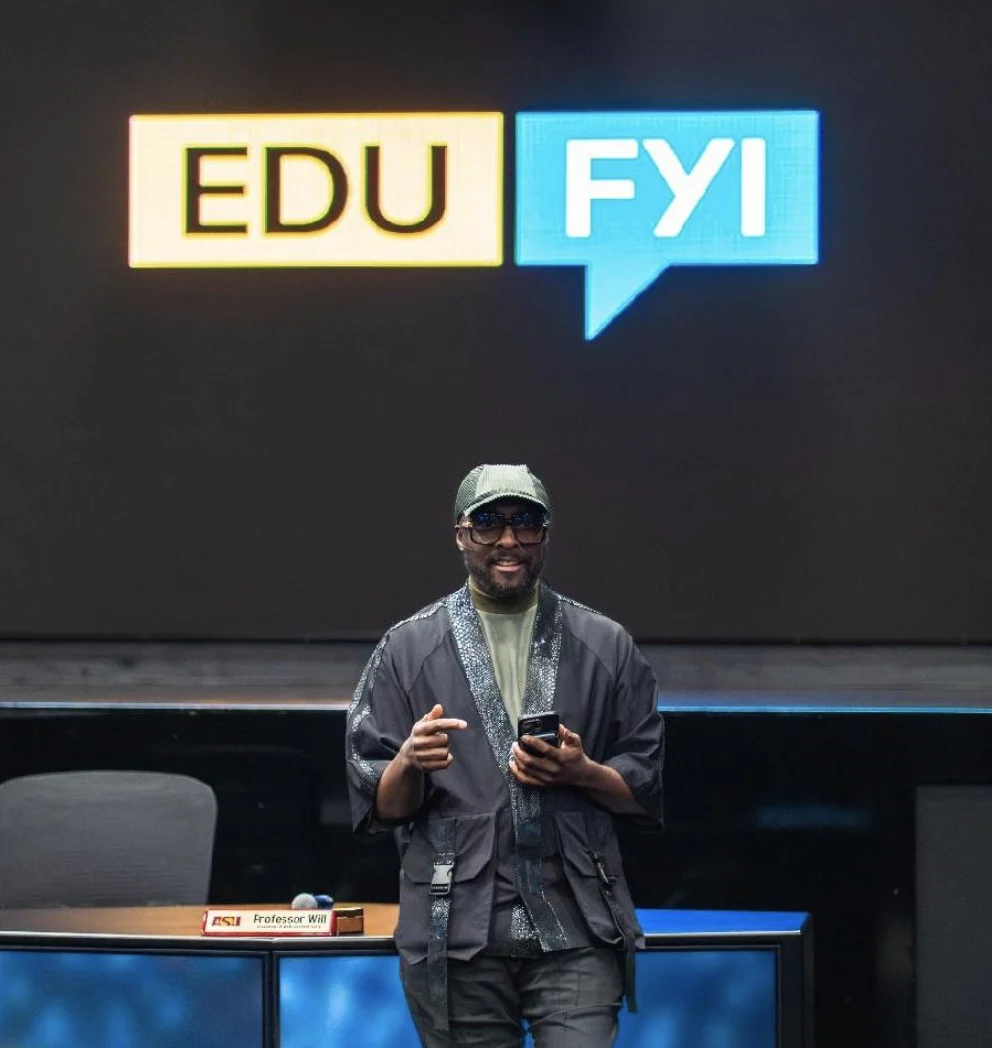
Arizona State University’s innovative "The Agentic Self" course, a collaborative vision between music icon will.i.am and ASU, has emerged as a pivotal incubator for the next generation of AI-powered innovation. Launched in 2025, the program has already begun to redefine how individuals and organizations approach the integration of artificial intelligence, emphasizing human agency, ethical development, and the transformative power of collaborative learning environments. The program’s unique approach, exemplified by its dedicated learning space at the FYI campus in Hollywood, is prompting a critical re-evaluation of workforce readiness and organizational design in the age of advanced AI.
A Vision for Human-Centered AI Development
The genesis of "The Agentic Self" course lies in a shared aspiration by will.i.am and ASU leadership to cultivate a new paradigm for AI development – one that is fundamentally human-led. will.i.am, a vocal advocate for technological advancement and its potential to uplift society, envisioned a space where creativity and critical thinking could flourish within the burgeoning AI landscape. This vision materialized at the FYI campus, a dynamic hub described as a "magical hip-hop version of Willy Wonka’s factory," but instead of confections, it produces music, products, and, most importantly, empowered individuals capable of shaping the future with AI.
The core philosophy of the course, as articulated by will.i.am, centers on the concept of the "agentic self." He defines this as "you claiming your data and now putting it to work for you by creating an agent that reflects your beliefs, your concerns, your passions, your interests." This principle underscores a move away from passive consumption of AI to active, data-driven self-creation and empowerment. This philosophy is central to the curriculum, aiming to equip students with the skills and mindset to leverage AI as a tool for personal and societal advancement, rather than being supplanted by it.
The "Room Where It Happens": A Catalyst for Collaboration and Insight
A crucial element of the "The Agentic Self" experience is a specially designed learning environment within the FYI campus. This space, meticulously planned in collaboration with ASU leadership and professors, adopts a U-shaped configuration reminiscent of the United Nations. Each participant is provided with their own chair and microphone, facilitating seamless communication, particularly when virtual participants are integrated into discussions. This intentional design fosters an environment of equal participation and open dialogue, essential for navigating complex AI concepts and ethical considerations.
The immersive nature of this physical space, coupled with the intellectual rigor of the course, has a profound impact on participants. As one student from the inaugural cohort noted, "Being in that room changed how I think about agency, curiosity and what it means to stay human-led in a world of AI agents." This sentiment highlights the course’s success in cultivating not just technical proficiency, but a deeper understanding of human values and their indispensable role in AI development. The experience also ignited a crucial question for many: "What if organizations created the conditions for their people to have that same experience?"
The Power of Exploration: From Spark to AI-Guided Mastery
The journey of an idea within "The Agentic Self" course is characterized by iterative exploration across diverse AI platforms. This process, as exemplified by a learning innovation professional’s experience, underscores the principle that "you rarely know what a spark can do until you move it through different environments." The initial spark for this individual was the realization, two years prior, that AI tools like large language models could transcend mere efficiency gains and revolutionize how individuals learn, practice, and prepare for complex conversations.
This insight led to the development of a "conversational skill builder" – a tool designed to allow users to practice real-world scenarios, receive immediate, personalized feedback, and engage in guided reflection for lasting behavioral change. The initial exploration of this concept took place on ChatGPT, a foundational step to validate the core functionality and usefulness of the idea. This initial foray was not about achieving a complete solution, but about initiating the transition from abstract concept to tangible action.
The evolution of this idea across various AI platforms illustrates a critical learning trajectory:
- ChatGPT: Served as an initial sandbox for testing the core concept of the conversational skill builder. This stage focused on validating the interaction and its immediate utility for individual learning.
- Copilot Studio (at Providence St. Joseph Health): Here, the focus shifted to enterprise-scale deployment. As a manager of learning innovation for a large healthcare system, the challenge was to author and implement the idea within the complex constraints of organizational governance, strategic alignment, and operational realities. This phase highlighted the friction points inherent in scaling innovative solutions within established structures.
- Acolyte: Engaging with a small AI startup as a strategic innovation consultant, the idea was explored on a platform designed for easy authoring of multimodal experiences. The integration of avatars promised a richer, more immersive learning environment, demonstrating the potential for enhanced engagement and a broader scope of application.
- FYI: The most transformative evolution occurred on the FYI platform. Here, the idea transcended its initial form as a mere skill builder and evolved into a "personalized, guided, action-based learning experience." This phase crystallized a core principle: AI’s true potential for learning and performance support lies in a "middle ground" – a space that is neither the overwhelming openness of a blank AI prompt nor the rigid confinement of static traditional learning materials. It is an adaptive, scaffolded support system that guides without constraining, offering structure and freedom in equal measure.
This journey culminated in the concept of "AI-guided mastery," a significant leap from the initial vision of a simple skill builder. The repeated observation that the "same core spark blooms differently depending on the environment it enters" became a guiding tenet. Each platform offered unique insights: ChatGPT provided the initial validation, Copilot Studio revealed the challenges of enterprise authoring, Acolyte showcased the power of multimodal creation, and FYI demonstrated the potential for expansive, collaborative learning. The FYI platform, in particular, facilitated a shift from a standalone learning tool to a more comprehensive experience where individuals engage through personalized AI personas, fostering deeper discussions and guided exploration leading to tangible action. This confirms the fundamental truth that continuous exploration reveals not only an idea’s capabilities but its ultimate purpose.

Implications for Leadership and Organizational Readiness
The insights gleaned from "The Agentic Self" course have profound implications for organizational leaders, founders, and executives. The concept of "best fit" is paramount: an idea’s success is significantly influenced by the environment it encounters. A strong idea, when aligned with the right platform, culture, and workflow, becomes easier to adopt, utilize, and integrate into daily operations. Conversely, a mismatch can lead to even promising concepts stalling. This underscores the strategic importance of carefully considering the context in which innovation is introduced and nurtured.
Furthermore, the human element surrounding innovation is as critical as the technology itself. The FYI experience, for instance, is valued not solely for its technological advancements but for the community it fosters – a space where individual interests, perspectives, and ethical considerations are central to the collective endeavor. This emphasis on human-first AI work, guided by a strong moral and ethical compass, is vital in a rapidly evolving AI landscape. Organizations that fail to cultivate such environments risk falling behind competitors who discover similar ideas in more conducive settings.
The Workforce Readiness Gap
While many organizations have moved beyond initial AI adoption hurdles – licensing tools, establishing governance, and announcing AI initiatives – a persistent gap remains. A small segment of early adopters races ahead, while a larger portion of the workforce exhibits caution, uncertainty about AI’s relevance to their roles, and concerns about responsible usage. The challenge has shifted from mere access to AI to genuine workforce readiness, a problem that is fundamentally human rather than technical.
"The Agentic Self" course clarifies that readiness stems not solely from access but from environments that actively encourage exploration. This means providing individuals with the permission to test ideas, transfer them across contexts, and build through curiosity rather than mandated compliance. To cultivate a truly AI-ready workforce, organizations must design learning cultures that nurture the "agentic self," fostering skilled users who are also empowered creators. This requires creating psychological safety and structural support for exploration, allowing for failure, and enabling individuals to discover what best fits their needs and contributions.
Brad Bigelow, founder of Acolyte AI, corroborates this perspective, noting that organizations often invest heavily in AI access while underinvesting in the support structures necessary for confident and purposeful application. He emphasizes that the gap is rarely technical but cultural or architectural. Leaders who bridge this divide do so by deliberately designing environments that support exploration, guide application, and provide room for sustained capability building. The distinction between being "equipped" and being "ready" will ultimately define which organizations lead and which follow in the AI era.
This principle is already being applied in practice. An initiative that began as a concept within "The Agentic Self" course has successfully navigated the governance process at Providence St. Joseph Health and is now being deployed organization-wide. This transition from concept to enterprise reality exemplifies the power of combining innovative ideas with supportive organizational structures.
A Personal Transformation and a Call to Action
The impact of "The Agentic Self" course extends beyond professional development; it fosters a profound personal transformation. Participants report a shift in their approach to innovation, characterized by more focused intention, continuous exploration of new tools and environments, and a commitment to helping others learn and prepare. The emphasis is on collaborating with individuals who prioritize ethical considerations and believe in AI’s capacity to augment, rather than replace, human agency.
The adage "the company you keep matters" resonates deeply with this experience. The choice of environments, the communities joined, and the people engaged with all profoundly influence the trajectory of one’s work. Being part of this specific learning community has provided a clearer vision for future endeavors, prioritizing work that aligns with human-centric AI principles.
The course offers an invitation to all: "What spark have you been carrying, and what environment might help it become something more?" In a world characterized by rapid change, the willingness to explore is not an optional luxury but a fundamental requirement for staying human-led. It is the engine that drives learning and propels progress across all domains. The course has demonstrated that the right environment can amplify individual sparks into transformative movements, fundamentally altering personal possibilities and professional behaviors. This journey underscores that in the accelerating landscape of AI, continuous learning, courageous curiosity, and human-led innovation are not just advantageous, but essential for sustained success and meaningful impact.