



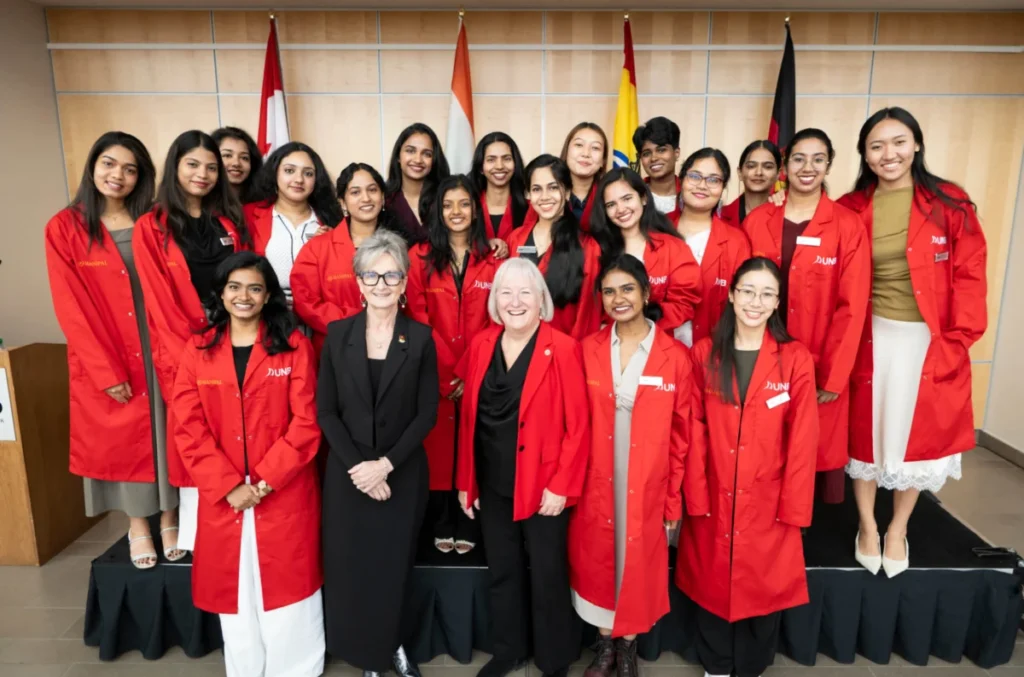
Canada’s persistent and growing shortage of registered nurses (RNs) is a critical issue impacting healthcare delivery across the nation. While the country annually welcomes thousands of foreign-educated nurses (IENs) eager to contribute their skills, the complex and often lengthy provincial regulatory processes present significant hurdles. These challenges can delay or even deter qualified IENs from entering the Canadian workforce, a situation that Dr. Lorna Butler, Dean of Nursing at the University of New Brunswick (UNB), finds deeply problematic. In response to this complex scenario, UNB, in collaboration with the Manipal Academy of Higher Education (MAHE) in India, launched an innovative dual nursing program in 2022. This pioneering initiative aims to streamline the path for IENs, ensuring they are equipped with Canadian nursing standards from the outset and can transition more seamlessly into the Canadian healthcare system.
The Challenge of Integrating Internationally Educated Nurses
Canada’s healthcare system relies heavily on the expertise of registered nurses, with over 300,000 RNs currently practicing. A significant and growing proportion of these professionals are IENs. Data indicates that approximately 15% of Canada’s working RNs are internationally educated, a number that has steadily increased. In Ontario, for example, the Ontario College of Nurses reported that more than half of the new RN licenses issued in recent periods were granted to IENs. This statistic underscores the vital role IENs play in bolstering the nursing workforce.
However, the journey for these internationally trained professionals is far from simple. To qualify for licensure in Canada, IENs typically face a protracted process that can span years and involve substantial financial investment. This often includes upgrading language proficiency and clinical skills to meet the rigorous demands of provincial licensing examinations. The financial burden can be considerable, often running into thousands of dollars, and the time commitment required can be equally daunting.
The consequences of these systemic barriers are significant. Many IENs, after investing considerable time and resources, are forced to abandon their aspirations of practicing as registered nurses in Canada. Instead, they often seek employment in more accessible, though lower-paying, roles such as personal care workers or cleaning staff. This "de-skilling" of highly trained professionals is a major concern for nursing leaders like Dr. Butler. "The ‘de-skilling’ of their registered nursing licensure is problematic for me," she stated. "And at the same time, there is a concern raised by the International Council of Nurses that wealthy countries are stripping Third World countries of their senior nurses, leaving their organizations potentially devastated."
Ethical Concerns and Economic Implications
The recruitment of IENs by wealthy nations like Canada also raises ethical questions and has significant economic implications for developing countries. A 2025 report by the International Council of Nurses (ICN) highlighted that Canada annually avoids an estimated $1 billion in training costs by recruiting nurses from low- and middle-income countries, including the Philippines, India, and Nigeria. This practice, sometimes referred to as "brain drain," can have a detrimental impact on the healthcare infrastructure of these nations, potentially exacerbating their own shortages of skilled medical professionals. The ICN report labelled this phenomenon the "Great Global Nursing Ripoff," emphasizing the significant financial savings accrued by developed countries at the expense of developing ones.
This context underscores the need for more ethical and sustainable recruitment strategies that benefit both the host country and the countries of origin. The UNB-MAHE dual program emerges as a potential model for addressing these multifaceted challenges.
The Genesis of the Dual Nursing Program
Dr. Lorna Butler and her team at the University of New Brunswick’s Faculty of Nursing and Health Sciences recognized the inherent inefficiencies and ethical dilemmas in the traditional pathway for IENs. Driven by a desire to create a more direct, ethical, and efficient route into the Canadian nursing profession, they conceptualized and launched the dual nursing program in 2022. The core innovation of this program is its integration of Canadian nursing standards directly into a four-year Bachelor of Science in Nursing (BScN) program offered at MAHE, a leading university in India.
The rationale behind this approach is to equip students with the necessary knowledge and skills aligned with Canadian nursing practices from the very beginning of their academic careers. This proactive integration aims to circumvent the need for extensive post-graduation retraining and credential evaluation that often plagues IENs. By embedding Canadian standards into the curriculum, the program seeks to ensure that graduates are not only academically prepared but also culturally and professionally attuned to the Canadian healthcare environment.
Program Structure and Development
The development of the UNB-MAHE dual nursing program was a meticulous and collaborative undertaking. The UNB team conducted a thorough line-by-line analysis of MAHE’s existing nursing curriculum to identify any gaps or areas requiring adaptation to meet Canadian educational and professional standards. Based on this comprehensive review, specific modules were developed to address these discrepancies. These modules focused on key areas such as social justice principles in healthcare, advanced clinical decision-making processes, and Canadian healthcare system nuances.
Beyond curriculum development, the program incorporated immersive experiences for students. Two small cohorts of MAHE students were brought to Fredericton for summer institutes. These visits provided invaluable opportunities for students to experience UNB’s nursing program firsthand, interact with faculty, and gain exposure to local medical facilities and the Canadian healthcare setting. These early introductions were crucial for assessing student adaptability and fostering a connection to the Canadian professional environment.
Multi-Stakeholder Engagement and Collaboration
A critical success factor for the dual program has been the extensive engagement and collaboration with a wide array of stakeholders. From its inception, Dr. Butler and her team actively involved multiple levels of government, including Immigration, Refugees and Citizenship Canada. They also worked closely with provincial nursing regulators, ensuring alignment with licensing requirements. Furthermore, crucial partnerships were established with Fredericton’s hospital network, specifically Horizon Health Network, and local nursing homes, such as Shannex, which would serve as internship sites and potential employers for the graduates.
This multi-faceted approach ensured that all entities with influence or the capacity to support the smooth transition of students to Canada were engaged. "We’ve made sure that anyone that would have influence or could support the movement of the students to and from Canada are engaged," Dr. Butler emphasized. "Because if there’s not a seamless transition when nurses finish this degree and get to Canada, then that’s a [reputational] issue for Canada."
To foster deeper understanding and build trust among these partners, Canadian stakeholders, including New Brunswick nursing regulators, UNB’s registrar, and executives from Horizon Health Network and Shannex, accompanied Dr. Butler on visits to the MAHE campus in India. These visits were instrumental in allowing Canadian representatives to witness the quality of education and the dedication of the students and faculty at MAHE. "I felt that if they didn’t see for themselves what Manipal had to offer it would be very difficult for us to explain or represent them properly," Dr. Butler explained. "We didn’t want any assumptions or any preconceived ideas from television or social media. We wanted them to go and experience it themselves. And I really think that made a difference."
Ensuring Domestic Capacity and Ethical Recruitment
A key consideration for MAHE was to ensure that the dual program did not compromise its commitment to educating domestic Indian students. Permission was obtained from India’s nursing council to allocate additional seats to accommodate the Canadian program without reducing the number of seats available for local Indian students. "Manipal still has its 100 seats a year… so they (will) graduate the same number that they always did," Dr. Butler clarified, reassuring that the program adheres to ethical recruitment principles by not depleting local resources.
A Direct Pathway to Canadian Licensure and Immigration
The dual program is designed to offer a significantly more direct route to Canadian nursing licensure and, consequently, immigration. The curriculum delivery involves UNB faculty teaching classes virtually alongside Manipal professors during the first and third years. Additionally, a month of in-person teaching by UNB faculty takes place at MAHE at the end of the third year.
A pivotal component of the program is the six-week preceptorship offered in Fredericton during the spring of the fourth year. Students have the option to complete this hands-on clinical experience with Horizon Health Network and local Shannex nursing homes. This year, nineteen students undertook this preceptorship, many of whom were traveling outside of India for the first time.
For Dr. Butler, these preceptorships are more than just clinical training. They serve as a critical assessment of the students’ integration into Canadian society. "Being here for the preceptorship is not just about nursing," she stated. "It’s also whether or not they feel that this is a community where they will be welcomed, whether it is safe to bring their families, whether they are valued."
The expectation is that the majority of the dual program graduates will choose to immigrate to Canada to pursue their nursing careers. To facilitate this transition, UNB will offer licensure preparation classes and dedicated immigration assistance to graduates planning to work in New Brunswick, starting this fall.
Positive Reception and Student Dedication
The MAHE students involved in the program have expressed enthusiasm and optimism about the opportunities it presents. Della Raju, a student at MAHE, shared with CBC News, "If I get a job opportunity here, I’ll be coming back." This sentiment highlights the program’s success in creating a clear and appealing pathway to employment and settlement in Canada.
The dedication and work ethic of the students have also been noted and praised by UNB faculty members. During the preceptorships, Canadian faculty observed the students’ intense focus and eagerness to learn. "We found that the students were so intense and they just wanted to learn everything," Dr. Butler remarked. "We were exhausted by the end of the day." This level of commitment underscores the students’ strong motivation to succeed in the Canadian healthcare system.
Scalability and Future Potential
While currently a relatively small initiative by national standards, the UNB-MAHE dual nursing program possesses significant potential for expansion and replication. Dr. Butler believes the model is highly transferable and could be adopted by other educational institutions and healthcare organizations seeking to address nursing shortages ethically and effectively. "This model would be transferable to any other organization or nursing program that wanted to do this," she concluded.
The program represents a forward-thinking approach to a complex national challenge, demonstrating how strategic international partnerships, coupled with a commitment to ethical recruitment and seamless integration, can offer tangible solutions to Canada’s critical nursing shortage. Its success could pave the way for similar initiatives, ultimately strengthening Canada’s healthcare system while offering a dignified and accelerated pathway for skilled international professionals. The ongoing evaluation of its impact on both the Canadian healthcare system and the participating students will be crucial in shaping its future development and wider adoption.