


Academic research, the bedrock of knowledge advancement, is facing an unprecedented challenge, with a recent report from an AI Task Force convened by the prestigious journal Organization Science revealing a disturbing trend: a significant increase in submission volume coupled with a marked decrease in readability and overall quality since the widespread availability of generative artificial intelligence tools. This phenomenon is taxing the volunteer-driven peer-review system and raising profound questions about the future of scholarly communication.
The task force’s findings, initially highlighted in a report titled "More Versus Better," underscore a critical inflection point in academic publishing. Editors and reviewers across the board have noted a shift in the nature of incoming manuscripts. While superficially appearing complete, these papers often possess a "weightless" quality, making it difficult for seasoned academics to parse their meaning. This subtle yet pervasive change has prompted a deep dive into the underlying causes, pointing squarely to the rapid adoption of AI writing assistants.
The AI Inflection Point: A Timeline of Change
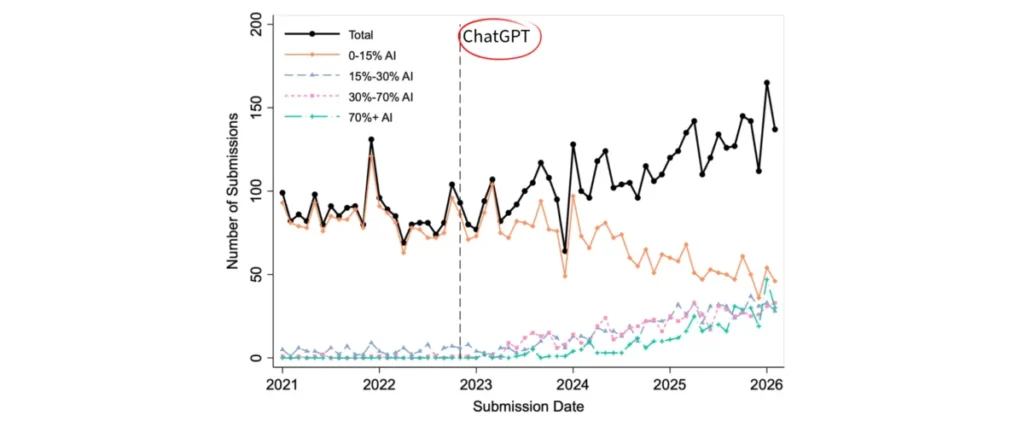
The chronology of this shift is stark. Prior to late 2022, when OpenAI’s ChatGPT became publicly accessible, the academic publishing landscape, while competitive, maintained a relatively stable baseline for submission quality and readability. However, starting in 2023, immediately following ChatGPT’s release, Organization Science observed a rapid and sustained increase in the volume of manuscript submissions. This surge was not merely an incremental rise but a distinct spike that correlated precisely with the widespread availability of sophisticated AI writing tools.
Simultaneously, the task force diligently tracked the estimated proportion of submissions utilizing minimal AI assistance. Before 2023, nearly 100% of submissions were classified as having minimal to no AI involvement. By early 2024, this figure had plummeted to approximately 30%. This dramatic reversal suggests a rapid and widespread integration of AI tools into the manuscript drafting process by a significant portion of the research community. While specific data points for other journals are still emerging, preliminary discussions within the broader academic publishing community suggest that Organization Science‘s experience is not isolated, hinting at a systemic change across various disciplines.
Deterioration in Readability: A Quantifiable Decline
Perhaps the most alarming finding is the quantifiable deterioration in manuscript readability. The task force employed a standard "reading ease" metric—a widely accepted measure often based on factors like sentence length, word complexity, and syllable count—to assess submissions. Their analysis revealed a significant decline in scores, falling by 1.28 standard deviations between January 2021 and January 2026 (a projection based on observed trends). This substantial drop indicates that scholarly articles are becoming demonstrably harder for human readers to comprehend and absorb.
This finding challenges a common misconception that AI-generated text is inherently "cleaner" or "more polished." While AI can indeed produce grammatically correct and syntactically sound prose, the task force’s report clarifies that this often comes at the expense of genuine clarity and meaning. The report elaborates that AI writing tends to feature "longer words, more complex sentence structures, more jargon, and more nominalizations." Nominalizations, the process of turning verbs or adjectives into nouns (e.g., "to analyze" becoming "analysis"), often lead to denser, less direct, and more abstract language, making it more challenging for readers to grasp the core arguments and insights. This "weightlessness" described by editors appears to be a direct consequence of AI’s tendency to prioritize formal academic style over substantive communication.
The Efficiency Paradox: More Output, Less Value
The crucial question then becomes: if papers are becoming more difficult to read, is this compensated by an increase in the quality or novelty of the scientific content? The evidence from Organization Science strongly suggests otherwise. The journal’s desk-rejection rates, a critical early filter in the peer-review process where papers are rejected without being sent to external reviewers, have revealed a stark disparity. Manuscripts identified as making heavy use of AI face a desk-rejection rate of nearly 70%, significantly higher than the 44% rate for papers written with minimal to no AI assistance.
This trend continues through the later stages of the editorial process. The ultimate acceptance rate for high-AI papers stands at a mere 3.2%, in stark contrast to the 12% acceptance rate for low-AI papers. It is paramount to note that these classifications of AI usage were determined retrospectively by the task force. The editors and reviewers making the initial desk-reject decisions and subsequent peer-review recommendations were unaware of the extent of AI involvement during their evaluations, ensuring that their judgments were based solely on the perceived quality and merit of the submission itself. This blind assessment strengthens the conclusion that AI-generated content, despite its superficial polish, often lacks the depth, nuance, and original contribution expected in top-tier academic research.
The Staggering Burden on the Peer-Review System
The implications of these findings for the academic ecosystem are profound and immediate. The current model of scholarly publishing relies heavily on the voluntary labor of researchers who serve as editors and peer reviewers. This system is already under immense pressure due to ever-increasing publication demands and a scarcity of qualified reviewers. The influx of a higher volume of submissions, particularly those of demonstrably lower quality and reduced readability, places an unsustainable burden on this volunteer workforce.
"The time and patience of our community are being severely tested," remarked a member of the Organization Science editorial board, speaking anonymously due to ongoing internal discussions. "Reviewers are dedicating more time to deciphering poorly articulated arguments, only to find the underlying research often lacks rigor or originality. This is not only inefficient but also risks reviewer burnout, threatening the integrity and sustainability of the entire peer-review process." This sentiment is echoed across various academic fields, with numerous discussions emerging in scholarly forums and professional organizations about the need for new strategies to manage this surge.
Beyond the Surface: Why AI-Generated Text Fails in Academia
The task force’s analysis provides crucial insights into why AI-generated text, despite its sophistication, often falls short in academic contexts. While AI can synthesize information and generate text that mimics academic style, it struggles with the core elements of original scholarly contribution: critical thinking, conceptual novelty, nuanced argumentation, and the precise articulation of complex ideas.
- Lack of Deep Understanding: Generative AI models predict the next most probable word or phrase based on vast datasets, but they do not "understand" the underlying concepts in the human sense. This can lead to text that is grammatically correct but semantically shallow, devoid of genuine insight, or prone to subtle inaccuracies.
- Over-reliance on Jargon and Formalisms: AI often prioritizes replicating the stylistic conventions of academic writing, leading to an overuse of jargon, convoluted sentence structures, and nominalizations. While these features are sometimes present in human academic writing, AI tends to employ them without the strategic intent or clarity that a human author would bring, thereby obscuring meaning rather than enhancing it.
- Difficulty with Original Argumentation: Scholarly articles are built upon original arguments, novel methodologies, and innovative interpretations of data. AI can summarize existing knowledge but struggles to construct truly original arguments or develop groundbreaking theories, often resulting in generic or derivative content.
- Ethical Concerns and Accountability: The use of AI in drafting raises significant ethical questions regarding authorship, intellectual honesty, and accountability. While AI can be a tool, the responsibility for the content, accuracy, and originality of a submission ultimately rests with the human authors.
Broader Implications and the Future of Academic Research
This "cautionary tale," as described by commentators like Cal Newport, extends far beyond Organization Science. It highlights a broader paradox in the pursuit of productivity: making a process "faster" or "easier" does not automatically equate to making it "better." While AI tools may offer individual researchers a shortcut in the arduous process of writing, the collective outcome, in this instance, appears to be a degradation of the scholarly output and an increased strain on the gatekeepers of academic quality.
The academic community is now grappling with how to adapt. This includes:
- Developing New Guidelines: Journals and academic institutions are exploring new policies for the ethical and transparent use of AI in research and writing, potentially requiring declarations of AI assistance.
- Enhancing Reviewer Training: Providing reviewers with tools and training to identify potential AI-generated content, or to more effectively assess the substance of such submissions.
- Re-evaluating Publication Metrics: A potential shift away from purely quantitative publication targets towards a greater emphasis on qualitative impact and originality to disincentivize the production of high-volume, low-quality work.
- Fostering Critical Thinking and Writing Skills: A renewed focus on foundational academic writing and critical thinking skills for students and early-career researchers, emphasizing that genuine intellectual contribution cannot be outsourced to algorithms.
The experience of Organization Science serves as a critical warning. The promise of generative AI in accelerating scientific discovery is immense, but its indiscriminate application in the core process of scholarly communication risks undermining the very foundations of rigorous, transparent, and meaningful academic exchange. As the academic world navigates this new technological frontier, the imperative to prioritize quality, clarity, and genuine intellectual contribution over mere speed and volume has never been more urgent. There are, indeed, some endeavors where shortcuts simply do not yield superior results, and academic writing, it seems, is prominently among them.