



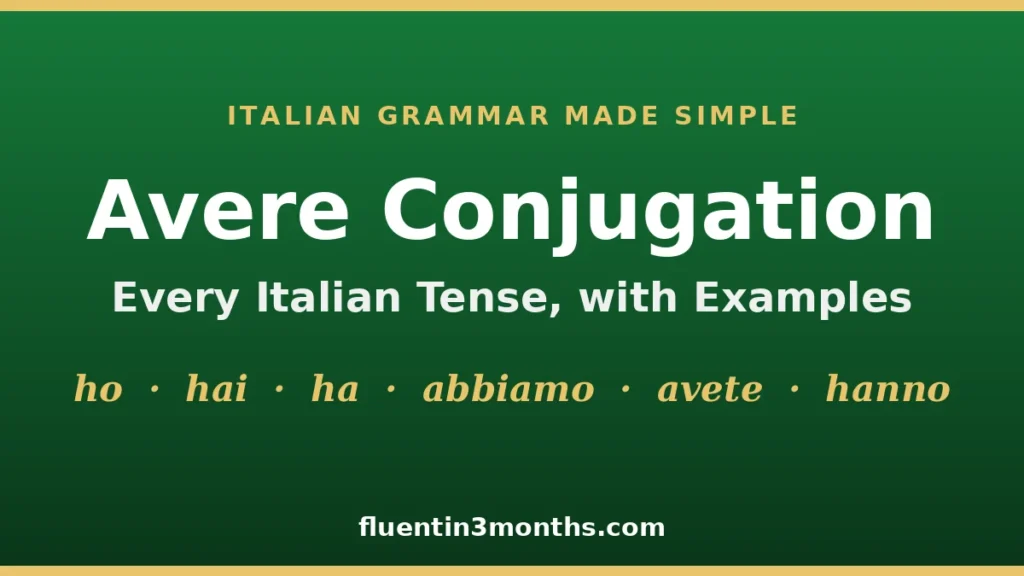
The Italian verb avere functions as the foundational pillar of the language, serving both as the primary verb for expressing possession and as the essential auxiliary required to construct compound tenses for a vast majority of transitive verbs. Mastery of avere is widely considered by linguists and educators to be the most critical threshold for learners progressing from beginner to intermediate proficiency. Because the verb is irregular, its conjugation deviates from the predictable patterns of standard first, second, and third-conjugation verbs, necessitating a structured approach to acquisition.
Historical Context and Linguistic Origins
The etymology of avere traces directly back to the Latin verb habēre, which similarly signified "to have" or "to hold." Throughout the evolution of Romance languages, habēre underwent significant phonetic shifts, leading to the development of avoir in French, haber in Spanish, and avere in Italian. Unlike its counterparts in other Romance languages, the Italian version retains a unique orthographic quirk: the inclusion of the letter "h" in the present indicative forms (ho, hai, ha, hanno).
This silent "h" is not merely a vestige of history; it is a vital functional element in modern Italian orthography. Because these forms would otherwise be homophones with prepositions or conjunctions, the "h" serves as a semantic differentiator. For instance, ho (I have) must be distinguished from o (or); hai (you have) from ai (to the); ha (he/she has) from a (to/at); and hanno (they have) from anno (year). This orthographic distinction is mandatory in all formal and informal writing to prevent ambiguity.
Chronology of Learning and Pedagogical Approaches
Language acquisition experts emphasize that students should not attempt to memorize the entire paradigm of avere in a single session. Instead, a phased approach—prioritizing high-frequency forms—is recommended for long-term retention.
Phase 1: The Present Indicative
The initial stage focuses on the present tense, which allows learners to articulate basic states of being and possession. Mastery of the six forms (ho, hai, ha, abbiamo, avete, hanno) provides the immediate utility required for basic conversation.
Phase 2: Compound Tense Construction
Once the present indicative is secured, students typically move to the passato prossimo. By combining the present tense of avere with the past participle avuto, learners can describe completed actions. This pattern acts as a template for other compound tenses, including the trapassato prossimo and the futuro anteriore.
Phase 3: Moods and Nuance
Advanced learners must eventually navigate the congiuntivo (subjunctive) and the condizionale (conditional). The subjunctive is particularly vital for expressing subjectivity, doubt, or necessity, often triggered by impersonal expressions such as credo che (I believe that).
Data and Conjugation Structures
The following table summarizes the foundational indicative forms of avere, representing the most frequently encountered conjugations in daily discourse:
| Pronoun | Presente | Imperfetto | Futuro Semplice | Condizionale |
|---|---|---|---|---|
| Io | ho | avevo | avrò | avrei |
| Tu | hai | avevi | avrai | avresti |
| Lui/Lei | ha | aveva | avrà | avrebbe |
| Noi | abbiamo | avevamo | avremo | avremmo |
| Voi | avete | avevate | avrete | avreste |
| Loro | hanno | avevano | avranno | avrebbero |
In addition to the indicative, the imperative mood—used for commands—is a crucial component for social interaction. Phrases like abbi pazienza (have patience) illustrate the practical application of the second-person singular imperative form.
Analysis of Usage: Possession and States of Being
A primary hurdle for English-speaking learners is the tendency to translate "to be" expressions directly into Italian. In English, we state that we "are" hungry or "are" thirsty. In Italian, these states are categorized under the umbrella of avere.
Common idiomatic expressions include:
- Avere fame (to be hungry)
- Avere sete (to be thirsty)
- Avere sonno (to be sleepy)
- Avere caldo/freddo (to feel hot/cold)
- Avere ragione/torto (to be right/wrong)
- Avere paura (to be afraid)
Using essere (to be) in these contexts is a common error that significantly impacts the natural flow of speech. For example, stating sono fame is grammatically incorrect and renders the speaker unintelligible to a native listener. The consistent application of avere for these physiological and cognitive states is a benchmark of linguistic accuracy.
Auxiliary Functions and Syntactic Implications
The role of avere as an auxiliary verb is essential for the construction of transitive verbs. While reflexive verbs universally utilize essere, the majority of transitive verbs—those that take a direct object—require avere.
A critical point of analysis involves the agreement of the past participle. In standard Italian, the past participle remains invariable when avere is used. However, a notable exception occurs when a third-person direct object pronoun (lo, la, li, le) precedes the verb. In these instances, the past participle must agree in gender and number with the preceding object. For example, in the sentence Le ho viste (I saw them, referring to feminine plural objects), the participle viste must change from its default masculine singular form to match the feminine plural pronoun le.
Regional Variations and Stylistic Register
The use of the passato remoto—a tense often reserved for distant, completed actions—presents a clear division in contemporary Italian usage. While the passato prossimo is the dominant choice in Northern Italy for conversational past-tense narration, the passato remoto maintains a strong presence in the dialects and formal speech of Southern and Central Italy.
Furthermore, the trapassato remoto (e.g., ebbi avuto) is now largely restricted to literary and formal historical writing. Its usage in casual conversation is rare and can sound archaic or overly formal. Learners are advised to prioritize the passato prossimo for functional communication while maintaining a passive understanding of the passato remoto to facilitate the reading of Italian literature and historical documentation.
Broader Implications for Language Learners
The systematic study of avere provides more than just a set of verbs; it provides a framework for understanding the internal logic of the Italian language. Because avere touches upon tense, mood, auxiliary syntax, and idiomatic expression, it acts as a microcosm of Italian grammar.
Experts in language acquisition suggest that students should integrate avere through active usage rather than passive memorization. By constructing sentences based on personal experience—such as Ho una casa (I have a house) or Ho avuto un’idea (I had an idea)—learners bridge the gap between abstract grammar and practical communication. The verb avere is the workhorse of the Italian language, and through diligent, iterative practice, it becomes the primary engine for effective, clear, and accurate expression. As one advances in their studies, the nuances of avere—from its silent "h" to its role in conditional moods—become second nature, allowing the speaker to focus on content and intent rather than the mechanics of conjugation.