


The acquisition of numerical literacy in the Turkish language serves as a fundamental pillar for effective communication, economic transaction, and social integration within the Republic of Turkey and among the broader Turkic-speaking diaspora. As Turkey continues to solidify its position as a global hub for tourism, real estate, and international trade, the ability to navigate its mathematical nomenclature has transitioned from a supplementary skill to a logistical necessity. From the bustling corridors of Istanbul’s Grand Bazaar to the formal administrative offices of Ankara, numbers dictate the rhythm of daily life, influencing everything from the payment of service tallies to the exchange of contact information and the precise scheduling of the nation’s extensive transit networks.
The Structural Logic of the Turkish Numerical System
The Turkish counting system is lauded by linguists for its exceptional regularity and logical progression. Unlike many Indo-European languages that feature irregular forms for numbers such as "eleven" or "twelve," Turkish utilizes a consistent agglutinative structure. This mathematical transparency allows learners to construct complex figures once a small set of root words is mastered.
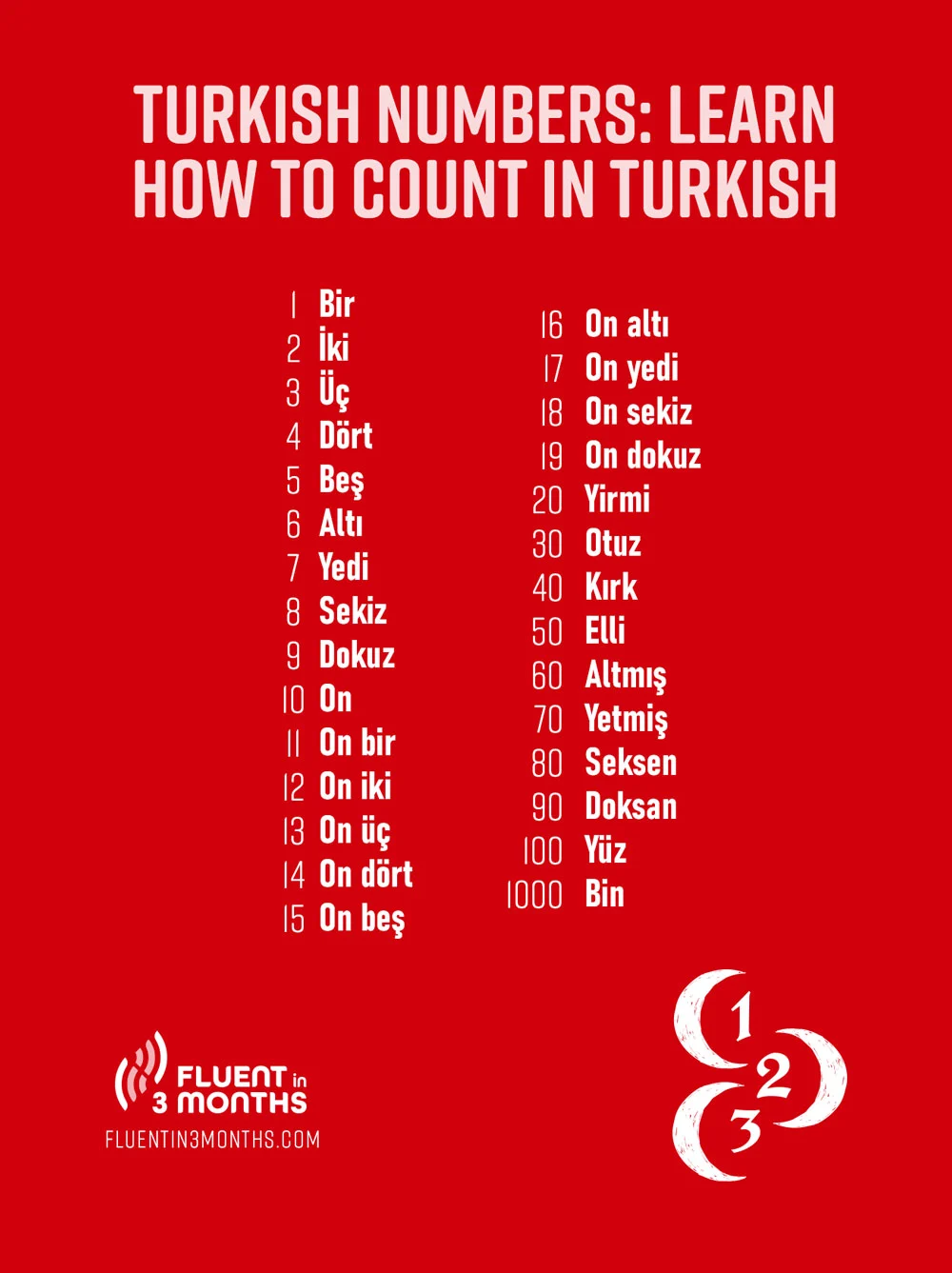
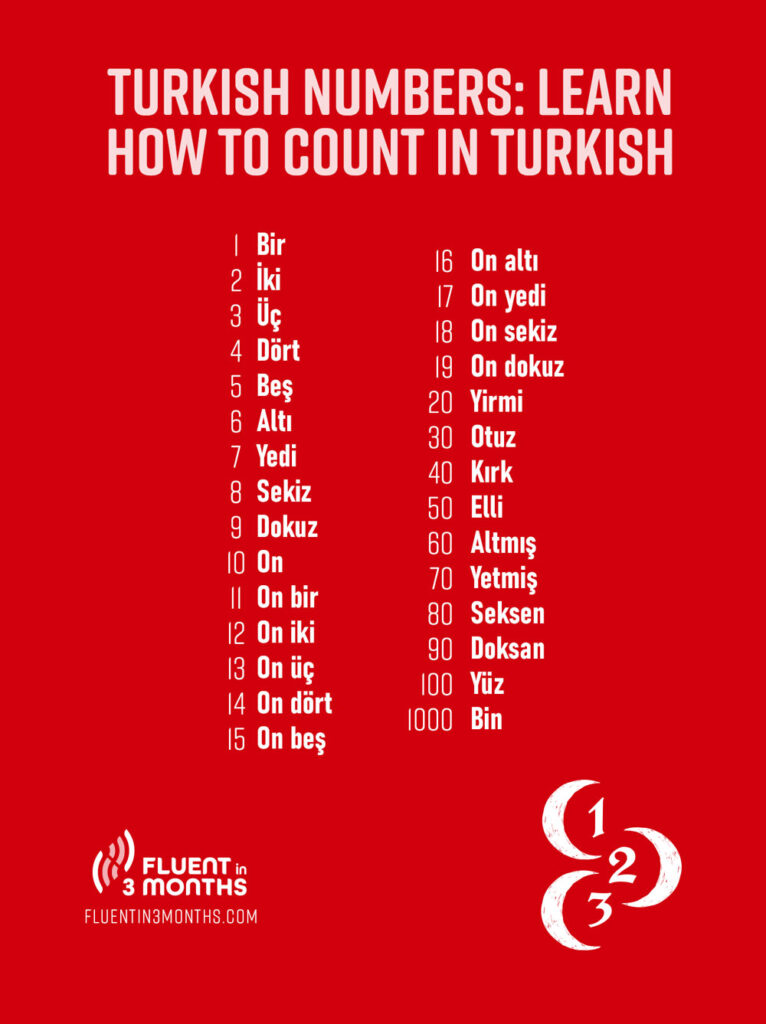
The foundational building blocks are the cardinal numbers from one to ten. These roots are essential for all subsequent numerical constructions:
- Bir (One)
- İki (Two)
- Üç (Three)
- Dört (Four)
- Beş (Five)
- Altı (Six)
- Yedi (Seven)
- Sekiz (Eight)
- Dokuz (Nine)
- On (Ten)
Data from language acquisition studies suggest that learners who achieve fluency in these ten primary digits can accurately predict the structure of roughly 90% of the remaining numbers up to 100. The transition into the "teens" (11–19) involves a simple additive process: the word for ten (on) is followed by the single digit. For example, eleven is expressed as on bir (ten-one) and nineteen as on dokuz (ten-nine). This lack of linguistic "exceptions" significantly lowers the barrier to entry for foreign investors and expatriates settling in the region.
Scaling the Decades: From Twenty to Ninety-Nine
Progressing beyond the number twenty requires the memorization of specific terms for each decade. Once these benchmarks are secured, the intervening numbers are formed by placing the single digit after the decade marker, maintaining a strictly linear logic.
The primary decade markers in Turkish are:
- 20: Yirmi
- 30: Otuz
- 40: Kırk
- 50: Elli
- 60: Altmış
- 70: Yetmiş
- 80: Seksen
- 90: Doksan
To illustrate the ease of construction, the number 45 is rendered as kırk beş, while 82 is seksen iki. Linguistic analysts note that this prefix-suffix relationship mirrors the decimal system used in modern mathematics, making it one of the most intuitive systems for Western learners to adopt. In commercial settings, such as retail or hospitality, this clarity reduces the margin for error during high-speed verbal transactions.
Higher Denominations and the Architecture of Large Numbers
As transactions scale into higher values—common in Turkey’s vibrant real estate market or when navigating the national currency—knowledge of hundreds and thousands becomes paramount. The word for one hundred is yüz. To express multiples of a hundred, the multiplier is placed before the word yüz:
- 200: İki yüz
- 500: Beş yüz
- 900: Dokuz yüz
The same logic applies to the word for thousand, which is bin. Thus, 2,000 is iki bin, and 50,000 is elli bin. For complex figures, the components are stated in descending order of magnitude. For instance, the number 1,235 is articulated as bin iki yüz otuz beş (thousand two hundred thirty five).
Significant Statistical Milestones
In contemporary Turkish society, certain numbers carry heavy administrative weight. For example, the Turkish Identification Number (T.C. Kimlik No) consists of 11 digits, and mobile phone numbers typically comprise 10 digits excluding the initial zero. Mastery of these larger sequences is vital for interacting with the e-Devlet (digital government) system or opening local bank accounts.
Ordinal Numerals and the Rules of Vowel Harmony
Ordinal numbers—used to denote rank, floor levels in buildings, or centuries—introduce one of the most distinctive features of the Turkish language: vowel harmony. To transform a cardinal number into an ordinal one (e.g., from "one" to "first"), the suffix -ıncı, -inci, -uncu, or -üncü is appended based on the final vowel of the root word.
The sequence from first to tenth is as follows:
- 1st: Birinci
- 2nd: İkinci
- 3rd: Üçüncü
- 4th: Dördüncü (Note: the ‘t’ in dört softens to a ‘d’)
- 5th: Beşinci
- 6th: Altıncı
- 7th: Yedinci
- 8th: Sekizinci
- 9th: Dokuzuncu
- 10th: Onuncu
This grammatical nuance is particularly relevant when navigating Turkish cities. Addresses are frequently cited by floor number, and public transport lines or historical eras (such as the 21. Yüzyıl or 21st Century) rely heavily on these ordinal forms.
Practical Applications in the Turkish Economy
Understanding numbers is inextricably linked to the practicalities of the Turkish Lira (TL). Since the redenomination of the currency in 2005, the Lira has been divided into 100 kuruş. In a journalistic context, it is important to observe the specific punctuation used in Turkish financial notation, which differs from the American and British standards.
The Punctuation Reversal
In Turkey, a period (.) is utilized as a thousands separator, while a comma (,) serves as the decimal separator.
- English Standard: 1,250.50 (One thousand two hundred fifty and fifty cents)
- Turkish Standard: 1.250,50 (Bin iki yüz elli lira, elli kuruş)
Failure to recognize this reversal can lead to significant misunderstandings in legal contracts or price negotiations. Furthermore, when giving phone numbers, Turks typically group digits in a specific 3-2-2 cadence (e.g., 05XX XXX XX XX), a cultural convention that facilitates easier memorization and transcription.
Temporal and Quantitative Measurements
The application of Turkish numerals extends into the specialized fields of timekeeping and physical measurements. In formal environments, such as airports, news broadcasts, and government offices, the 24-hour clock is the standard. For example, 2:00 PM is expressed as saat on dört (fourteen o’clock).
In informal, daily conversation, Turkish speakers utilize terms like buçuk (half) and çeyrek (quarter).
- 10:30 is on buçuk.
- Quarter past twelve is on ikiyi çeyrek geçiyor.
Quantities in the marketplace also demand numerical precision. Goods are often sold by the kilo (kilogram), gram, or metre. A shopper might ask for iki kilo elma (two kilos of apples) or beş yüz gram peynir (five hundred grams of cheese). Notably, in Turkish grammar, the noun following a number remains in the singular form; one does not say "two apples" (iki elmalar) but rather "two apple" (iki elma), a rule that simplifies syntax for the learner.
Chronology of Numerical Integration for Residents
For an individual moving to Turkey, the timeline of numerical mastery usually follows a predictable trajectory:
- Week 1: Mastery of 1-10 for basic shopping and dining.
- Month 1: Comprehension of 11-100 and currency notation to manage household bills and groceries.
- Month 3: Understanding of large numbers (thousands/millions) for rent agreements or vehicle purchases.
- Month 6: Fluency in ordinal numbers and complex time-telling for professional and social integration.
Implications for International Relations and Commerce
The broader impact of numerical literacy in Turkish cannot be overstated. As Turkey acts as a bridge between Europe and Asia, international firms increasingly require staff who can operate within the local linguistic framework. Economic analysts suggest that "linguistic proximity"—the ease with which a foreigner can navigate basic local systems—is a qualitative factor in the success of Foreign Direct Investment (FDI).
Statements from the Turkish Ministry of Culture and Tourism indicate that the "human touch" of speaking the local language, even if only through numbers, significantly enhances the visitor experience and fosters a sense of mutual respect. In the competitive landscape of Mediterranean tourism, this cultural competency provides a distinct advantage.
In conclusion, while the Turkish language may appear daunting to the uninitiated, its numerical system stands as a model of consistency and logic. By mastering the foundational roots and understanding the cultural conventions of punctuation and grouping, travelers and professionals can navigate the Turkish landscape with confidence. Whether one is negotiating a price in a local market, interpreting a financial report, or simply asking for the time, numbers are the universal language that unlocks the full potential of the Turkish experience. For those committed to fluency, these digits are not merely mathematical tools but are the keys to a deeper understanding of a nation that remains a pivotal player on the world stage.