


Artificial intelligence is reshaping work at an unprecedented pace, leaving many organizations struggling to adapt. Chief learning officers (CLOs), learning and development (L&D) leaders, and HR partners are under immense pressure to equip their workforces with new skills, integrate AI-powered tools, and demonstrate tangible business outcomes. Yet, a significant segment of employees reports feeling overwhelmed, uncertain, and exhausted by this relentless transformation. This widespread sentiment has coalesced into what is now commonly termed "AI fatigue." Crucially, employees are not inherently resistant to AI; rather, their exhaustion stems from a confluence of unclear expectations, the constant churn of new tools, and learning strategies that prioritize rapid adoption over genuine human readiness. The core message is clear: the challenge lies not with the technology itself, but with the design and implementation of the learning and support systems surrounding it. AI fusion skills offer a promising path forward. By shifting the focus of learning from mere tool mastery to cultivating human judgment and agency, fusion skills can alleviate employee overwhelm while fostering the durable capabilities necessary to navigate future disruptions.
The Genesis of AI Fatigue: A Growing Disconnect
AI fatigue is not an isolated phenomenon but rather an emergent consequence of a familiar dynamic within L&D circles: the rapid adoption of technology outstripping the development of robust human systems for learning, support, and integration. The evidence supporting this assertion is compelling. A comprehensive survey by The Upwork Research Institute, which polled 2,500 global workers, including C-suite executives and full-time employees, revealed a stark dichotomy. While an overwhelming 96% of C-suite leaders anticipate AI will boost worker productivity, a significant 77% of employees reported that AI tools have actually increased their workload. This disparity is exacerbated by a lack of understanding, with nearly half of these employees (47%) admitting they are unsure how to achieve the productivity gains their employers expect. The resultant strain is palpable, with 71% of full-time employees surveyed experiencing burnout.
This trend aligns with decades of research on "technostress," the psychological strain individuals endure when confronted with the demands of information systems. Scholars like Tarafdar, Cooper, and Stich have demonstrated that rapid technological change, when coupled with escalating job demands that outpace improvements in autonomy, clarity, and skill development, can lead to burnout. In such an environment, expecting employees to "experiment" with AI without structured guidance or adequate support does not foster innovation; it accelerates exhaustion.
Furthermore, a widening confidence gap is compounding the problem. Executives are adopting AI tools at significantly higher rates than frontline employees, creating a growing chasm between the enthusiasm at the leadership level and the on-the-ground reality. L&D leaders are often tasked with bridging this gap, a challenge that is partly a consequence of the very adoption pressures they are under. This creates a cyclical pattern where the push for AI adoption, without adequate human-centric support, paradoxically fuels the fatigue it aims to alleviate.
Understanding AI Fusion Skills: Beyond Technical Proficiency
The concept of "fusion skills" was pioneered by Paul R. Daugherty and H. James Wilson, senior leaders at Accenture with extensive expertise in human-machine collaboration. In their seminal Harvard Business Review article, "Embracing Gen AI at Work" (2024), they define fusion skills as the essential human capabilities required to effectively collaborate with generative AI. This definition emphasizes critical human attributes such as judgment, problem framing, and accountability over mere technical proficiency with specific AI tools.
Daugherty and Wilson identify three core fusion skills that differentiate genuine AI collaboration from superficial adoption:
- Intelligent Interrogation: This involves posing insightful questions to AI systems to elicit more accurate, relevant, and nuanced responses. It requires an understanding of the AI’s capabilities and limitations, and the ability to guide its output through sophisticated prompting and iterative refinement. This skill moves beyond simple commands to a more strategic dialogue with the AI.
- Judgment Integration: This skill focuses on the human capacity to critically evaluate AI-generated outputs, discern their validity, and integrate them effectively with human knowledge, experience, and context. It involves knowing when to trust the AI, when to question its conclusions, and how to synthesize AI-provided information with human expertise to make well-informed decisions.
- Reciprocal Apprenticing: This refers to the dynamic process where humans learn from AI and, in turn, teach AI through feedback and refinement. It acknowledges that AI systems learn and improve through interaction. This skill enables individuals to continuously enhance AI performance while simultaneously deepening their own understanding of the technology and its application.
Collectively, these three capabilities redefine AI’s role from a mere productivity shortcut to a powerful thinking partner that augments human expertise. This distinction has profound implications for learning design. The development of fusion skills is not primarily about teaching individuals how to operate specific software. Instead, it is about cultivating the nuanced judgment required to determine when to rely on AI, how to refine its outputs, and, crucially, when human expertise must ultimately take precedence. This nuanced approach acknowledges the evolving nature of work where human and artificial intelligence must coexist and collaborate effectively.
The Direct Impact of Fusion Skills on Mitigating AI Fatigue
AI fatigue, at its core, is driven less by the inherent nature of the technology and more by two underlying human-centric dynamics: a perceived loss of agency and an absence of clarity. Fusion skills are strategically designed to restore both of these critical elements.
Firstly, they restore a sense of control and autonomy. When employees are equipped with the understanding and skills to effectively frame tasks, critically evaluate AI outputs, and retain ultimate decision-making authority, AI transforms from a source of anxiety or a threat of obsolescence into a valuable resource. Extensive research consistently demonstrates that increased autonomy and a strong sense of perceived competence are potent antidotes to burnout and are key drivers of engagement in technology-rich environments. Fusion skills do not diminish the power of AI; rather, they empower humans to wield that power effectively and confidently. This empowerment is crucial for fostering a positive relationship with AI in the workplace.
Secondly, fusion skills anchor learning directly to real-world application. Instead of engaging in abstract, decontextualized training exercises, fusion skills are honed through authentic tasks and challenges. Research from Harvard Business Publishing Corporate Learning and Degreed, based on a global survey of 2,739 employees, found that individuals who are "AI-fluent" distinguish themselves through embedded experimentation within their daily workflows. These individuals are twice as likely to report learning about generative AI through hands-on practice compared to their less-fluent counterparts. This highlights the effectiveness of contextual, practice-based learning for developing durable skills that have lasting value.

By fostering this practical, integrated approach to learning, employees can begin to reframe AI as an augmentation of their capabilities, rather than a direct replacement. The fear of job obsolescence is a significant accelerant of AI fatigue. Fusion skills actively counter this by positioning AI as a collaborator that enhances human judgment and creativity, thereby building career resilience rather than posing a threat. This reframing is not mere rhetoric; it represents a pedagogically grounded shift in how employees perceive their own roles and contributions within the evolving human-AI partnership.
Strategic Imperatives for Learning Leaders
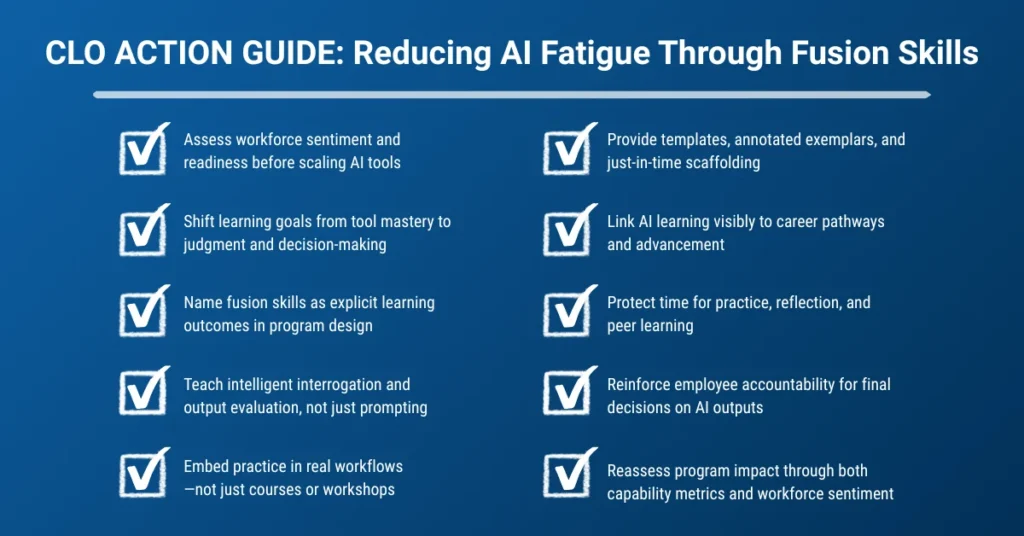
For CLOs and L&D leaders, the path to reducing AI fatigue does not necessitate a slowdown in technology adoption. Instead, it demands a deliberate and strategic redesign of how learning and development are approached. The following strategic priorities, grounded in current research and evolving best practices, offer a clear roadmap:
H2: Proactive Workforce Assessment: Understanding Sentiment Before Scaling
Before the deployment of any new AI capability, organizations must invest time and resources in understanding employee confidence levels, potential concerns, and overall readiness. Analysis by SHRM on enterprise AI adoption indicates that tailoring adoption strategies to specific workforce needs, rather than applying a monolithic, top-down approach, significantly reduces resistance and fatigue. A simple pulse survey or a focused cohort of focus groups can effectively identify critical gaps between leadership expectations and employee experiences—gaps that, if left unaddressed, can become significant liabilities to successful adoption. This proactive approach ensures that the human element is considered integral to the technological rollout.
H2: Explicitly Defining Fusion Skills as Learning Outcomes
The focus of L&D initiatives must evolve beyond mere tool training. Programs should be designed with clearly defined, assessable learning outcomes centered on intelligent interrogation, judgment integration, and reciprocal apprenticing. When employees can clearly see that a program is building transferable judgment and critical thinking skills, rather than just fluency with a tool that may become obsolete within 18 months, their engagement naturally increases, and the learning feels genuinely worthwhile and relevant to their professional growth.
H2: Seamless Integration of Learning into the Workflow
Creating structured opportunities for experimentation within the context of actual work is paramount. This can be achieved through various mechanisms, including dedicated learning labs, AI-assisted project sprints, peer critique sessions for AI outputs, and coached practice on real-world tasks. Research from Harvard Business Publishing Corporate Learning has identified a lack of organizational support, rather than a deficit in employee motivation, as the primary barrier to scaling AI fluency. The majority of workers are eager to learn and develop their AI capabilities; they simply require dedicated time, expert guidance, and the organizational permission to do so.
H2: Connecting AI Learning to Tangible Career Pathways
Employee fatigue significantly diminishes when learning initiatives are clearly linked to opportunities for professional advancement. Fusion skills should be framed not as mandatory compliance requirements, but as durable, transferable professional capabilities that will retain their value irrespective of the evolution of specific AI tools. Demonstrating to employees that the development of these skills opens up new opportunities and career paths will deepen their motivation and commitment to engaging with these learning initiatives.
H2: Cultivating Capacity and Capability: Addressing Overload
AI fatigue often reflects genuine workload overload rather than a simple lack of skill. Learning leaders should actively advocate for protected time for practice and reflection, and provide practical scaffolding to reduce cognitive load. This scaffolding can include readily available prompt templates, annotated exemplars of effective AI usage, clear decision frameworks, and just-in-time reference guides. Reducing cognitive burden during the learning phase is not an act of coddling; it is a fundamental principle of sound instructional design, ensuring that learning is effective and sustainable.
A Resilient Future Built on Human-AI Synergy
AI fatigue is not an indictment of employees’ willingness or ability to adapt. Instead, it serves as a critical signal that current learning strategies must evolve to meet the demands of this new era. The chasm between organizational expectations for AI and the lived experiences of employees is, fundamentally, a design problem—one that CLOs and L&D leaders are uniquely positioned to address.
By investing strategically in the development of AI fusion skills—encompassing intelligent interrogation, judgment integration, and reciprocal apprenticing—organizations can transition from a state of overwhelm to one of genuine, sustainable AI fluency. This approach will restore the confidence, clarity, and agency that are essential for making AI adoption not just a temporary trend, but a lasting source of competitive advantage.
The most resilient organizations of the future will not be those that simply deploy AI the fastest. They will be the organizations that proactively invest in equipping their people with the skills to think critically, judge wisely, and decide effectively alongside AI. This imperative is at the very core of the L&D mission and must be placed at the forefront of every CLO’s strategic agenda. The successful integration of AI into the modern workplace hinges on this fundamental human-centric approach to learning and development.