



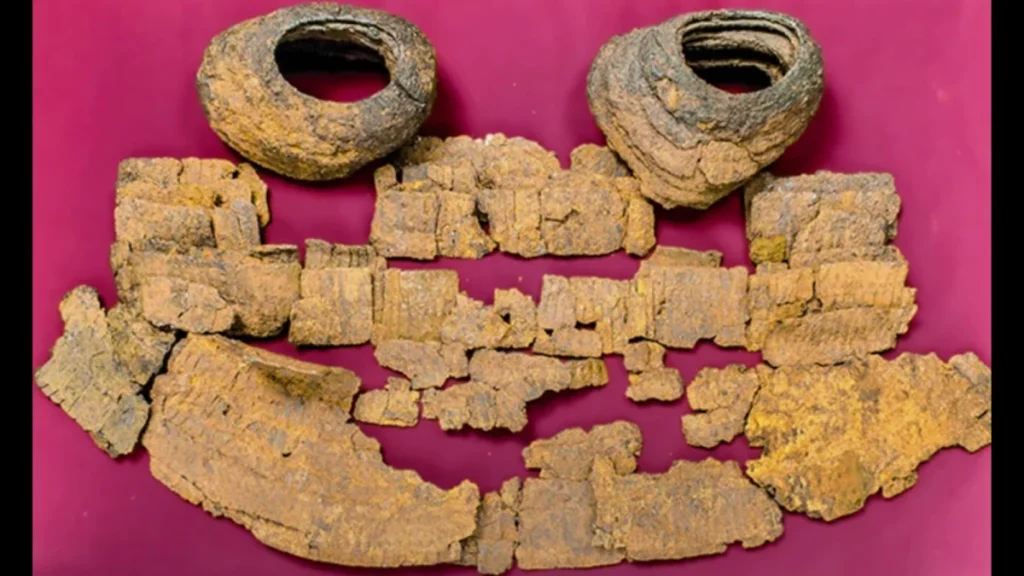
The intricate web of cultural and technological exchange between the Korean Peninsula and the Japanese archipelago has long been a subject of intense archaeological scrutiny, yet few discoveries offer as tangible a link as a set of iron fragments recovered from the foundations of a 7th-century temple. Recent breakthroughs in imaging technology and comparative analysis have allowed researchers to confirm that a suit of armor discovered nearly seven decades ago beneath Japan’s Asuka-dera Temple was crafted using techniques synonymous with the Baekje Kingdom, one of the three major powers of ancient Korea. This finding not only clarifies the origins of early Japanese military equipment but also underscores the profound influence of Korean artisans on the foundational structures of the Japanese state during the Asuka period.
The Discovery at Asuka-dera: A Decades-Long Mystery
The story of this historical revelation began in 1957 during an extensive excavation of the Asuka-dera Temple complex, located in the village of Asuka, Nara Prefecture. Asuka-dera holds a singular place in Japanese history; established around 596 CE under the patronage of the powerful Soga clan, it is recognized as Japan’s first full-scale Buddhist temple. During the 1957 dig, archaeologists focused on the foundations of the temple’s central pagoda, a site of immense spiritual and political significance.
Buried deep within the ritual offerings beneath the pagoda’s foundation stones, researchers unearthed fragments of iron plate armor. At the time of the discovery, the physical condition of the artifacts—heavily corroded and fused by centuries of oxidation—prevented a detailed assessment of their construction. While scholars speculated that the armor might have continental origins due to the temple’s known connections to Korean monks and craftsmen, the analytical tools of the mid-20th century were insufficient to prove a definitive link. The fragments remained in the care of the Nara National Research Institute for Cultural Properties, awaiting a generation of technology that could peer through the rust.
Technological Breakthroughs in Archaeological Analysis
The turning point for the Asuka-dera armor came in 2015, when the Nara National Research Institute for Cultural Properties initiated a high-tech re-examination of the fragments. Utilizing advanced X-ray radiography and 3D imaging, researchers were able to virtually "peel back" the layers of corrosion to reveal the original structure of the iron plates.
The imaging revealed a sophisticated lamellar construction, a method involving the interlacing of hundreds of small, rectangular iron plates, or "lamellae." These plates were perforated and bound together using leather or silk cords. Unlike the solid, rigid breastplates (tanko) common in earlier Japanese history, this lamellar style (keiko) offered a revolutionary balance of protection and mobility. The 3D scans specifically showed that the segments for the torso, upper arms, and shoulders were designed to be interconnected, functioning as a single, flexible unit similar to a modern shirt. This design allowed a warrior to move with greater agility, a critical advantage in the shifting tactics of 7th-century warfare.
The Baekje Connection: Comparative Evidence from Gongsanseong
The definitive link to the Baekje Kingdom was established through a comparative study with artifacts found on the Korean Peninsula. Between 2011 and 2014, excavations at the Gongsanseong Fortress in Gongju, South Korea—a former capital of the Baekje Kingdom—yielded strikingly similar specimens of lamellar armor.
The Gongsanseong armor was particularly significant because it featured lacquer-ware inscriptions that provided a precise chronological marker. One set of plates was dated to 645 CE, placing its manufacture squarely within the same era as the construction and expansion of the Asuka-dera complex. In 2024, Takehiro Hasumura, a prominent archaeologist at the Nara National Research Institute, conducted a firsthand examination of the Gongsanseong finds. Hasumura identified identical patterns in the size of the iron plates, the placement of the cord holes, and the specific method of overlapping the lamellae.
The structural identity between the Asuka-dera fragments and the Gongsanseong specimens led researchers to conclude that the armor found in Japan was either imported directly from Baekje or produced in Japan by immigrant armorers who had mastered Baekje’s specific metallurgical traditions.
Historical Context: The Baekje Kingdom and the Asuka Period
To understand the significance of this link, one must look at the geopolitical landscape of East Asia between the 4th and 7th centuries. The Baekje Kingdom (18 BCE – 660 CE) was a maritime power that maintained a sophisticated culture and a strong diplomatic relationship with the Yamato court in Japan.
According to the Nihon Shoki (The Chronicles of Japan), the second-oldest book of classical Japanese history, the transmission of Buddhism to Japan in the 6th century was a direct result of diplomatic missions from Baekje. These missions did not merely bring religious texts and statues; they brought a "brain trust" of specialists. These included:
- Monks and Scholars: To teach Buddhist philosophy and Chinese characters.
- Architects and Carpenters: To build the first tiled-roof temples like Asuka-dera.
- Artists and Sculptors: To create the iconic "Asuka Daibutsu" (Great Buddha).
- Metalworkers and Armorers: To provide the military technology necessary for the Yamato state to consolidate power.
The discovery of Baekje-style armor beneath a Buddhist pagoda suggests that military technology was viewed as part of the same "civilizational package" as religion. The armor was likely buried as a ritual offering, symbolizing the protection of the faith or the martial prowess of the temple’s patrons.
Chronology of Events
- 18 BCE: Traditional founding of the Baekje Kingdom on the Korean Peninsula.
- 596 CE: Completion of the original Asuka-dera Temple in Nara, Japan.
- Mid-7th Century (c. 645 CE): Manufacture of the lamellar armor found at Gongsanseong Fortress, matching the style of the Asuka-dera fragments.
- 660 CE: The fall of the Baekje Kingdom after an invasion by the Silla-Tang alliance, leading to a wave of refugees and artisans fleeing to Japan.
- 1957: Archaeologists discover the iron armor fragments beneath the Asuka-dera pagoda foundation.
- 2015: Nara National Research Institute begins using X-ray and 3D imaging to analyze the fragments.
- 2024: Archaeologist Takehiro Hasumura confirms the structural overlap between Japanese and Korean specimens, finalizing the link to Baekje.
Implications for Japanese Military Evolution
The confirmation of the armor’s origins has significant implications for the history of Japanese warfare. Before the 7th century, Japanese armor was largely dominated by the tanko, a solid iron cuirass made of large plates riveted together. While effective against frontal piercing attacks, it was heavy and restricted the wearer’s movement.
The introduction of the Baekje-style keiko (lamellar armor) represented a paradigm shift. This style was better suited for cavalry, which was becoming increasingly important in Japanese internal conflicts. The flexibility of the lamellar plates allowed a rider to twist in the saddle and use a bow or sword with greater ease. This technological adoption eventually laid the groundwork for the iconic "o-yoroi" armor used by the samurai in later centuries.
The research suggests that the "Japanese" warrior identity was, in its infancy, heavily influenced by continental innovations. The elite warriors of the Asuka period were likely outfitted in the latest Korean military fashion, utilizing technology that had been refined through Baekje’s frequent conflicts with neighboring Silla and Goguryeo.
Expert Analysis and Official Responses
Archaeologists and historians have hailed the findings as a "missing link" in the study of East Asian material culture. In a statement regarding the analysis, the Nara National Research Institute for Cultural Properties emphasized that the discovery highlights the "multi-dimensional nature" of early Japanese international relations.
"We have long known through texts that artisans from Baekje were instrumental in the building of Asuka-dera," the institute noted. "However, the physical evidence of their presence in the realm of military technology provides a much more vivid picture of how integrated these two cultures were. This wasn’t just a religious exchange; it was a wholesale transfer of state-building technology."
Takehiro Hasumura’s comparative work has also drawn praise for its precision. By focusing on the "grammar" of the armor’s construction—the specific ways in which plates were layered—he has moved the conversation beyond mere stylistic resemblance toward a definitive technological match.
Conclusion: A Shared Heritage
The 1,400-year-old fragments from Asuka-dera serve as a silent witness to a period of intense globalization in East Asia. The confirmation that this armor traces its lineage to the Baekje Kingdom serves as a reminder that the borders between ancient nations were porous, defined more by the flow of ideas and craftsmanship than by modern nationalistic distinctions.
As excavation projects continue at both the Gongsanseong Fortress and various sites in the Nara Basin, researchers hope to uncover more evidence of this shared heritage. For now, the Asuka-dera armor stands as a testament to the Baekje artisans who crossed the sea, bringing with them the tools and techniques that would help shape the early Japanese state and its martial traditions. This discovery ensures that the contribution of Korean craftsmanship to the foundation of Japanese culture is recognized not just in the silent halls of temples, but also in the iron strength of the warrior’s craft.