


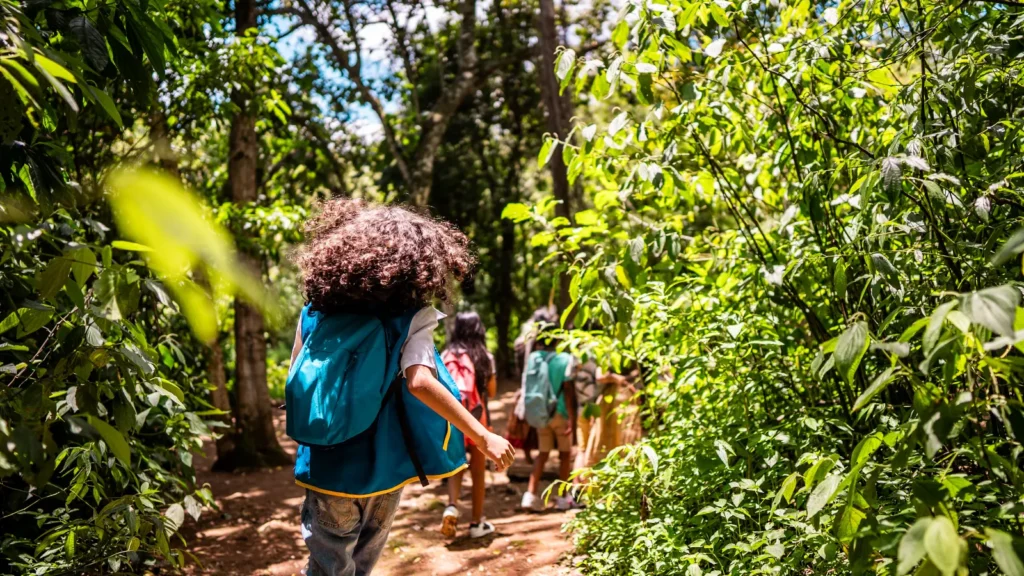
The modern adolescence is increasingly defined by glowing rectangles, algorithm-driven feeds, and the relentless pressure of digital validation. For many middle school students, the daily routine involves navigating the complex social hierarchy of the classroom, followed by hours spent in the digital ether of social media. However, a growing movement in educational enrichment is pushing back against this sedentary, screen-bound reality by trading classroom walls for the open expanse of the natural world. Through targeted outdoor adventure programs, educators and non-profit leaders are discovering that activities like rock climbing, canoeing, and orienteering offer a powerful antidote to the youth mental health crisis, fostering essential social-emotional skills that traditional academic settings often struggle to cultivate.
At Neal Math and Science Academy, a public middle school located in North Chicago, Illinois, school social worker Ellen Mazza has witnessed firsthand the profound transformation that occurs when students are introduced to the wilderness. Once a month, Mazza accompanies diverse groups of seventh and eighth graders on excursions organized by Chicago Voyagers, a local non-profit organization dedicated to providing free outdoor programming. These trips are far from casual field trips; they immerse students in demanding physical and mental challenges, including hiking, cross-country skiing, camping, and rock climbing.
According to Mazza, these wilderness adventures serve as dynamic laboratories for interpersonal growth. In environments where students must rely on one another to navigate a trail or paddle a canoe in unison, artificial social barriers begin to break down. Students who might never interact within the hierarchical confines of a school hallway are forced to communicate, solve problems, and build mutual trust.
The Mechanics of Wilderness Therapy and Social-Emotional Learning
The intentional design of these outdoor excursions targets specific developmental milestones crucial for early adolescents. During middle school, youth undergo rapid neurological, physiological, and emotional changes, making them particularly vulnerable to anxiety, self-doubt, and peer pressure. Programs like those offered by Chicago Voyagers are structured to address these vulnerabilities through experiential education.
Canoeing, for instance, serves as an immediate lesson in collaborative communication. A canoe cannot move efficiently or safely without synchronized effort and verbal coordination between the paddlers. Mazza notes that when students struggle to understand a task or manage a physical obstacle on the water, their first instinct increasingly shifts toward helping their peers rather than retreating into frustration. This cooperative ethos is not left behind in the woods; educators observe that the communication strategies and conflict-resolution skills learned on the water frequently translate back into the classroom environment.
Furthermore, the selection process for these excursions is designed to cultivate leadership potential rather than merely rewarding pre-existing academic achievement. Mazza and participating educators look for students who demonstrate latent leadership qualities, framing the experience around active questions such as, "What would a leader do right now?" By emphasizing accountability, active listening, and the ability to follow intricate directions in high-stakes outdoor scenarios, students learn the weight of responsibility. They discover that leadership is not about status, but about service to the group, reliability, and emotional regulation when facing unfamiliar or intimidating tasks.
Confronting the Digital Epidemic and Sedentary Lifestyles
The urgency behind initiatives like Chicago Voyagers is underscored by a mounting body of public health research detailing the detrimental effects of excessive screen time and digital saturation on youth development. Alex Goodfellow, executive director of Chicago Voyagers, points to a growing consensus among psychologists and public health officials regarding the dopamine loops perpetuated by social media platforms. Unlike the fleeting, anxiety-inducing validation derived from "likes" and "shares," the dopamine and serotonin boosts earned through physical exertion in nature are grounded in authentic accomplishment.
Goodfellow emphasizes that the organization’s mission directly challenges youth to step outside their comfort zones, test their physical and mental resilience, and construct an authentic sense of self-confidence. The relentless spiral of digital media consumption has been widely linked by public health agencies to rising rates of adolescent depression, anxiety, and social alienation. Nature, by contrast, provides a tangible, distraction-free sanctuary where sensory overload is replaced by sensory engagement. It lowers cortisol levels, reduces perceived stress, and compels individuals to focus entirely on the present moment—whether that moment involves maintaining balance on a rock-climbing wall or reading a topographic map in the freezing wind.
This detachment from the digital world is particularly vital for urban youth, many of whom experience chronic environmental stressors. By replacing the blue light of a smartphone with the natural green and blue of forests and lakes, these programs offer a neurological reset, allowing the adolescent brain to recover from the continuous cognitive fragmentation demanded by modern technology.
Equity, Access, and the Mission of Inclusive Outdoor Recreation
A critical barrier to youth outdoor education has historically been socioeconomic inequality. High-end outdoor recreation equipment, specialized clothing, guided expeditions, and transportation to remote state or national parks can be prohibitively expensive for working-class families. Consequently, low-income youth and marginalized communities have often been systematically excluded from the physical and psychological benefits of nature immersion.
Chicago Voyagers operates on a completely free-of-charge model designed to dismantle these financial and logistical barriers. Goodfellow explains that the organization provides all necessary gear, including weather-appropriate clothing, heavy-duty equipment, and professional, safety-certified guides, ensuring that socioeconomic status never dictates a student’s right to experience the outdoors.
This equity-driven approach is particularly resonant in a geographically fragmented city like Chicago. Situated on the shores of Lake Michigan—one of the largest freshwater bodies in the world—the city nevertheless features stark neighborhood disparities in safety, recreational infrastructure, and open green spaces. Goodfellow notes that a surprising number of urban youth have never actually laid eyes on Lake Michigan or explored the surrounding forest preserves, despite living within miles of them.
By intentionally engaging marginalized populations, including lower-income students, Black youth, Spanish speakers, and students with disabilities, Chicago Voyagers seeks to foster a profound sense of civic and environmental belonging. Exposure to expansive natural landscapes fundamentally alters a young person’s worldview, expanding their conception of identity, potential, and geographic possibility. When a student stands on the shore of a vast lake or conquers a steep hiking trail, their mental horizon expands beyond the immediate confines of their neighborhood, planting seeds of long-term aspiration and civic connection.
Redefining Relationships: Educators and Students Beyond Institutional Walls
Beyond the immediate physical and psychological benefits for the students, these outdoor excursions radically reshape the interpersonal dynamics between educators and the youth they serve. In a traditional school setting, interactions are frequently bound by institutional constraints: rigid schedules, disciplinary protocols, standardized testing pressures, and the physical boundaries of desks and chalkboards. These constraints can inadvertently cast teachers and social workers in authoritarian roles, fostering an adversarial dynamic between educator and student.
The wilderness environment completely upends this dynamic. When educators like Mazza camp, hike, and canoe alongside their students, the traditional hierarchy softens into a partnership of shared survival and exploration. Teachers and school social workers are seen outside the rigid "box" of the classroom, revealing their own vulnerabilities, humor, and humanity.
Goodfellow emphasizes the profound value of this relational shift. Students have the opportunity to interact with community members—ranging from school social workers to art or physical education teachers—in relaxed, authentic settings. They witness their mentors laughing, struggling with physical tasks, and problem-solving in real-time. Conversely, educators gain a holistic view of their students, observing their unmasked personalities, their coping mechanisms under mild stress, and their natural peer-to-peer communication styles away from academic evaluation. This deepens mutual trust, ensuring that when students return to the school building, they possess a reliable, trusted adult advocate whom they know intimately outside the context of academic discipline.
Broader Implications for K-12 Educational Policy and Public Health
As school districts nationwide grapple with chronic absenteeism, declining mental health metrics, and post-pandemic academic recovery, programs that integrate experiential outdoor learning into the educational ecosystem are attracting serious consideration from policymakers and child development experts. While traditional education models heavily prioritize cognitive and desk-bound learning, mounting evidence suggests that holistic development requires an integration of physical movement, emotional resilience, and environmental connection.
The success of partnerships between public middle schools like Neal Math and Science Academy and non-profit organizations like Chicago Voyagers demonstrates a scalable blueprint for community-integrated education. By leveraging external expertise and specialized resources, public schools can effectively bypass budgetary and logistical limitations that might otherwise prevent them from offering experiential programming.
The implications of this model extend far beyond the immediate joy of a monthly hiking trip. By systematically building autonomy, self-advocacy, cross-cultural acceptance, and stress-regulation skills during the critical developmental window of middle school, these programs lay the foundation for healthier, more resilient adults. In an era defined by digital isolation and environmental disconnect, returning youth to the natural world is not merely an extracurricular luxury; it is an essential public health intervention that fortifies the minds and communities of the next generation.