

Early last year, Ontario Premier Doug Ford appeared at a meeting of Canada’s first ministers wearing a navy baseball cap embroidered with the phrase: "Canada is not for sale." At the time, the accessory served as a localized political shorthand, a plain-language rebuttal to economic anxieties regarding international trade pressures. Yet, eighteen months later, the sentiment has transcended political theater to become a defining national question. The recent decision by Prime Minister Mark Carney to withdraw from a high-stakes trade agreement with the United States—a move driven by the determination that the proposed terms would fundamentally erode Canadian sovereignty—has signaled a shift in the national zeitgeist. What was once a slogan is now a principle being tested under the harsh glare of real-world geopolitical pressures.
This transition from declaration to reality requires more than just legislative defense; it demands an introspection of what it means to act as a sovereign nation when the pressure hits home. It is within this context of national recalibration that OCAD University’s latest exhibition, Skennenkowa ken? (Do You Carry Great Peace?), currently on display at the Canada Pavilion of the Gwangju Biennale in South Korea, gains profound relevance.
The Great Law and the Modern State
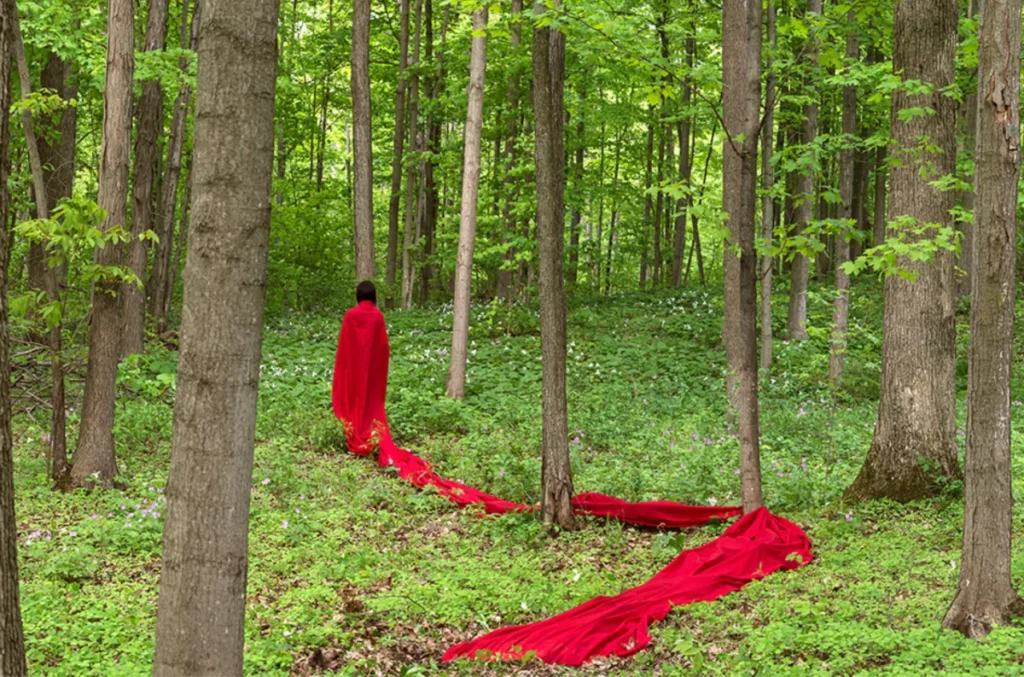
The exhibition features the works of three prominent Kanien’kehaka artists and OCAD University alumni: Shelley Niro, Melissa General, and Hannah Claus. The title of the exhibition is drawn from a daily Kanien’kehaka greeting rooted in the Kaianere’kowa—the Great Law of Peace—which serves as the foundational constitution of the Haudenosaunee Confederacy.
To understand the exhibition is to understand a definition of peace that contrasts sharply with Western diplomatic models. In the Haudenosaunee tradition, peace is not a static endpoint or a signed treaty; it is a dynamic, active state of being. It requires constant renewal through personal conduct, community decision-making, and the acceptance of responsibility. The exhibition posits that the philosophical tenets of the Great Law offer a framework for understanding power, suggesting that true authority is exercised through peace rather than coercion.
While Haudenosaunee sovereignty and Canadian sovereignty are distinct legal and historical entities, placing their respective traditions side-by-side reveals a critical insight: sovereignty is not merely the legal ability to dictate terms; it is the ethical manner in which power is deployed, particularly when a nation is under duress.
The Gwangju Connection: A Global Stage for Sovereignty
The selection of the Gwangju Biennale for this exhibition is not incidental. Founded in 1995, the Biennale has established itself as one of the most significant contemporary art exhibitions in Asia. Its home city, Gwangju, is inextricably linked to the May 1980 Democratic Uprising, a seminal moment in South Korean history characterized by the civilian struggle for democracy and self-determination against authoritarian rule.
By presenting Indigenous-led work in a city that fought for its own sovereignty, OCAD University is highlighting the universal resonance of self-determination. The exhibition serves as a bridge between the Haudenosaunee principle of the "Good Mind" and the modern, global struggle for cultural autonomy. For Indigenous peoples in Canada, who are currently navigating the complexities of the Truth and Reconciliation process, the Land Back movement, and ongoing efforts toward rematriation, the exhibition provides a platform to assert that sovereignty is fundamentally cultural. It is the right to define one’s own identity, steward one’s own land, and transmit knowledge across generations.
OCAD University at 150: A Pivot in Institutional Identity
As OCAD University approaches its 150th anniversary in 2026, the institution finds itself at a historical crossroads. Founded in 1876, the university’s origins are firmly rooted in the European academic models that defined the Canadian state during the colonial era. For much of its early history, the curriculum prioritized Western aesthetics, knowledge systems, and pedagogical structures.
The presentation of Skennenkowa ken? marks a deliberate departure from that legacy. By centering an Indigenous political and philosophical tradition that predates the Canadian state, OCAD is engaging in an act of institutional decolonization. According to university officials, the exhibition represents a shift in how academic institutions can facilitate a broader dialogue between the state’s current crises and deep-rooted, ancestral knowledge.

Economic Pressure and Political Fault Lines
The national anxiety surrounding "Canada is not for sale" is, in practice, a question of economic resilience. As the federal government faces trade volatility, the impact of these decisions is rarely distributed evenly. Historical data suggests that trade disputes and the subsequent protectionist measures often create significant "political fault lines."
Regional industries—such as forestry in British Columbia, manufacturing in Ontario, or agriculture in the Prairies—often bear the brunt of geopolitical posturing. When the federal government must decide which sectors to prioritize for subsidies or which trade-offs to accept to maintain a broader national interest, the internal social contract is strained.
The exhibition invites the public to consider these moments of crisis through the lens of the "Great Law." It does not suggest that conflict should be ignored or that difficult economic choices can be bypassed. Rather, it asks whether a society, in the midst of extreme pressure, can maintain a "good mind"—a state of clarity and responsibility that accounts for the most vulnerable and looks toward the long-term health of the collective, rather than the immediate gratification of a short-term political win.
Implications for the Future
The current trade landscape provides a quantitative backdrop for these philosophical questions. Canada’s reliance on integrated supply chains means that any shift in sovereignty—whether through trade deals or industrial policy—has a direct, measurable impact on GDP, employment rates, and the cost of living.
However, the authors of the exhibition argue that if Canada is to successfully navigate this era of global uncertainty, it must look beyond the balance sheet. The "Great Law" suggests that the sustainability of a nation is dependent on the sustainability of its relationships. Whether it is the relationship between the state and Indigenous nations, or the relationship between Canada and its trading partners, the ability to act with integrity, foresight, and a commitment to peace is the ultimate measure of sovereign strength.
As Shelley Niro, Melissa General, and Hannah Claus explore themes of land, memory, and language, they emphasize the role of women in Haudenosaunee political life. This focus is particularly timely as modern governance models increasingly recognize the necessity of diverse leadership and the role of women in ensuring the continuity of community and environmental stewardship.
Conclusion: The Test of Sovereignty
The question, Skennenkowa ken?, is perhaps more pertinent today than at any point in the last century. As the Canadian state grapples with the practical reality of maintaining its independence in a volatile global economy, the exhibition at the Gwangju Biennale serves as a quiet, yet powerful, intervention.
Canada is currently being forced to defend its sovereignty through trade policy, legal frameworks, and international diplomacy. But the harder test, as suggested by the artists and curators involved in this project, is how that sovereignty is practiced. Can a nation remain clear-minded in the face of pressure? Can it make decisions that reflect a commitment to the generations to come, rather than just the immediate demands of a political cycle?
If the "Canada is not for sale" sentiment is to evolve from a defensive slogan into a coherent national identity, it may require the very clarity and responsibility that the Haudenosaunee have practiced for centuries. By elevating this perspective on the global stage, OCAD University and its alumni are proposing that the future of Canadian sovereignty may well lie in the lessons of the past. As the Gwangju Biennale continues to draw international attention, the work of Niro, General, and Claus stands as a testament to the fact that power, when used with a "good mind," is the most durable form of independence.