



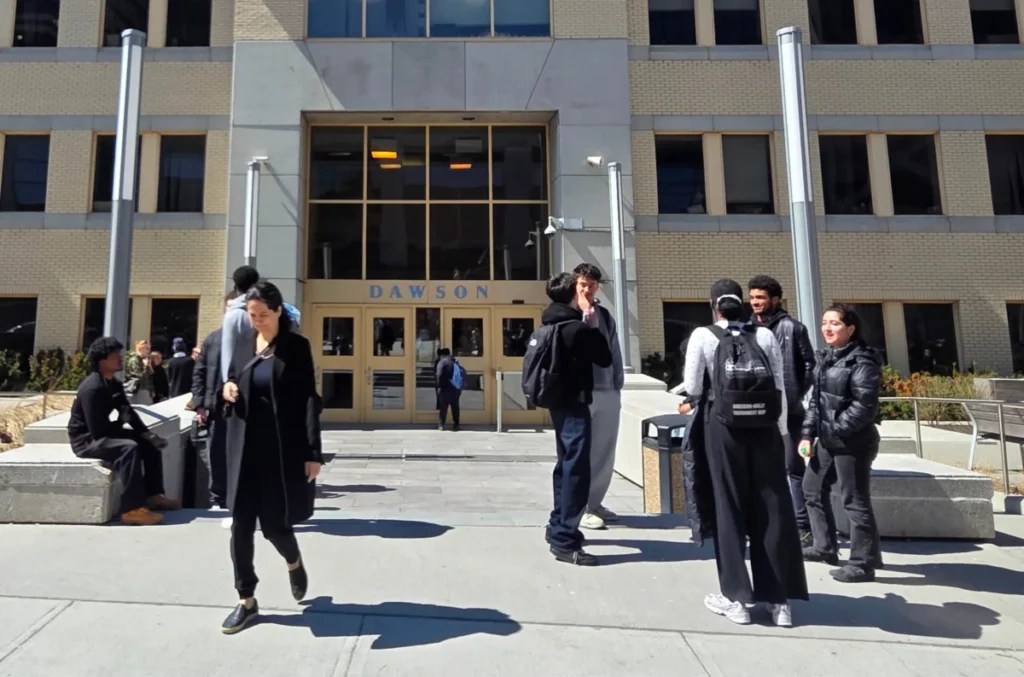
Outside Montreal’s Dawson College, the vibrant energy of students enjoying the sun between classes and the hum of activity within its cafeteria and artisan market mask a growing undercurrent of dissent. For weeks, a simmering anger has been building beneath the calm facade of the English-language CEGEP, culminating in student and teacher meetings to strategize challenges against Quebec’s recently enacted Bill 9. This legislation, which further restricts the public display of religious symbols, has ignited a firestorm of opposition, particularly within educational institutions, many of which are preparing for organized protests.
The Dawson Student Union (DSU), a hub of student activism adorned with anti-capitalist posters and advocacy materials, has spearheaded a significant student walkout scheduled for Friday, May 1. This action follows a history of protest at Dawson College, which became a focal point during the widespread opposition to the prior Bill 21, a law that also targeted the public display of religious symbols. Lauren Tzimopoulos, vice-president of academic affairs and advocacy for the DSU, articulated the sentiment driving these movements: "Our message to the government is that we won’t stand idly by and watch our rights be stripped away. We won’t back down. We’ll keep defending students’ interests.”
This sentiment is echoed by Sara El Alami Saidi, president of North Africa Now, a club representing students from that region. “We’re not opposed to keeping religion and state separate,” Ms. El Alami Saidi explained, “But the government’s approach clearly discriminates against minorities.” Both Ms. El Alami Saidi and Ms. Tzimopoulos contend that Bill 9 disproportionately targets religious minorities, including Muslims, Jews, and Sikhs, whose visible religious symbols are integral to their faith. Ms. El Alami Saidi also highlighted concerns for Christian students, noting that the legislation’s provisions could impact access to prayer rooms, stating, "They’re not happy, either.”
A History of Legislative Restrictions on Religious Expression
The roots of Bill 9 can be traced back to 2010 with the introduction of Bill 94, an initial attempt by the Quebec government to regulate religious accommodations within the public service. Although Bill 94 was not adopted, its underlying principles laid the foundation for Quebec’s secularism policy, formally established with Bill 21 in 2019. A key aspect of this policy, and its subsequent iterations, is the exemption for existing religious symbols, predominantly Catholic iconography, on public property. These are often framed as part of Quebec’s cultural heritage, a distinction that has drawn criticism for its perceived selective application.
Bill 21, when passed in 2019, prohibited public service workers in positions of authority, such as police officers, teachers, and judges, from wearing religious symbols. This initial legislation was met with significant backlash from civil liberties advocates and minority groups who argued it infringed upon fundamental rights. The provincial government, led by the Coalition Avenir Québec (CAQ), has since expanded these restrictions, with Bill 9 extending the prohibitions to a wider array of educational settings.
Bill 9’s Expanded Scope and Impact on Educational Institutions
Bill 9 broadens the scope of religious symbol restrictions to include daycare workers, subsidized private schools, and higher education institutions. Under the new legislation, universities are mandated to close prayer rooms, religious practices are to be banned on campus, and students are prohibited from wearing face coverings when accessing educational services.
Ms. Tzimopoulos vehemently criticized the government’s legislative approach, arguing, "It violates our rights, and they know it. They use the Charter’s notwithstanding clause to pass bills they know are discriminatory to advance their political agenda.” The notwithstanding clause, enshrined in Section 33 of the Canadian Charter of Rights and Freedoms, allows provincial legislatures to enact laws that override certain Charter rights for a renewable period of five years. The CAQ government has invoked this clause on multiple occasions since coming to power, a tactic that critics argue undermines the very foundations of rights protection in Canada.
At Dawson College, the existence of prayer rooms for Christian, Muslim, and Jewish students has historically been a non-issue, according to Ms. Tzimopoulos. This sentiment is shared by Antonia Fikkert, Secretary-Treasurer of the Dawson Teachers’ Union (DTU). "Our students coexist very well," she stated. "We are a multicultural, diverse, interfaith campus. To our eyes, this legislation is a solution to a problem that simply doesn’t exist.”
Faculty Concerns: Preserving Inclusivity and Student Well-being
The faculty at Dawson College has also voiced strong opposition. In September 2025, the DTU passed a motion to reject the legislative assembly’s report on the draft bill. Ms. Fikkert articulated the faculty’s core concerns: "As an atheist teacher, I want all my students to be able to come to me as they are and know they can be wholly themselves within this institution. If they can’t be themselves here, they will choose, more and more, not to be here at all.” This perspective highlights the potential for Bill 9 to create an unwelcoming environment, potentially leading to a decline in student enrollment and diversity within Quebec’s educational landscape.
The impact of these laws is deeply felt by students who identify with minority religious groups. Leah, a first-year Dawson student who wears a hijab, shared a perspective echoed by many: "As a Muslim, you learn growing up that some places aren’t meant for you. They’re for other students. When the bill was passed, it confirmed a lot about Quebec that I already believed.”
Despite her aspirations in tutoring and a potential career in teaching, Leah acknowledges that wearing a hijab has historically presented barriers in Quebec. "It’s sad that Quebec – where I was born and have considered home all my life – and the politicians in charge make us feel like we don’t belong, or that we’ve done something wrong. But it doesn’t matter, they still won’t be able to get rid of minorities in Montreal or in Quebec."
Leah, who chose to study science to pursue a career where she feels she can freely express her religious identity, will be participating in the upcoming protest. She noted the broadening scope of opposition: "A lot of people are getting involved who aren’t religious at all. They feel it infringes on their rights, too – and they’re right. Once one minority is targeted, nothing is stopping them from targeting others.” This observation underscores a growing awareness that the erosion of rights for one group can set a precedent for the erosion of rights for others, regardless of religious affiliation.
A United Front: Student Mobilization Across Quebec
The opposition to Bill 9 is not confined to Dawson College. The Quebec Student Union (QSU), representing students from 14 universities including HEC Montréal, Université de Montréal (UdeM), Polytechnique Montréal, and l’École nationale d’administration publique (ENAP), is calling for a general strike. Flora Dommanget, President of the QSU, expressed frustration with the legislative process. "We drafted a brief and petitioned to present it to the parliamentary commission in person, but we never heard back,” she stated. "Our central demand is that Bill 9 be withdrawn, pure and simple.”
Beyond Bill 9, the QSU has raised concerns about what they describe as the government’s "authoritarian overreach," asserting that such measures "will hamper access to education by discriminating against certain people based on religious symbols.” Ms. Dommanget emphasized the disconnect between government policy and lived realities, saying, "The government is completely disconnected from the actual situation. It is critical to listen closely to the people who are directly affected by this legislation.” Many students involved in the movement believe that the opposition is only just beginning, and Bill 9 could serve as a significant case study in the ongoing struggle for civil liberties in Quebec if their voices are not heeded.
On May 1, coordinated actions are planned across the province. Contingents from Montreal universities are expected to participate in a main rally at Victoria Square at 6:00 p.m. Several CEGEPs, including Ahuntsic and Saint-Jérôme, are organizing picket lines in front of their institutions and local rallies, demonstrating a widespread and decentralized mobilization against the legislation.
In response to inquiries regarding their positions on Bill 9, several Quebec universities provided statements. UdeM, Université Laval, Université du Québec à Rimouski, and Université du Québec à Montréal indicated that their institutions do not currently house prayer rooms. Concordia University and McGill University stated that they are in the process of assessing Bill 9 and its potential implications for their campuses. Dawson College administrators did not respond to requests for an interview by the publication deadline. The ongoing student and faculty resistance suggests that the debate surrounding religious freedom, secularism, and individual rights in Quebec is far from over, with Bill 9 becoming a focal point for a generation grappling with the balance between state policy and personal identity.