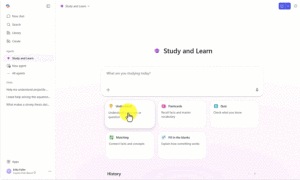




Microsoft has officially announced the induction of more than 43,000 Microsoft Innovative Educator (MIE) Experts and 900 Microsoft Showcase Schools into its global education network for the 2025–2026 academic year. This latest cohort represents a significant expansion of the company’s efforts to integrate artificial intelligence (AI) into primary and secondary education systems worldwide. The selection process for this year focused heavily on visionary leadership, AI transformation, and the promotion of AI literacy as essential components of modern pedagogy.
The announcement comes at a time when educational institutions are grappling with the rapid integration of generative AI tools. By designating these educators and schools as leaders in the field, Microsoft aims to create a standardized framework for how technology can be used to personalize learning and streamline administrative tasks. The 2025–2026 cohort is tasked with not only utilizing these tools within their own classrooms but also acting as mentors and models for the broader global teaching community.
The Strategic Role of Microsoft Elevate in Modern Education
Central to this year’s program is the integration of Microsoft Elevate, a specialized initiative designed to provide advanced AI capabilities to educators, workforce partners, and nonprofit organizations. By aligning the MIE Expert and Showcase School programs with Elevate, Microsoft is shifting its focus toward "people-centered AI innovation." This philosophy posits that while AI can handle data processing and content generation, the human educator remains the essential catalyst for student development and emotional intelligence.
The Elevate initiative provides a support structure that includes specialized coaching, access to early-stage software features, and opportunities for global collaboration. For the 2025–2026 cohort, this means a deeper immersion into how large language models (LLMs) and other AI-driven tools can be used to reduce the "burnout" often associated with lesson planning and grading, thereby allowing teachers to focus more on direct student engagement.
During the recent launch events for the program, participants highlighted the urgency of this transition. MIE Expert Eleanor Jenkins noted that the current educational landscape is preparing students for a workforce that is still being defined. Jenkins emphasized that because many future careers do not yet exist, the role of the educator has shifted from being a purveyor of static knowledge to a facilitator of adaptable skills.
A Chronology of the MIE and Showcase School Programs
The MIE Expert program has evolved significantly since its inception over a decade ago. Initially focused on basic digital literacy and the use of productivity tools like Word and PowerPoint, the program has transitioned through several technological eras, including the rise of mobile learning, the shift to the cloud with Office 365, and the emergency pivot to remote learning during the COVID-19 pandemic.
The 2025–2026 cycle marks the "AI Era" of the program. The timeline for this year’s cohort began in early 2024 with the opening of self-nominations. Educators were required to complete a series of professional learning paths on the Microsoft Learn platform, focusing on inclusive classroom design and the ethical application of AI. Following a rigorous review process by regional Microsoft teams, the final list of 43,000 experts was ratified in late 2024 to prepare for the start of the new academic cycle.
Showcase Schools follow a similar but more institutionalized timeline. Schools typically begin as "Incubator Schools," a status that allows them to work through the Microsoft Education Transformation Framework (ETF). This framework provides a blueprint for school-wide change, focusing on leadership, policy, and the creation of "intelligent environments." Only after demonstrating a sustained commitment to these pillars can an institution apply for full Showcase School status.
Data-Driven Justification for AI Integration
The emphasis on AI in this year’s program is supported by emerging labor market data. According to research from LinkedIn’s 2025 report, "AI and the Global Economy: Unlocking Growth and Reshaping Work," approximately 70% of the skills currently utilized in the global workforce are expected to change or become obsolete by 2030. This shift is driven by the automation of routine tasks and the increasing value placed on "AI fluency"—the ability to work alongside intelligent systems.
Internal Microsoft data further indicates a surge in AI adoption within the educational sector. A recent "AI in Education" report found that educators using AI tools saved an average of several hours per week on administrative duties, which was subsequently redirected into small-group instruction and student mentorship. For the 900 Showcase Schools, the goal is to scale these individual successes into institutional standards, ensuring that every student, regardless of their socioeconomic background, graduates with a foundational understanding of how to use technology responsibly and effectively.

Defining the Tiers of Leadership: MIE Experts, Fellows, and Showcase Schools
The Microsoft education ecosystem is structured into distinct tiers, each with specific responsibilities and expectations:
Microsoft Innovative Educator (MIE) Experts
These are individual classroom teachers or instructional coaches who have demonstrated a high level of proficiency with Microsoft’s suite of educational tools. To maintain their status, MIE Experts must engage in continuous professional development and contribute to the global community through webinars, blog posts, and social media outreach. Their primary focus is the "student-centered classroom," where technology is used to differentiate instruction for learners with diverse needs.
MIE Fellows
MIE Fellows represent the top tier of the educator community. These individuals are personally nominated by Microsoft staff based on their long-term contributions to the program. Fellows often serve as regional leads, mentoring new MIE Experts and presenting at major international conferences such as BETT or ISTE. In the 2025–2026 cycle, Fellows will work closely with the Microsoft Elevate team to design new curriculum modules that address the ethical challenges of AI, such as bias in algorithms and data privacy.
Microsoft Showcase Schools
Showcase Schools are whole-institution models of excellence. These schools have moved beyond individual "pockets of innovation" to ensure that technology is woven into the very fabric of the school’s culture. From the principal’s office to the cafeteria, Showcase Schools utilize Microsoft 365, Teams, and AI-powered analytics to track student progress and foster a collaborative environment. They serve as "living labs" where other school districts can visit to see the Education Transformation Framework in action.
Global Reactions and Educational Implications
The announcement has garnered attention from educational policy analysts and school administrators worldwide. The consensus among experts is that the 2025–2026 cohort represents a critical mass of tech-forward educators who could influence national education policies.
Inferred reactions from the academic community suggest a mix of optimism and caution. While the potential for AI to personalize learning is widely praised, there are ongoing discussions regarding the "digital divide." By supporting schools in diverse geographic and economic regions, the Showcase School program attempts to mitigate the risk that AI-driven education becomes a luxury available only to elite institutions.
The implications of this program extend into the higher education and corporate sectors. Universities are increasingly looking for students who possess "soft skills"—critical thinking, collaboration, and creativity—that are enhanced by the purposeful use of technology. Similarly, corporations are seeking a workforce that does not fear AI but understands how to leverage it for productivity. The MIE Experts and Showcase Schools of 2025–2026 are essentially the architects of this new pipeline between the classroom and the modern economy.
Future Outlook: Building an Inclusive and Inspired Future
As the 2025–2026 academic year progresses, Microsoft has signaled that it will continue to update its toolsets to reflect the feedback from this cohort. The relationship between the company and these educators is reciprocal; while Microsoft provides the infrastructure, the educators provide the real-world data on what works in a classroom setting.
The ultimate goal of the MIE Expert and Showcase School programs is to move education toward a more inclusive model. Through tools like Immersive Reader, live captioning in Teams, and AI-driven accessibility features, these innovators are proving that technology can be a great equalizer. By the end of this academic cycle, the 43,000 experts and 900 schools are expected to have impacted millions of students, setting a new global benchmark for what is possible in the digital age.
The program’s success will be measured not just by the number of badges issued or software licenses activated, but by the measurable improvement in student engagement and the preparedness of the next generation to navigate an AI-augmented world. As this community grows, it remains committed to the core belief that while technology provides the tools, it is the inspired educator who provides the vision.