



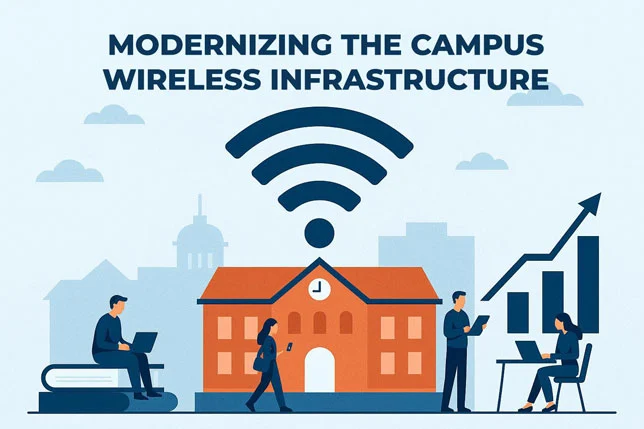
For colleges and universities today, updating the campus wireless infrastructure is no longer a matter of making a few select technical upgrades. To deliver on the promise of emerging technologies and fulfill the operational expectations of a modern university constituency, forward-looking IT leaders are making plans to modernize their networks — from the ground up, and for the future. This comprehensive overhaul is a strategic imperative, designed not just to keep pace with current demands but to proactively position institutions to leverage the next wave of technological innovation, including advanced artificial intelligence applications, the burgeoning proliferation of Bring Your Own Device (BYOD) ecosystems, and the explosive growth of data generated by cutting-edge research programs.
The Paradigm Shift: Beyond Incremental Upgrades
The notion that a simple "upgrade" can suffice for today’s dynamic higher education environment is rapidly becoming obsolete. Institutions now plan for multi-year, full modernizations of the campus wireless infrastructure, a stark contrast to previous cycles of incremental hardware replacements. This shift acknowledges that the challenges and opportunities presented by the digital age demand a foundational rethinking of network architecture. As Gary DePreta, Cisco’s senior vice president of U.S. public sector, highlighted in a recent discussion, the current imperative is to view this not merely as another technology upgrade, but as a "true network modernization for the entire campus." This mindset, he posits, is what will ultimately deliver meaningful return on investment (ROI).
These modernization plans are designed to bring the speed and capabilities of the latest Wi-Fi standards, such as Wi-Fi 6E and the impending Wi-Fi 7, while simultaneously building a future-ready state. This state must be capable of responding quickly to a wave of AI-driven applications that demand unprecedented bandwidth and low latency, or the continuous proliferation of new BYOD devices that saturate existing networks, or the exponential growth of data repositories generated by novel research programs. Whatever disruptive technologies or practices are on the horizon, universities aim to be ready to convert them into opportunities for innovation, enhancing learning, research, and administrative efficiency.
Historical Context: The Evolution of Campus Connectivity
The journey of campus connectivity has been a continuous race to keep up with escalating demand. In the early 2000s, Wi-Fi 802.11b and g standards offered rudimentary wireless access, often confined to common areas or libraries. The introduction of laptops as essential student tools, followed by the smartphone revolution, propelled Wi-Fi to a campus-wide necessity. Each subsequent Wi-Fi standard – 802.11n (Wi-Fi 4), 802.11ac (Wi-Fi 5) – brought improvements in speed and capacity, but these were often implemented as reactive measures. IT departments would upgrade access points, increase backhaul, and manage bandwidth as best they could, patching over deficiencies rather than fundamentally redesigning the underlying infrastructure.
However, the sheer volume and complexity of connected devices and data streams today represent an entirely new order of magnitude. The challenges extend beyond mere bandwidth to encompass security, latency, device management, and the integration of diverse applications. Campus networks are no longer just about internet access; they are the central nervous system of a complex, interconnected educational ecosystem. The transition from Wi-Fi 5 to Wi-Fi 6/6E marked a significant leap, not just in speed, but in efficiency and capacity management, particularly in dense user environments typical of university campuses. This technological evolution, coupled with the explosion of digital demands, has rendered piecemeal upgrades unsustainable, necessitating the holistic modernization approach currently being adopted.
Drivers of Modernization: A Deep Dive
Several interconnected trends are compelling universities to undertake these extensive network modernizations:
-
Hybrid Learning and Digital Pedagogy: The pandemic accelerated the adoption of hybrid and online learning models, making robust, ubiquitous wireless connectivity non-negotiable. Students and faculty now expect seamless transitions between physical and virtual learning spaces, demanding high-definition video conferencing, interactive virtual labs, and instant access to cloud-based resources. Rich media content, augmented reality (AR) for practical training, and collaborative digital whiteboards are becoming standard tools, all requiring a network capable of handling significant data loads with minimal latency. Data suggests that over 70% of higher education institutions now offer some form of hybrid learning, a figure projected to grow, solidifying the need for adaptable network infrastructure.
-
The BYOD Tsunami and IoT Proliferation: The average university student today brings 3-5 personal devices to campus – laptops, smartphones, tablets, smartwatches, and even smart home devices for dorm rooms. Multiply this by tens of thousands of students, faculty, and staff, and the device count becomes staggering. Beyond personal devices, the Internet of Things (IoT) is rapidly expanding on campuses, encompassing smart sensors for building management, security cameras, smart lighting, digital signage, and even specialized laboratory equipment. Each IoT device, while individually consuming less bandwidth, contributes to network congestion and presents unique security challenges, demanding sophisticated network segmentation and management capabilities. Industry forecasts predict a 15-20% annual growth in connected devices on campus networks.
-
The AI Revolution and Data Demands: Artificial intelligence is transforming every facet of university life, from administrative automation and personalized learning analytics to advanced research simulations and intelligent campus operations. AI-driven applications often require massive datasets to be processed and transferred, sometimes in real-time. Whether it’s a medical student accessing high-resolution imaging for AI diagnostics, a computer science student running machine learning models, or an administrator leveraging AI for predictive analytics on student retention, the network must support these computationally intensive tasks. The sheer volume of data generated and consumed by AI workloads necessitates not only high bandwidth but also low latency and robust security to protect sensitive information. Early adoption rates for AI in higher education indicate a significant increase, with some reports showing a 30% rise in AI-related course offerings and research projects in just the last two years.
-
Novel Research Programs: Modern scientific research is increasingly data-intensive and collaborative. Fields such as genomics, astrophysics, climate modeling, and particle physics generate petabytes of data that need to be transferred, stored, and analyzed, often in collaboration with institutions worldwide. High-performance computing (HPC) clusters, specialized lab equipment, and remote sensing technologies place immense strain on network infrastructure. A modern wireless network must provide reliable, high-speed conduits for these critical research endeavors, facilitating global collaboration and accelerating scientific discovery.
Cisco’s Perspective and "The State of Wireless" Report
It is within this rapidly evolving landscape that Cisco has recently released its inaugural report, "The State of Wireless" (April 2026), specifically focusing on higher education. This comprehensive study aims to provide strategists with a deeper understanding of the profound impacts of radical changes within the wireless ecosystem.

Gary DePreta, Cisco’s senior vice president of U.S. public sector, shared insights into the report’s significance during a recent interview. "It’s good to be here… happy to do it," DePreta began, expressing enthusiasm for the report’s release. "As you and your readers may know, Mary, we’ve just published our inaugural report on The State of Wireless. My chat here with you is the first conversation I’m having externally about this fantastic research report from Cisco."
DePreta reiterated the critical distinction between traditional upgrades and true modernization. "We all see a lot of dynamics around wireless infrastructure for education, but the key thing schools are realizing now is to respond to this not as another technology upgrade, but as a true network modernization for the entire campus. That’s the mindset that’s going to deliver ROI, ultimately." He further emphasized that while technological advancements are crucial, the ultimate goal transcends mere technical specifications. "Even with the full-scale modernizations that would solve some of these issues and support many innovations technically, it’s important to understand that at the end of the day, we want to deliver a super-positive experience for students, faculty, administrators, and researchers. It’s not about the technology or tools; it’s about delivering the best experience possible." This focus on user experience underscores a shift from infrastructure as a utility to infrastructure as an enabler of institutional mission and a differentiator in a competitive market.
Key Technological Pillars of Modernization
Modern wireless infrastructure relies on several advanced technological pillars to meet future demands:
-
Wi-Fi 6, 6E, and the Horizon of Wi-Fi 7: These latest Wi-Fi standards are foundational. Wi-Fi 6 (802.11ax) significantly improves efficiency and capacity in dense environments through technologies like OFDMA (Orthogonal Frequency-Division Multiple Access) and MU-MIMO (Multi-User, Multiple-Input, Multiple-Output). Wi-Fi 6E extends these benefits into the 6GHz spectrum, providing a vast, clean block of airwaves free from interference from older Wi-Fi devices and household appliances. This new band offers significantly higher speeds and lower latency, ideal for demanding applications like VR/AR and 4K streaming. Looking ahead, Wi-Fi 7 (802.11be), or Ultra-High Reliability (UHR), promises even greater throughput, lower latency, and enhanced reliability, further solidifying the network’s ability to handle future AI and IoT workloads.

-
Network Segmentation and Security: With a massive influx of diverse devices, including personal, IoT, and sensitive research equipment, network security is paramount. Modernization includes robust network segmentation, often leveraging zero-trust principles and micro-segmentation. This means isolating different device types and user groups into separate virtual networks, limiting the lateral movement of threats and protecting critical data. Advanced intrusion detection, threat intelligence, and identity-based access control are integrated to create a multi-layered security posture.
-
Cloud-Managed Networking: Cloud-managed solutions offer unparalleled scalability, flexibility, and centralized control. Universities can manage their entire wireless network from a single dashboard, automate provisioning, and leverage AI-driven analytics for proactive problem identification and optimization. This reduces operational complexity, frees up IT staff for strategic initiatives, and ensures consistent performance across geographically dispersed campuses.
-
Edge Computing Integration: As AI and IoT proliferate, processing data closer to its source – at the "edge" of the network – becomes crucial. Edge computing reduces latency, conserves bandwidth by processing data locally, and enhances real-time decision-making for applications like smart campus automation or immediate security alerts. Integrating edge capabilities into the wireless infrastructure prepares the network for the decentralized processing demands of future AI-powered campus environments.
Strategic Imperatives for University IT Leaders
For university IT leaders, the decision to modernize is fraught with strategic considerations:
-
ROI and Innovation: The investment in wireless modernization must be clearly tied to institutional goals, demonstrating how enhanced connectivity directly supports student success, research breakthroughs, and administrative efficiency. It’s about enabling new pedagogical models, attracting top-tier faculty, and fostering an environment of innovation that justifies the significant financial outlay. Projections suggest that well-executed modernization can lead to a 15-20% increase in network efficiency and a measurable improvement in user satisfaction scores.
-
Scalability and Agility: The pace of technological change shows no signs of slowing. A modernized network must be inherently scalable, capable of accommodating future growth in devices, users, and bandwidth demands without requiring another complete overhaul in a few years. Agility ensures the network can quickly adapt to new technologies, security threats, and institutional priorities.
-
User Experience as the Ultimate Metric: As DePreta emphasized, the "super-positive experience" for all constituents is the ultimate goal. This translates to consistent, high-speed, reliable, and secure connectivity everywhere on campus – from lecture halls and dorms to research labs and outdoor spaces. A poor network experience can negatively impact learning outcomes, research productivity, and overall satisfaction, potentially affecting student enrollment and faculty retention.
-
Sustainability and Energy Efficiency: Modern network hardware is often significantly more energy-efficient than older equipment. Incorporating sustainability goals into modernization plans can reduce operational costs and align with broader institutional environmental commitments.
Implications Across the Campus Ecosystem

The implications of a fully modernized wireless infrastructure reverberate across the entire university ecosystem:
- For Students: Enhanced learning experiences through access to rich digital content, virtual reality simulations, and seamless collaboration tools. Improved access to administrative services, mental health resources, and social connections, fostering a more engaging and supportive campus life.
- For Faculty: The freedom to implement innovative teaching methodologies, leverage advanced research tools, and collaborate effortlessly with peers globally. Reduced technical friction allows faculty to focus more on instruction and discovery.
- For Administrators: Streamlined operations through IoT-driven campus management, data-driven decision-making, and improved security protocols. Enhanced emergency response capabilities and efficient resource allocation contribute to a safer and more productive campus.
- For Researchers: Unfettered access to high-bandwidth networks for transferring massive datasets, running complex simulations, and collaborating in real-time with national and international partners. This accelerates discovery and positions institutions at the forefront of scientific advancement.
The Road Ahead: A Continuous Journey
It is crucial to understand that wireless infrastructure modernization is not a destination but a continuous journey. The digital landscape will continue to evolve, bringing new devices, applications, and security challenges. Universities must adopt a strategic posture of continuous assessment, adaptation, and investment to maintain their future-ready state. The competitive environment for attracting students, faculty, and research funding further underscores the necessity of a robust, agile, and user-centric network. Institutions that embrace this comprehensive approach will not only meet the demands of today but also proactively shape the educational and research paradigms of tomorrow.