



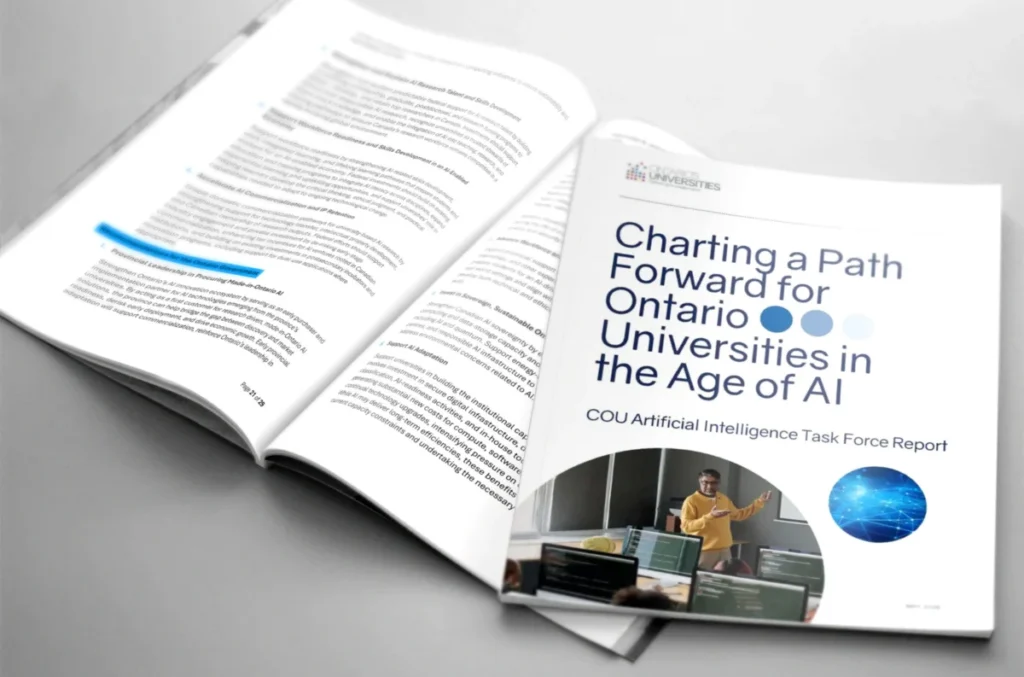
A pivotal new report released by the Council of Ontario Universities (COU) asserts that Ontario’s post-secondary institutions must urgently enhance their collective AI literacy and foster cross-sectoral collaboration to navigate the transformative landscape of artificial intelligence. The 29-page document, titled Charting a Path Forward for Ontario Universities in the Age of AI, warns that failure to act decisively could lead to institutions being outpaced by this technological revolution rather than capitalizing on its immense potential.
The report, a product of a seven-member task force comprising senior university leaders with expertise in digital technologies, aims to provide a strategic roadmap for the safe, ethical, and effective integration of AI within Ontario’s universities. Crucially, it emphasizes the need to equip graduates with the necessary skills to thrive in a workforce increasingly shaped by AI.
AI as a Structural Shift: A Call for Coordinated Action
"AI represents a structural shift, not a passing trend, and coordinated action across all levels will be essential to harness its benefits while upholding the core mission and values of higher education," the report states, underscoring the profound nature of AI’s impact. This sentiment was echoed by Dr. Vivek Goel, President and Vice-Chancellor of the University of Waterloo and chair of the task force, at the report’s launch. Speaking on May 29th to an audience of 470 attendees at a luncheon hosted by The Empire Club of Canada at Toronto’s Fairmont Royal York hotel, Dr. Goel acknowledged the rapid and often disorienting pace of AI development.
"Artificial intelligence in universities is moving so fast, it’s confusing, and everyone’s trying to keep up," Dr. Goel remarked. He highlighted the imperative for institutional collaboration, stating, "If we work together as institutions, one: we can share what we’re learning, what the impact on pedagogy, research, operations looks like; but we can also share in either developing or procurement of the different tools. We can share in the literacy programs that we need to develop." In a demonstration of the report’s subject matter, Dr. Goel noted that the task force itself utilized AI tools to meticulously track the burgeoning volume of reports on AI and higher education.
The report’s structure is designed to provide a comprehensive framework for understanding and addressing the challenges and opportunities presented by AI. It begins with an exploration of potential future scenarios for universities in the age of AI, followed by an assessment of current institutional readiness and "adaptation" – the report’s preferred term for proactive integration, which implies a fundamental reimagining of practices rather than mere adoption of new technologies. This is followed by a set of guiding principles and strategic approaches for adaptation, culminating in actionable recommendations for universities, as well as the federal and Ontario provincial governments.
Universities as Anchors in an AI-Disrupted Future
The report posits that universities can serve as vital "anchors" during periods of AI-driven disruption. To achieve this, institutions must proactively prepare for a spectrum of change, from gradual evolution to rapid upheaval. Key strategies recommended include redesigning academic assessments to prioritize higher-order cognitive skills such as judgment, creativity, and critical thinking, and reinforcing transparency and reproducibility in research methodologies. The report also stresses the importance of championing the unique human contributions inherent to university functions, such as fieldwork and community engagement, and investing in shared infrastructure that facilitates cross-sectoral partnerships.
By embedding AI competencies across their academic programs, offering robust experiential learning opportunities, and providing lifelong learning pathways to ensure workforce relevance, universities can solidify their roles as "economic and cultural anchors." Furthermore, their academic expertise is crucial for informing public discourse on AI’s capabilities and limitations. The report advocates for the implementation of tiered AI training programs for students, staff, and faculty, focusing on critical areas like bias detection, misinformation identification, and the ethical application of AI. It also suggests that universities could leverage their unique expertise and facilities to accelerate AI adoption across various sectors and to spearhead collaborative efforts to address complex societal challenges with AI-driven solutions.
A core tenet of the report is that all AI-related decisions within universities must uphold academic integrity and remain aligned with institutional missions and responsibilities. The deployment of AI should aim to augment, rather than replace, human judgment and expertise. Moreover, the report introduces a significant consideration for environmental sustainability, recommending that universities be accountable for the environmental footprint of their AI technologies and actively contribute to mitigation efforts.
Navigating Financial, Privacy, and Academic Integrity Concerns
A critical concern highlighted in the report is the potential for smaller institutions with limited financial resources to be left behind in the AI race. The substantial investments required for AI infrastructure could, paradoxically, help these institutions expand their offerings and services. This disparity underscores the urgent need for shared service models and sector-wide collaboration to ensure equitable progress.
Consultations and surveys conducted by the task force revealed that universities are currently in the nascent stages of AI adaptation. Their primary focus lies in building foundational AI competency and familiarity among their stakeholders, alongside establishing and investing in secure AI tools and supporting infrastructure. Financial constraints were identified as a major hurdle, with significant concerns also surrounding data transparency, privacy protection, and the broader implications of AI for the university workforce.
The report forecasts a substantial increase in AI utilization across universities within the next three years. Institutions anticipate AI offering opportunities for more personalized learning experiences, enhanced insights into student learning through advanced analytics, accelerated and refined research processes, and improved institutional compliance with regulations and risk management protocols. However, these opportunities are juxtaposed with significant risks, including threats to data privacy, security, and control; potential copyright and intellectual property infringements; AI-enabled security vulnerabilities; and a loss of institutional autonomy due to reliance on dominant technology platforms. Existing university policies are being adapted to address AI use, rather than entirely new AI-specific policies being developed, indicating an evolving regulatory landscape.
The protection of academic integrity has emerged as a paramount concern. In response, universities are showing renewed interest in oral assessments and "declaration-based practices," whereby students are permitted to use generative AI but must transparently disclose its usage. The report advocates for the integration of "AI experts across disciplines" to adequately prepare graduates for an AI-driven economy.
Recommendations for Governments and Universities
The task force’s recommendations to government entities address familiar yet critical areas for progress. These include calls for increased investment in graduate, postdoctoral, and research funding to attract top AI research talent, alongside dedicated funding for work-integrated learning, experiential education, and AI skills development. Specifically, the federal government is urged to invest in AI infrastructure and to streamline the commercialization of university AI research through enhanced technology transfer and intellectual property support. The Ontario government is advised to act as an early adopter of AI technologies developed within its universities, thereby fostering broader commercialization, and to support collaborative AI tool procurement among its post-secondary institutions.
The most extensive set of recommendations is directed towards universities themselves, comprising 12 distinct points. Many of these emphasize the importance of sharing best practices in AI-related training, pedagogy, leadership, and quality assurance. The recommendations strongly advocate for collaboration not only within the Ontario university system but also with international partners.
The task force proposes leveraging sector-wide organizations, such as the Ontario University Council of Chief Information Officers (OUCCIO), to investigate the feasibility of shared AI platforms and potential cost-recovery models. Explorations into pooled infrastructure and joint service delivery are also encouraged. To this end, the report notes that the Council of Senior Administrative Officers and OUCCIO will establish a joint working group focused on identifying opportunities to enhance operational efficiency through AI, including the potential for shared data centers and collaborative procurement strategies. Dr. Goel reiterated that while individual institutions might attempt to navigate the AI landscape alone, their success is far more probable through collective action.
Looking ahead, Dr. Goel expressed optimism: "I’m optimistic that our institutions are going to be at the leading edge of figuring out how to use these technologies in a responsible way and really focus in on the human skills that our students are going to need in the world going forward." This forward-looking perspective underscores the dual challenge and opportunity that AI presents to higher education in Ontario.