
The strategic acquisition of high-frequency vocabulary serves as the primary gateway for non-native speakers to navigate the linguistic complexities of the Turkish language, a member of the Turkic language family spoken by over 80 million people globally. Rather than attempting to memorize the exhaustive lexicon of the Turkish Language Association (Türk Dil Kurumu), educators and linguists advocate for a "building block" methodology. This approach prioritizes the most common nouns, verbs, and adjectives, allowing learners to facilitate daily communication, describe environmental contexts, and comprehend the core themes of complex conversations. By focusing on these fundamental elements, students can achieve functional fluency more efficiently, leveraging these words as a scaffold for more advanced grammatical structures.
The Strategic Importance of High-Frequency Vocabulary in Turkish Pedagogy
In the field of second language acquisition, the Pareto Principle—often referred to as the 80/20 rule—suggests that approximately 80% of daily communication is derived from a mere 20% of a language’s total vocabulary. For Turkish, a language characterized by its agglutinative nature, where suffixes are added to root words to convey complex meanings, mastering high-frequency roots is essential. According to data from the Foreign Service Institute (FSI), Turkish is classified as a Category III language for English speakers, requiring approximately 1,100 hours of directed study to reach "General Professional Proficiency." By isolating the most common words, learners can reduce the cognitive load associated with early-stage acquisition.
The linguistic landscape of Turkey has undergone significant transformation since the Alphabet Revolution of 1928, which transitioned the language from the Arabic script to a Latin-based alphabet. This historical pivot was designed to increase literacy rates and modernize the state. Today, the language continues to evolve, influenced by global media and the proliferation of Turkish television dramas, known as dizis, which have exported Turkish vocabulary to audiences in over 150 countries.
Foundations of Social Interaction: Greetings and Etiquette
Social cohesion in Turkish culture is deeply rooted in linguistic politeness. The initial phase of any interaction requires a mastery of formal and informal greetings. "Merhaba" remains the standard, neutral greeting suitable for nearly all contexts, while "Selam" is reserved for informal peer-to-peer interactions. Time-specific greetings such as "Günaydın" (Good morning) and "İyi akşamlar" (Good evening) are essential for navigating the daily social rhythm.
Furthermore, the Turkish language places a high premium on the distinction between formal and informal address. The use of the second-person plural for formal situations or when addressing elders—seen in phrases like "Nasılsınız?" (How are you?) versus the informal "Nasılsın?"—is a critical component of cultural competency. Failure to observe these nuances can result in social friction, emphasizing the need for learners to understand the sociolinguistic context of their vocabulary.
The Nuance of Politeness and Cultural Expressions
Beyond basic greetings, Turkish utilizes a unique set of polite phrases that reflect the nation’s values of hospitality and communal respect. "Teşekkür ederim" (I thank you) is the standard formal expression of gratitude, while "Sağ ol" (be healthy/thanks) offers a more colloquial alternative.
Specialized phrases such as "Afiyet olsun" (May it be a blessing to your health) are used before or after meals, and "Geçmiş olsun" (May it be in the past) is an essential expression of empathy when someone is ill or facing a hardship. Two particularly distinctive phrases illustrate the depth of Turkish social etiquette:
- Elinize sağlık: Translating literally to "Health to your hands," this is used to compliment a cook or a craftsman for their manual effort.
- Kolay gelsin: Translating to "May it come easy to you," this is a ubiquitous phrase used to acknowledge anyone performing a task, from a bank teller to a street sweeper.
Categorical Analysis of Essential Nouns: Food, Family, and Place
Nouns provide the substantive foundation for any language. In Turkish, these are categorized by their utility in daily life.
Alimentary Vocabulary
Food is central to Turkish identity. Essential terms include "Ekmek" (bread), "Su" (water), "Çay" (tea), and "Kahve" (coffee). The importance of precise vocabulary is highlighted by "false friends" in linguistics; for instance, "pasta" in Turkish refers specifically to cake, while "makarna" is the term for pasta. Understanding these distinctions prevents logistical errors in commercial and social settings.
Kinship and the Complexity of Family Ties
Turkish kinship terminology is significantly more descriptive than English, reflecting a traditional emphasis on family structure. The language distinguishes between paternal and maternal relatives. For example, a paternal uncle is "Amca," while a maternal uncle is "Dayı." Similarly, a paternal aunt is "Hala," and a maternal aunt is "Teyze." This specificity extends to siblings, where "Abla" (older sister) and "Abi" (older brother) are used not only for relatives but also as respectful titles for older acquaintances in social settings.
Navigation and Urban Spaces
For travelers and expatriates, "Ev" (house), "Okul" (school), "Hastane" (hospital), and "Havalimanı" (airport) are critical for navigation. The mastery of these terms, combined with time-related nouns like "Bugün" (today), "Yarın" (tomorrow), and "Şimdi" (now), allows for the effective coordination of schedules and logistics.
The Mechanics of Action: Common Verbs and Agglutination
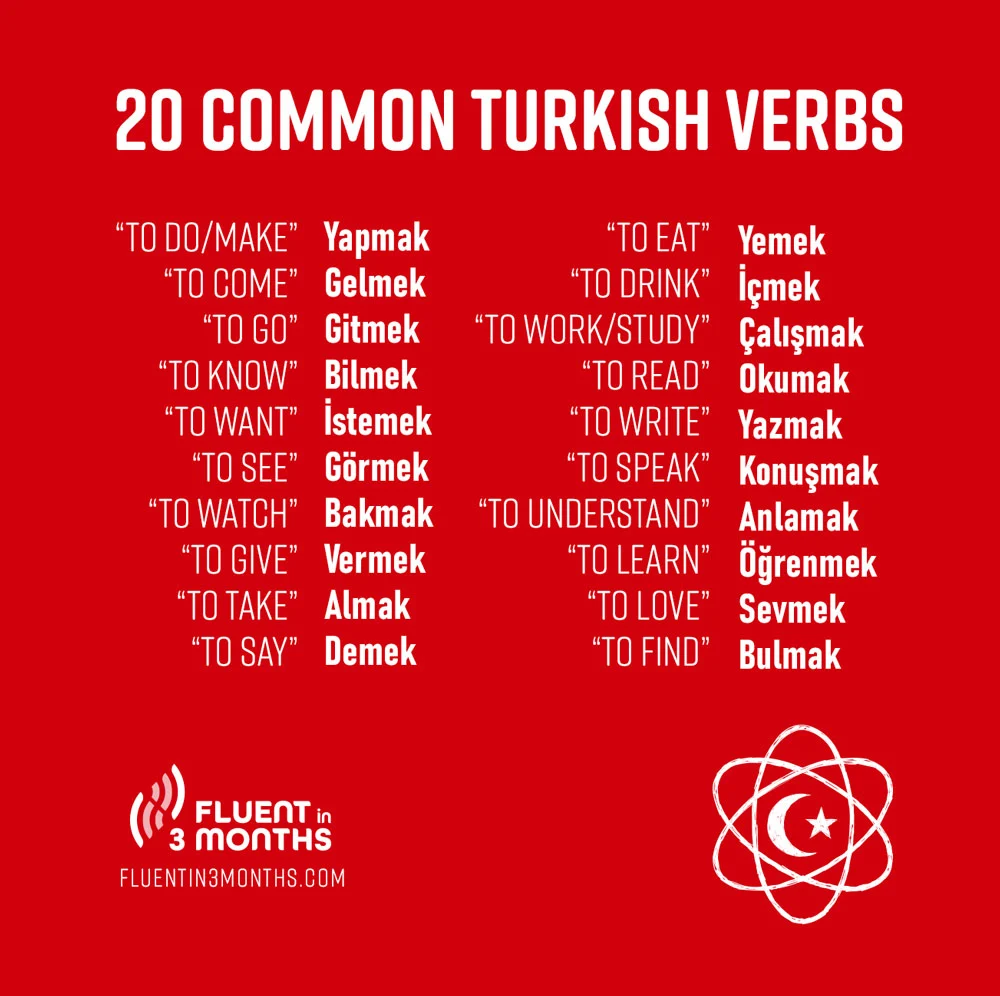
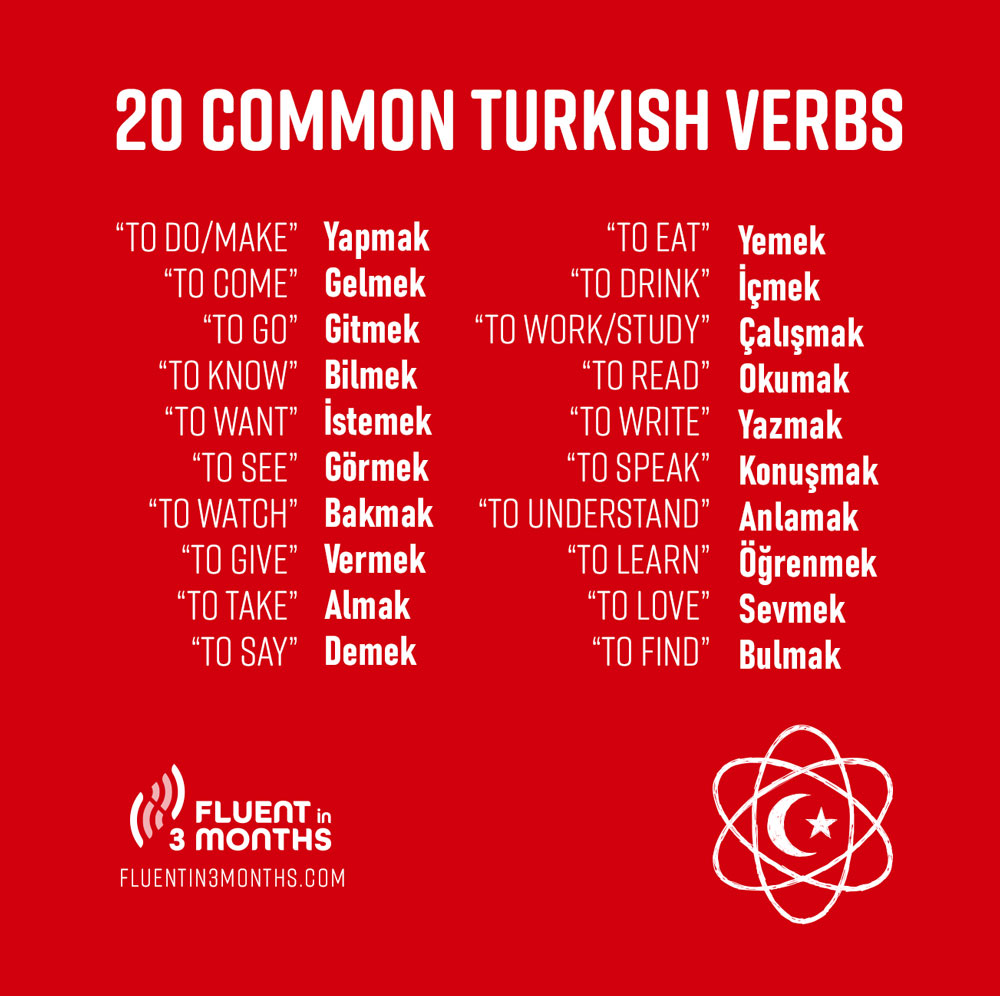
Verbs in Turkish follow a Subject-Object-Verb (SOV) order, a departure from the Subject-Verb-Object (SVO) structure common in English. High-frequency verbs such as "Yapmak" (to do/make), "Gelmek" (to come), "Gitmek" (to go), and "İstemek" (to want) are the engines of the sentence.
A unique feature of Turkish grammar is the absence of separate words for "to be" or "to have." These concepts are expressed through suffixes. For example, "Öğretmenim" (I am a teacher) incorporates the "am" into the noun "öğretmen" via the suffix "-im." Possession is expressed using "var" (there is/exists) and "yok" (there is not/does not exist). To say "I have a cat," one says "Benim bir kedim var" (My one cat exists). Understanding these functional substitutes is vital for basic sentence construction.
Descriptive Accuracy: Adjectives and Colors
Turkish adjectives consistently precede the nouns they modify. Common descriptors like "Büyük" (big), "Küçük" (small), "Güzel" (beautiful), and "Yeni" (new) allow for immediate environmental description. Interestingly, Turkish provides different words for "old" depending on the context: "Eski" is used for inanimate objects, while "Yaşlı" is reserved for people. This distinction is a key marker of a learner’s proficiency.
The color palette—"Kırmızı" (red), "Mavi" (blue), "Yeşil" (green), and "Beyaz" (white)—further enriches the learner’s ability to specify and identify objects in trade and daily interaction.
Chronology of Acquisition and Linguistic Milestones
Linguistic researchers suggest a specific timeline for mastering these core elements:
- Phase 1 (Weeks 1-4): Mastery of greetings, polite phrases, and basic subject pronouns (Ben, Sen, O, Biz, Siz, Onlar).
- Phase 2 (Months 2-4): Integration of high-frequency nouns and the 20 most common verbs, alongside basic present-tense conjugation.
- Phase 3 (Months 6+): Application of adjectives and conjunctions (Ve, Ama, Çünkü) to create complex sentences.
Broader Impact: The Global Proliferation of Turkish Vocabulary
The surge in popularity of Turkish media has led to an unprecedented global familiarity with certain Turkish words. Terms like "İnşallah" (God willing), "Valla" (I swear), and endearments like "Canım" (my dear) or "Aşkım" (my love) have entered the vernacular of international fans of Turkish television. This "soft power" effect has increased the demand for Turkish language education, with platforms like Duolingo reporting significant growth in Turkish learners in Europe, the Middle East, and Latin America.
From a geopolitical and economic perspective, Turkey’s position as a bridge between Europe and Asia makes language proficiency a valuable asset for professionals in logistics, diplomacy, and international trade. Understanding the core vocabulary is no longer just a hobby for travelers; it is a strategic tool for engagement in an increasingly interconnected regional economy.
Expert Analysis of Linguistic Implications
Linguists point out that the logical, phonetic, and consistent nature of Turkish—where each letter typically represents a single sound—makes the initial vocabulary acquisition phase more rewarding than in languages with irregular spelling like English or French. However, the challenge lies in the "mathematical" nature of adding suffixes.
"The hurdle for most learners isn’t the words themselves, but how they attach to one another," explains a language consultant at the Yunus Emre Institute. "Once a student internalizes the most common 200 to 300 words, the logic of the language begins to unfold. It is about pattern recognition. By learning ‘Yemek’ as both the noun for food and the verb to eat, the student begins to see the efficiency of the Turkish linguistic system."
In conclusion, the path to Turkish proficiency is paved with the strategic selection of high-frequency vocabulary. By prioritizing greetings, essential nouns, and core verbs, and by understanding the cultural weight behind phrases of politeness, learners can move beyond rote memorization toward meaningful cultural integration. As the Turkish language continues to expand its global footprint, these foundational building blocks remain the most effective tools for communication and mutual understanding.