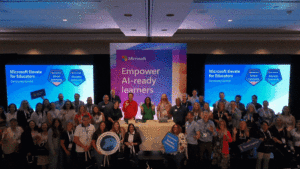




Microsoft has officially announced the opening of the advanced recognition application window for its flagship education program, Microsoft Elevate for Educators, for the 2026–2027 academic year. This initiative, designed to spotlight and support the global community of teachers and school administrators, focuses on the integration of artificial intelligence (AI) and digital transformation within the classroom. The application period, which commenced this month, is scheduled to remain open until July 31, 2026, offering a significant opportunity for educational institutions and individual practitioners to gain international recognition through the Educator Expert and Showcase School designations.
The program arrives at a pivotal moment for global education. As generative AI continues to reshape professional industries, the demand for AI literacy in K-12 and higher education has reached an all-time high. Microsoft’s Elevate for Educators initiative seeks to bridge the gap between technological potential and pedagogical practice, providing a framework for educators to move beyond basic digital literacy toward advanced AI fluency. By participating, educators join a massive global network currently exceeding 43,000 members, all of whom are dedicated to leveraging technology to improve student outcomes and streamline administrative burdens.
Strategic Objectives and Program Structure
The Microsoft Elevate for Educators program is structured around three core pillars: community connection, professional credentialing, and capacity building. The initiative is not merely a recognition program but a comprehensive professional development ecosystem. It provides educators with laddered pathways for training, ensuring that those at various stages of technological proficiency can find relevant resources to advance their skills.

The Educator Expert designation is awarded to individual teachers who demonstrate a commitment to innovation. These individuals are characterized by their ability to use Microsoft tools—including AI-driven platforms—to foster creativity and collaboration among students. On an institutional level, the Showcase School designation recognizes entire campuses that have successfully integrated technology into their organizational culture. These schools serve as regional and global models, demonstrating how digital tools can empower teaching and prepare students for a future dominated by automated and intelligent systems.
Chronology and Key Milestones for 2026–2027
The rollout of the 2026–2027 program follows a structured timeline designed to provide maximum support to applicants. Following the opening of the application window, Microsoft has scheduled a series of informational sessions and "office hours" to assist educators in navigating the requirements for recognition.
The scheduled sessions are as follows:
- June 3, 2026: Initial Program Overview (8:00 AM PT)
- June 17, 2026: Office Hours for applicant Q&A (4:00 PM PT)
- June 24, 2026: Office Hours for global time zone coverage (11:00 PM PT)
- July 8, 2026: Mid-cycle Program Overview (4:00 PM PT)
- July 15, 2026: Multiple Office Hour sessions (8:00 AM, 4:00 PM, and 11:00 PM PT)
- July 29, 2026: Final Office Hour sessions prior to deadline (8:00 AM and 4:00 PM PT)
The July 31 deadline is a hard cutoff for the 2026–2027 cycle, after which applications will undergo a rigorous review process. Successful applicants are typically notified in the late summer or early fall, allowing them to carry their new designations into the start of the northern hemisphere’s academic year.

Background and Context: The Evolution of Microsoft Education
Microsoft’s involvement in education technology spans several decades, evolving from providing basic productivity software to offering sophisticated, cloud-based learning management tools. The Elevate for Educators program is the latest iteration of Microsoft’s commitment to "MIE" (Microsoft Innovative Educator) principles. Historically, these programs have been instrumental in helping schools transition through various technological eras, from the introduction of personal computers in every classroom to the current era of ubiquitous cloud computing.
In recent years, the focus has shifted heavily toward AI. Since the integration of Copilot and other large language model (LLM) features into the Microsoft 365 ecosystem, the company has prioritized "AI literacy" as a fundamental skill. The 2026–2027 cycle represents a deepening of this commitment, as the program now explicitly looks for educators who are using AI not just as a tool for efficiency, but as a catalyst for "reshaping what students can create and imagine."
Supporting Data: The Rising Role of AI in Education
The expansion of the Elevate for Educators program is supported by emerging data regarding the adoption of technology in schools. According to recent industry reports, over 60% of K-12 educators have experimented with AI tools for lesson planning or grading assistance. Furthermore, a 2025 study on global workforce readiness indicated that students who graduate with a high degree of AI literacy are 35% more likely to secure entry-level positions in high-growth sectors such as data science, digital marketing, and software engineering.
Microsoft’s internal data highlights the scale of the Elevate community. With over 43,000 members, the network facilitates thousands of peer-to-peer interactions monthly. This community-led model of professional development is often cited by educational researchers as more effective than traditional top-down training, as it allows for the sharing of real-world classroom experiences and localized solutions to global educational challenges.

Official Responses and Inferred Implications
While specific statements from the 2026 announcement emphasize the "bold commitment" of educators, the broader implication from Microsoft’s leadership is clear: technology providers view educators as the primary gatekeepers of future economic competitiveness. By empowering teachers, Microsoft aims to ensure that the next generation of workers is proficient in the tools that the company produces, creating a symbiotic relationship between the tech sector and the public education system.
Educational analysts suggest that programs like Elevate for Educators serve a dual purpose. First, they provide a much-needed morale boost and professional validation for teachers, a group that has faced significant burnout in the post-pandemic era. Second, they provide Microsoft with a "feedback loop" of innovative use cases, which the company can then use to refine its software products for the education market.
Analysis of Broader Impact and Workforce Readiness
The long-term impact of the Microsoft Elevate for Educators program extends beyond individual classroom achievements. By standardizing what it means to be an "Expert" or a "Showcase School," Microsoft is effectively helping to define the global benchmarks for modern education. This standardization is particularly important in a globalized economy where educational credentials must be recognized across borders.
For students, the benefits are tangible. Schools that achieve Showcase status often report higher levels of student engagement and better performance in STEM subjects. The focus on AI literacy ensures that students are not merely passive consumers of technology but are capable of understanding the ethical implications, limitations, and creative possibilities of artificial intelligence.

Furthermore, the program addresses the "digital divide." By providing free resources, toolkits, and research to the Elevate community, Microsoft helps schools in lower-income districts gain access to the same high-level training and guidance available to elite private institutions. This democratization of AI expertise is essential for ensuring that the benefits of the "AI revolution" are distributed equitably across the global population.
Conclusion and Future Outlook
As the application window for 2026–2027 remains open, the educational community is expected to see a surge in interest. The integration of AI into the core curriculum is no longer a futuristic concept but a present-day requirement. Microsoft’s Elevate for Educators provides the necessary infrastructure for this transition, offering a blend of recognition and practical support that is unique in the EdTech landscape.
The upcoming informational sessions in June and July will be critical for those looking to join the 43,000-strong community. As education continues to evolve in a "digital-first" world, the leaders identified through this program will likely be the ones to define the pedagogical standards of the 2030s and beyond. For educators and school leaders ready to "lead with AI," the window for global recognition is now open.