



As Greece continues to solidify its position as one of the world’s premier travel destinations, with the Bank of Greece reporting a record-breaking 32.7 million international arrivals in recent fiscal cycles, the demand for linguistic competence among visitors has reached a new zenith. While English is widely spoken in major urban centers like Athens and Thessaloniki, as well as on high-traffic islands such as Mykonos and Santorini, a foundational understanding of the Greek language remains a critical asset for meaningful cultural exchange and practical navigation. The Greek language, a branch of the Indo-European family with a documented history spanning over 3,400 years, offers a unique window into Western civilization. For the modern traveler or student, mastering a specific set of high-frequency phrases is not merely an academic exercise but a functional necessity for navigating the complexities of local social etiquette, commerce, and emergency situations.
The Evolution and Context of Modern Greek
To understand the current linguistic landscape, it is essential to recognize that Modern Greek (Demotic) is the result of centuries of evolution from Ancient and Koine Greek. Unlike many European languages that underwent radical structural shifts, Greek maintains a high degree of continuity, though its pronunciation and syntax have streamlined significantly. Today, approximately 13.5 million people speak Greek globally, primarily in Greece and Cyprus. In the context of international relations and tourism, the Hellenic Ministry of Tourism has frequently emphasized that "Philoxenia"—the ancient Greek concept of hospitality toward strangers—is best unlocked when visitors attempt to engage with the local vernacular. This cultural bridge-building is supported by data from language learning platforms, which indicate a 20% year-over-year increase in interest for Mediterranean languages, driven by the rise of "slow travel" and digital nomadism.
The Foundations of Daily Communication
The primary building blocks of Greek interaction involve a series of affirmative, negative, and polite interjections. For the English speaker, the most common pitfall occurs with the word for "Yes." In Greek, "Yes" is rendered as Nai (pronounced ‘ne’), which phonetically resembles the English "Nay" or "No." Conversely, the word for "No" is Ochi (pronounced ‘o-hee’). This linguistic inversion often leads to confusion during initial transactions.
Beyond simple affirmations, the core of Greek politeness is centered on two words: Parakalo (Please) and Efcharisto (Thank you). Parakalo is a versatile term; it serves as "Please," "You’re welcome," and even "I beg your pardon?" depending on the inflection. For apologies, the term Signomi is used universally, whether one is physically bumping into someone on a crowded street or seeking to interrupt a conversation for a query.
Navigating Social Hierarchies through Greetings
Greek social interaction is governed by a distinction between formal and informal registers. This is most evident in the use of Yassas and Yasou.
- Yassas (Formal/Plural): This is the appropriate greeting when addressing elders, professionals, or groups of people. It conveys a level of respect essential in formal business environments or when entering a local shop.
- Yasou (Informal): This is reserved for friends, family, and children.
The temporal nature of Greek greetings is also strictly observed. Kalimera (Good morning) is typically used from sunrise until midday. After 12:00 PM or 1:00 PM, the transition to Kalispera (Good evening) begins, although in many rural areas, Kalo apogevma (Have a good afternoon) is used as a transitional parting. Kalinihta (Good night) is strictly a parting phrase used when one is going to sleep or leaving a venue late at night.
Survival Greek for the International Traveler
For the millions of tourists navigating the Greek islands and archaeological sites, "Survival Greek" focuses on logistics, commerce, and health. Data from the Hellenic Statistical Authority (ELSTAT) suggests that the majority of tourist interactions occur in the hospitality sector, where specific phrases can significantly alter the quality of service.
Logistics and Navigation:
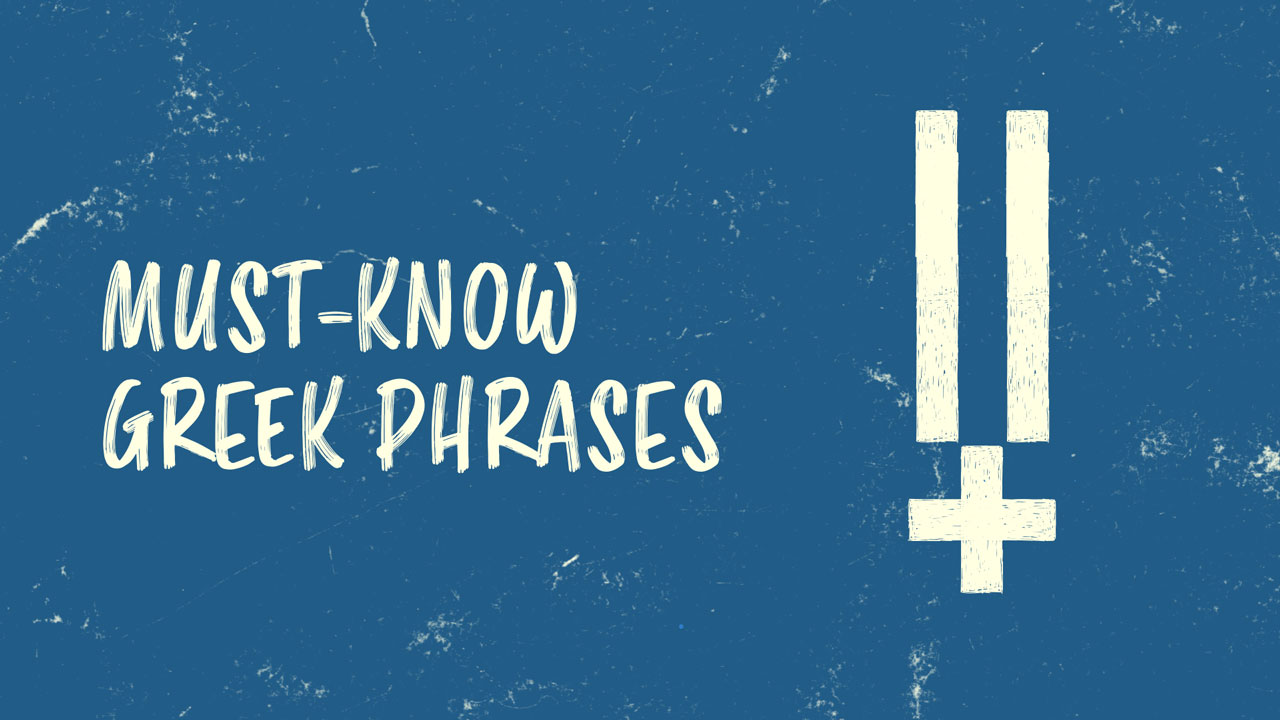
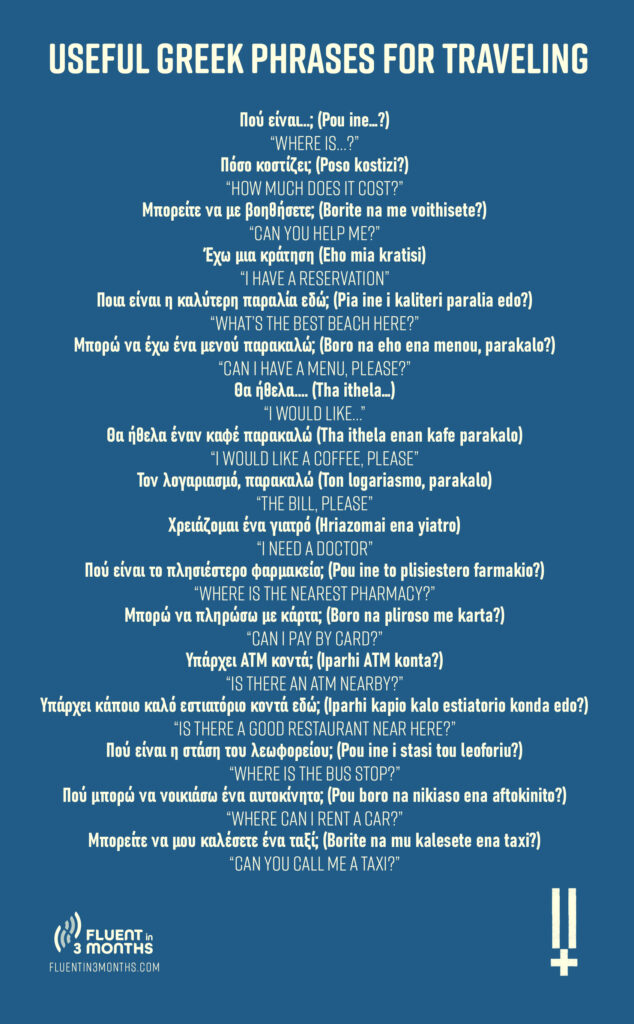
The phrase Pou ine…? (Where is…?) is the most vital tool for any traveler. Whether searching for the tualeta (bathroom) or the stasi tou leoforiu (bus stop), this prefix allows for basic orientation. In the event of a medical emergency, knowing Hriazomai ena yiatro (I need a doctor) or asking for the plisiestero farmakio (nearest pharmacy) provides a critical safety net.
Dining and Commerce:
Greece’s culinary reputation is a primary driver of its tourism economy. When dining, requesting the menu (Boro na eho ena menou, parakalo?) and eventually the bill (Ton logariasmo, parakalo) are standard procedures. For those with specific dietary needs or preferences, the phrase Tha ithela… (I would like…) followed by a noun is the standard way to order. In retail environments, particularly in markets where prices may not be fixed, Poso kani? (How much is it?) or the more formal Poso kostizi? (How much does it cost?) are essential.
Introducing the Self in a Professional and Social Context
For expatriates and long-term visitors, the ability to introduce oneself facilitates deeper social integration. The standard inquiry for a name is Pos se lene?, to which the response is Me lene… (My name is…). Identifying one’s origin is equally important; Ime apo tin Ameriki (I’m from America) or Ime apo to Inomeno Vasilio (I’m from the United Kingdom) are common responses to the question Apo pou ise? (Where are you from?).
Furthermore, discussing one’s profession or status—such as Ime fititis (I am a student) or Ime daskalos (I am a teacher)—helps establish a social profile. In a country that values education and lineage, these exchanges are often the precursor to the famous Greek "coffee culture," where conversations can last for hours.

The Role of Slang and Informal Vernacular
No analysis of the Greek language is complete without addressing its informal side. The word malaka is perhaps the most internationally recognized Greek slang term. While technically a profanity, its usage among friends is ubiquitous, often serving as a term of endearment or a casual filler similar to "dude" or "mate" in English. However, linguistic experts caution that its use by foreigners should be handled with extreme care, as it remains offensive if directed at strangers or in formal settings.
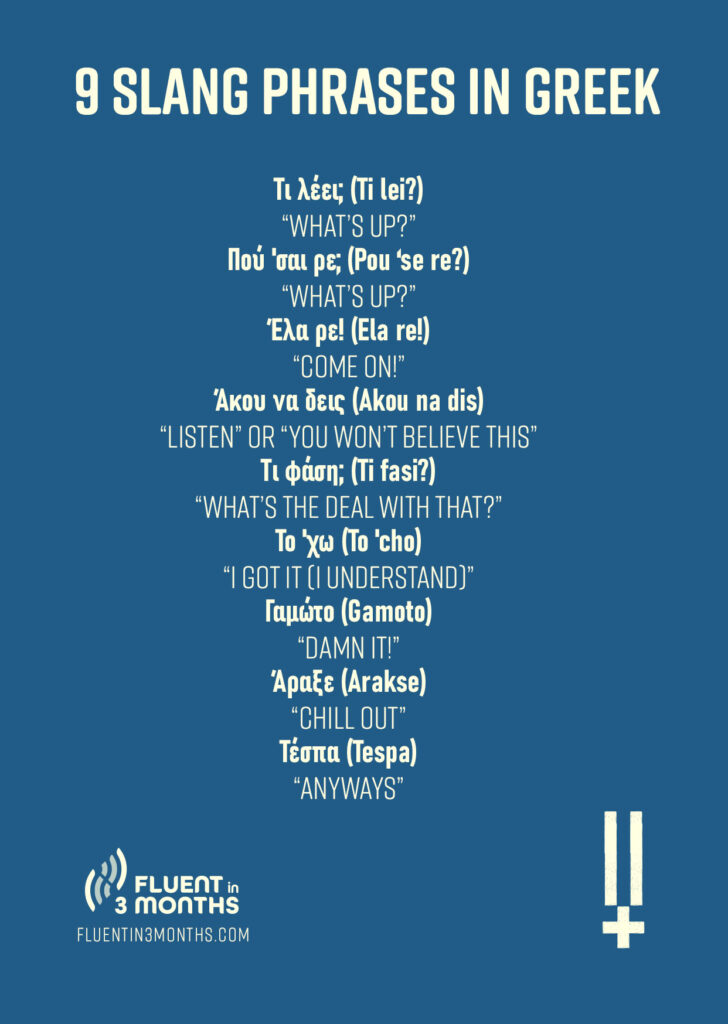
Other useful slang terms include Ti lei? (What’s up/What does it say?), Ela re! (Come on!/No way!), and Tespa (short for telos panton, meaning "anyways"). These terms are indicative of the rhythmic, expressive nature of Greek speech, which relies heavily on tone and hand gestures.
Cultural Wisdom through Proverbial Analysis
Proverbs (Paroimies) offer a deeper look into the Greek psyche, reflecting a history of resilience and philosophical inquiry. Analyzing these phrases provides more than just vocabulary; it provides a cultural framework.
- "The tongue has no bones, but it breaks bones": A warning about the power of speech and gossip.
- "Every beginning is difficult": A common encouragement for those starting new endeavors, including language learning.
- "With patience, the sour grape becomes honey": A testament to the Greek value of persistence and the rewards of time.
- "A drop of honey catches more flies than a barrel of vinegar": An endorsement of kindness over aggression in social dealings.
- "Better to have your eye out than your name out": Highlighting the supreme importance of reputation and honor (Filotimo) in Greek society.
Economic and Sociological Implications of Language Proficiency
The enrichment of a traveler’s vocabulary has measurable impacts on the local economy. Studies in sociolinguistics suggest that travelers who speak basic local phrases are less likely to be targeted by "tourist pricing" and more likely to receive authentic recommendations that support small, local businesses rather than large international chains. This "linguistic empathy" fosters a more sustainable form of tourism that benefits the host community’s cultural pride.
Furthermore, the Greek government has recently invested in digital infrastructure to make the language more accessible. The "Study in Greece" initiative, for instance, promotes Greek language courses for international students, viewing the language as a form of "soft power." By learning these phrases, visitors are not just navigating a country; they are participating in the preservation of a linguistic tradition that has shaped the modern world’s concepts of democracy, philosophy, and science.
Future Outlook: The Digital Language Learning Market
As we move toward the latter half of the decade, the integration of AI and augmented reality into language learning is expected to change how travelers interact with the Greek language. Real-time translation apps are becoming more sophisticated, yet the consensus among educators remains that "human-to-human" linguistic effort is irreplaceable for building trust. The phrases outlined in this guide represent the "gold standard" of essential Greek communication—a toolkit that remains relevant regardless of technological advancement.
In conclusion, while the Greek alphabet and its unique phonetic sounds may initially seem daunting to the uninitiated, the effort to learn basic phrases is a high-yield investment. It transforms a standard vacation into an immersive cultural experience, opening doors to the "authentic Greece" that lies beyond the palace walls of the major resorts. Whether it is a simple Yamas! (Cheers!) over a glass of ouzo or a complex inquiry about the kaliteri paralia (best beach), speaking the language of the land is the ultimate tribute to the enduring spirit of Hellas.