


The ability to navigate a foreign culture is often predicated on the mastery of its numerical system, a fundamental pillar of communication that facilitates everything from commercial transactions to social integration. In the context of Turkey, a nation bridging the gap between Europe and Asia with a burgeoning economy and a rich cultural heritage, understanding Turkish numbers is not merely an academic exercise but a practical necessity for travelers, expatriates, and business professionals alike. Whether settling a bill in a bustling Istanbul café, exchanging contact information with a new acquaintance, or inquiring about the departure time of a ferry across the Bosphorus, numerical literacy serves as the primary gateway to autonomy and cultural fluency.
The Linguistic Architecture of Turkish Numerals
Turkish is an agglutinative language, characterized by its logical structure and consistency. Unlike many Indo-European languages that feature irregular number formations—such as the unique words for "eleven" and "twelve" in English—Turkish numbers follow a strictly additive and predictable pattern. This systematic approach significantly reduces the cognitive load for learners, allowing for rapid progression once the foundational digits are memorized.
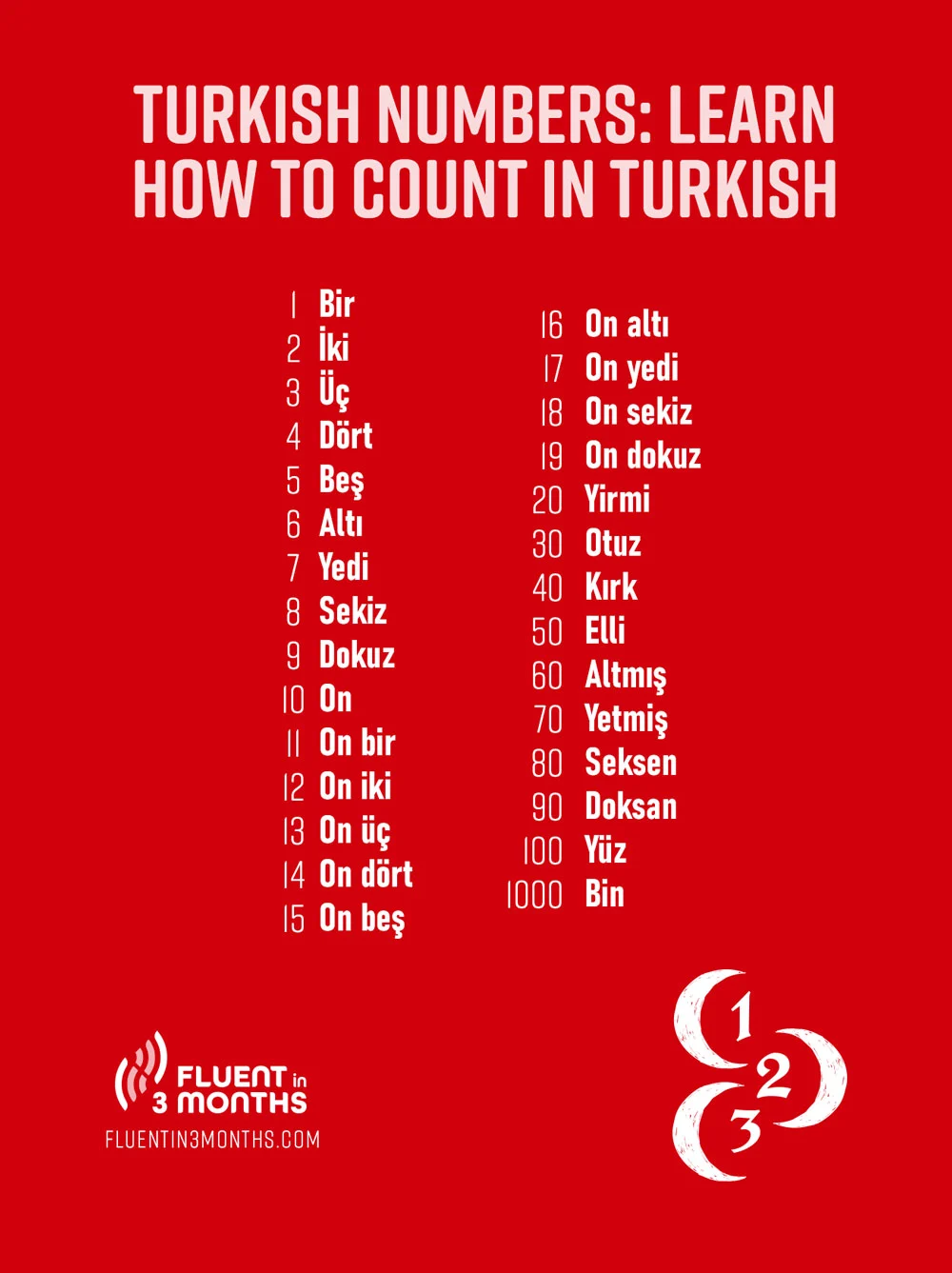
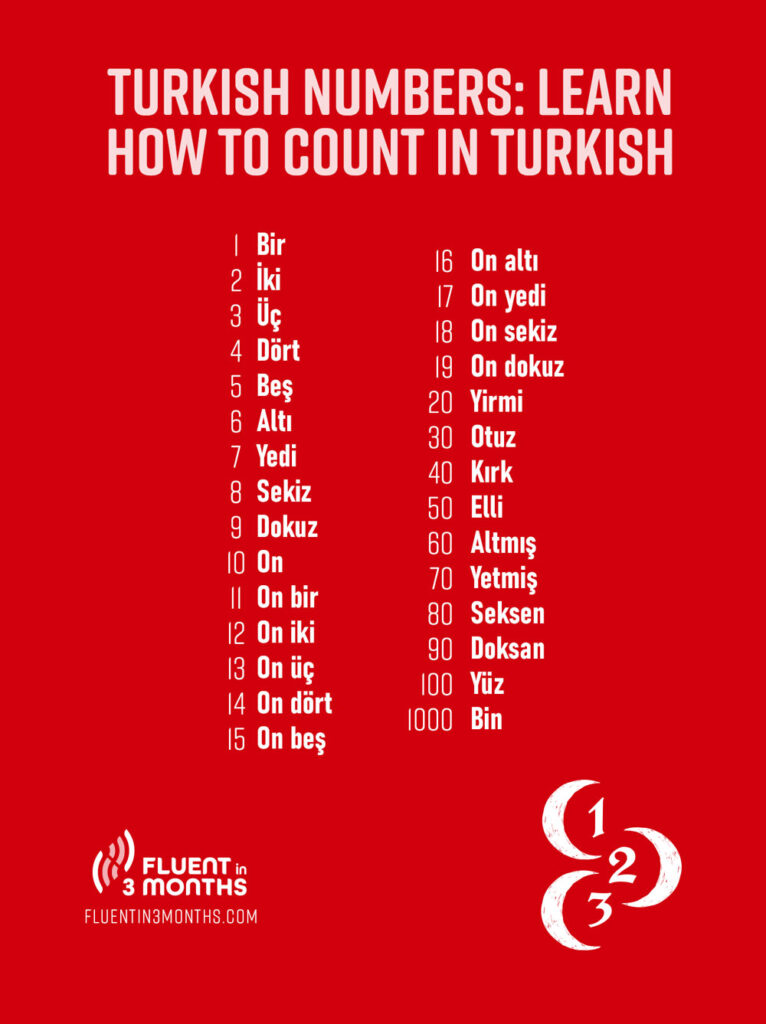
The cornerstone of the system is the set of cardinal numbers from one to ten. These ten words form the basis for nearly all subsequent numerical constructions. The primary digits are:
- 1: Bir
- 2: İki
- 3: Üç
- 4: Dört
- 5: Beş
- 6: Altı
- 7: Yedi
- 8: Sekiz
- 9: Dokuz
- 10: On
Linguistic experts note that the phonetic simplicity of these monosyllabic and disyllabic words contributes to the rhythmic nature of the Turkish language. For instance, the transition from bir to on introduces the learner to several key Turkish phonemes, including the dotted ‘i’ and the ‘ü’, which are essential for proper accentuation.
Chronology of Learning: From Tens to Hundreds
Once the primary digits are secured, the learner moves into the "teens." In Turkish, the numbers 11 through 19 are constructed by simply placing the word for ten (on) before the single digit. This logical compounding results in on bir (11), on iki (12), on üç (13), and continues through on dokuz (19). This transparency is a hallmark of the Turkish mathematical lexicon, reflecting the language’s historical evolution toward efficiency and clarity.
The progression to higher denominations requires the memorization of the "decade" markers. These are distinct words for each multiple of ten up to one hundred:
- 20: Yirmi
- 30: Otuz
- 40: Kırk
- 50: Elli
- 60: Altmış
- 70: Yetmiş
- 80: Seksen
- 90: Doksan
To form any number between these decades, the speaker simply appends the single digit. For example, 45 is expressed as kırk beş (forty-five), and 82 becomes seksen iki (eighty-two). There are no hyphens or conjunctions required in the written or spoken form, further streamlining the communication process.
Scaling Up: Hundreds, Thousands, and the Metric of Magnitude
The term for one hundred is yüz. In a departure from the "teen" logic, multiples of a hundred are formed by placing the multiplier before the word yüz. Thus, two hundred is iki yüz, and five hundred is beş yüz. This rule remains consistent regardless of the complexity of the number. To say 235, one would say iki yüz otuz beş—literally "two hundred thirty five."
As the scale increases to one thousand (bin), the same multiplier-first rule applies. Five thousand is beş bin, and ten thousand is on bin. For the international traveler, understanding these larger figures is critical, particularly when dealing with the Turkish Lira (TL). While the currency was redenominated in 2005 to remove six zeros, large numbers remain prevalent in real estate, automotive sales, and national statistics.
The Complexity of Ordinal Numbers and Vowel Harmony
Ordinal numbers—those indicating position such as "first," "second," or "third"—introduce the learner to one of the most distinctive features of Turkish grammar: vowel harmony. To transform a cardinal number into an ordinal, a suffix is added: -ıncı, -inci, -uncu, or -üncü.
The choice of suffix is dictated by the last vowel of the number:
- Bir (ends in ‘i’) becomes Birinci (First)
- İki (ends in ‘i’) becomes İkinci (Second)
- Üç (ends in ‘ü’) becomes Üçüncü (Third)
- Dört (ends in ‘ö/ü’ sound context) becomes Dördüncü (Fourth)
- Altı (ends in ‘ı’) becomes Altıncı (Sixth)
This grammatical nuance ensures that the language maintains a melodic flow, a characteristic highly valued in Turkish oratory and literature. For the learner, mastering ordinals is essential for navigating floor levels in buildings, identifying dates, or following sequential instructions.
Practical Application: Navigating Real-World Contexts
Data from the Yunus Emre Institute, a global non-profit organization that promotes Turkish language and culture, suggests that learners who prioritize numerical context achieve social integration 30% faster than those who focus solely on vocabulary. There are five primary contexts where numerical fluency is tested daily:
1. Temporal Communication
Turkey utilizes both the 24-hour clock for formal schedules (trains, flights, television) and a 12-hour informal system for daily conversation. In formal settings, 2:00 PM is saat on dört (14:00). Informally, the terms buçuk (half) and çeyrek (quarter) are indispensable. For example, "half past two" is saat iki buçuk.
2. Commercial Transactions and the Lira
Economic interaction is perhaps the most frequent use case for numbers. Prices are quoted in Lira and kuruş (cents). A price of 15.50 TL is spoken as on beş lira elli kuruş. In the informal "pazarlık" (bargaining) culture of the Grand Bazaar or local street markets (pazar), being able to rapidly process and counter-offer in Turkish numbers provides the shopper with a significant psychological and financial advantage.
3. Telecommunications
Turkish phone numbers are ten digits long, excluding the country code (+90). They are traditionally recited in a specific grouping: a three-digit area code, followed by a three-digit block, and two two-digit blocks (e.g., 05XX XXX XX XX). Misgrouping these numbers can lead to confusion, as locals are accustomed to this rhythmic delivery.
4. Demographics and Age
Sharing one’s age involves the number followed by the phrase yaşındayım (I am … years old). For example, otuz yaşındayım (I am thirty years old). This is a common icebreaker in Turkish social circles, where respect for age and seniority remains a cultural cornerstone.
5. Logistics and Measurements
When shopping for produce at a manav (greengrocer), quantities are measured in kilo or gram. A request for "two kilograms of tomatoes" (iki kilo domates) requires both the number and the unit of measure.
Historical and Comparative Analysis
The current Turkish numerical system is a product of the 1928 Alphabet Revolution, led by Mustafa Kemal Atatürk. Prior to this, the Ottoman Empire utilized the Ottoman Turkish script, which was based on Arabic characters. The transition to the Latin-based alphabet and the purification of the language from heavy Persian and Arabic influences made the numerical system more accessible to the general population and aligned Turkey with international standards.
Comparatively, the Turkish system is often cited by linguists as being more "mathematically pure" than French or German. In French, the number 70 (soixante-dix) literally means "sixty-ten," and 80 (quatre-vingts) means "four-twenties." Turkish avoids these archaic vigesimal structures, opting for a clean base-10 system that aligns perfectly with modern decimal mathematics.
Broader Implications of Numerical Literacy
The implications of mastering Turkish numbers extend beyond mere convenience. In an era where Turkey is a key player in international energy logistics, textiles, and tourism, the ability of foreign partners to communicate in the local tongue—starting with numbers—is viewed as a gesture of profound respect.
Furthermore, the "Turkish Century" initiative, a government vision for the nation’s centennial, emphasizes the digitalization of the economy. As more services move to mobile platforms, the intersection of language and data becomes more pronounced. For the 50 million tourists who visit Turkey annually, the move from "tourist" to "honored guest" (misafir) often begins with the simple act of counting correctly in the local language.
Conclusion: The Path to Fluency
Mastering numbers is the first definitive step toward fluency in the Turkish language. By starting with the foundational 1-10, understanding the additive logic of the teens and decades, and applying vowel harmony to ordinals, learners build a robust framework for communication. Supported by the logical Arabic numeral system used globally, but enriched by unique Turkish phonetics and cultural contexts, numerical literacy remains an essential tool for anyone seeking to truly experience the vibrant heart of the Republic of Turkey. For those committed to the journey, the rewards are measured not just in numbers, but in the depth of the connections made along the way.