



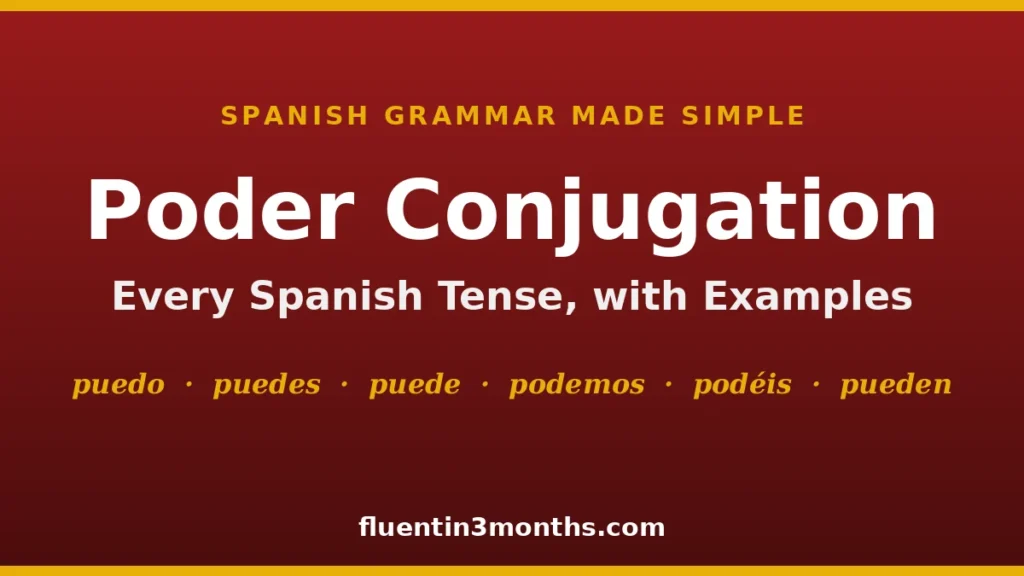
The Spanish verb poder serves as the functional bedrock of daily communication, acting as the primary linguistic mechanism for expressing ability, possibility, and permission. As a high-frequency modal verb, it is indispensable for learners and native speakers alike, yet its conjugation patterns present significant challenges due to its double-layered irregularity. Understanding the mechanics of this verb—specifically its stem-changing nature and its unique preterite forms—is essential for achieving communicative competence in Spanish.
Linguistic Anatomy and Structural Irregularities
Poder is classified as an irregular verb, specifically categorized under the "o-ue" stem-changing group. This phonetic shift occurs when the root vowel "o" undergoes a diphthongization to "ue" under stress. This pattern is consistent across the present indicative and present subjunctive moods, with the notable exception of the nosotros (we) and vosotros (you all) forms. In these instances, the stress shifts to the terminal syllable, preserving the original stem.
Beyond the stem-changing phenomenon, poder possesses a "strong preterite." This group of verbs, which includes tener (to have), estar (to be), and poner (to put), replaces the standard infinitive-based stem with an entirely new, irregular root. In the case of poder, the stem transforms into pud-. Notably, these preterite forms do not utilize written accents on the first-person singular (pude) or third-person singular (pudo) forms, a common point of confusion for students.
Historical Context and Usage Trends
Linguistically, poder traces its origins to the Latin potere, a compound of potis (able) and esse (to be). Its evolution has mirrored the general simplification of Romance language syntax, moving from a complex set of Latin inflections to the streamlined, albeit irregular, modal system used in modern Spanish.
Data from the Royal Spanish Academy (RAE) corpus indicates that poder consistently ranks among the top 20 most frequently used verbs in the Spanish language. This frequency underscores the necessity of mastering its various tenses, as it is foundational for constructing complex sentences involving compound verbs and auxiliary structures.
The Poder vs. Saber Distinction
A frequent stumbling block for English-speaking learners is the overlap between poder and saber. While both can be translated as "can" in English, they are not interchangeable in Spanish. Saber denotes learned skill or knowledge ("Saber nadar"—to know how to swim), whereas poder signifies physical ability or situational feasibility ("Poder nadar"—to be able to swim because the pool is open).
Failure to distinguish between these terms can lead to ambiguity. Research into language acquisition suggests that early mastery of this distinction is a reliable indicator of a learner’s transition from basic survival Spanish to intermediate fluency.
Chronology of Conjugation Patterns
To effectively utilize poder, it is helpful to categorize its application across different moods and tenses:
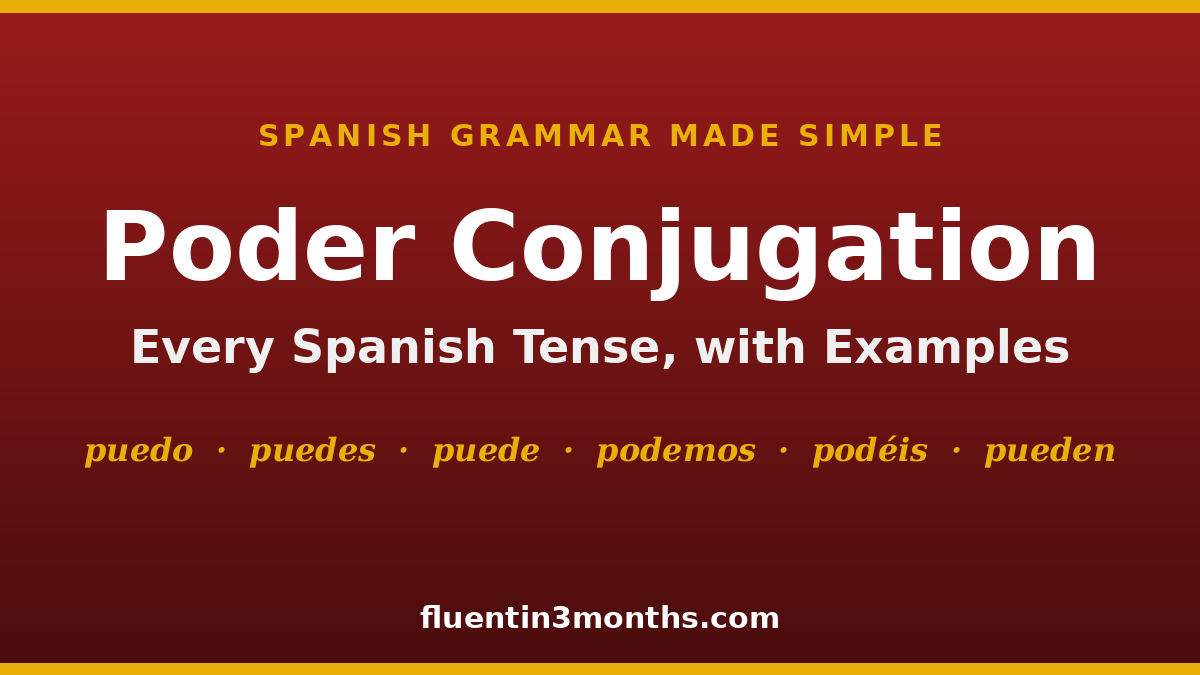
1. The Indicative Mood (Stating Facts)
- Present: Utilized for current capacity (e.g., puedo—I can).
- Preterite: Used to describe a specific achievement or a completed attempt. This is often translated as "managed to" or "succeeded in."
- Imperfect: Describes a general or ongoing capacity in the past, often used for descriptions of circumstances.
- Future and Conditional: Used to express hypothetical scenarios or future capabilities. Podría (I could) is the standard, polite form used for requests.
2. The Subjunctive Mood (Doubt and Desire)
The subjunctive is employed when expressing uncertainty, emotions, or hypothetical outcomes. The present subjunctive (pueda) and the imperfect subjunctive (pudiera/pudiese) are the most critical for everyday usage. The "ra" and "se" variants of the imperfect subjunctive are technically interchangeable, though regional preferences often lean toward the "ra" form in Latin America.
3. Compound Tenses
These are constructed by combining the auxiliary verb haber with the past participle podido. This structure allows for the expression of complex temporal relationships, such as the pluperfect ("I had been able to") or the future perfect ("I will have been able to").
Quantitative Analysis of Modal Usage
Language researchers have observed that in spontaneous speech, approximately 80% of poder usage is restricted to the present indicative and the conditional podría. Consequently, linguistic pedagogy often emphasizes these forms as "high-yield" content. For learners, prioritizing these forms can yield immediate results in communicative efficacy, while the more complex tenses, such as the pretérito anterior (hube podido), remain largely reserved for formal literature or legal documents.
Practical Applications and Implications
The implications of misusing poder are primarily pragmatic. Because it is a modal verb, it often dictates the tone of a social interaction. For example, the shift from the indicative puedes (you can) to the conditional podrías (could you) is the difference between a direct statement and a polite request. Mastering this nuance is a hallmark of cultural literacy in Spanish-speaking regions.
Furthermore, the "strong preterite" nature of poder serves as a gateway to understanding a broader set of irregular verbs. Once a student grasps the pud- stem shift, they can apply similar logic to tener (tuv-) and estar (estuv-), thereby accelerating the learning process for other essential verbs.
Expert Perspectives on Language Acquisition
Pedagogical experts often advocate for a "functional" approach to learning poder. Rather than rote memorization of complete, sprawling conjugation tables, instructors suggest focusing on "sentence stems"—fixed phrases that incorporate the verb in its most useful forms. For instance, practicing "No he podido…" (I haven’t been able to…) or "Podrías…" (Could you…) allows the speaker to navigate daily challenges—such as negotiating schedules, asking for help, or clarifying permissions—without requiring total mastery of the future perfect or the future subjunctive.
Future Perspectives in Spanish Linguistics
As Spanish continues to evolve, the usage of poder remains remarkably stable due to its status as a core modal verb. While some regional variations exist in the use of the subjunctive, the fundamental rules governing poder are unlikely to shift. For those engaged in language study, the consensus among linguists remains clear: focus on the present tense for immediate utility, master the conditional for politeness, and recognize the past tense patterns to ensure narrative clarity.
In conclusion, poder is more than a linguistic curiosity; it is a tool for agency. By understanding the intersection of its irregular stem changes and its specific situational roles, learners can move beyond simple vocabulary acquisition and into the realm of fluid, nuanced expression. Whether navigating a professional setting in Madrid or engaging in casual conversation in Mexico City, the ability to command poder is, quite literally, the ability to participate in the language.