



Microsoft has officially released a comprehensive update to its Education AI Toolkit, signaling a pivotal shift in how academic institutions transition from localized artificial intelligence pilots to systemic, campus-wide integration. As primary schools, universities, and regional districts increasingly deploy sophisticated technologies—ranging from multilingual instructional bots to automated administrative assistants—the updated toolkit provides a structured roadmap designed to address the complexities of scaling AI in diverse learning environments. The latest iteration of the resource focuses on "agentic AI," institutional innovation, and the move from individual productivity gains to collective organizational transformation.
Strategic Foundations of the AI Transformation
The Microsoft Education AI Toolkit is now structured around a streamlined, landscape-oriented navigation system designed to facilitate easier access for administrators and educators. The framework is built upon three core pillars that Microsoft identifies as the essential components of a successful AI strategy: Student Success, Institutional Innovation, and Simplified/Secure IT.
Under the Student Success pillar, the focus remains on personalizing the learning experience. This includes the deployment of tutoring-style support systems, automated assessment tools that provide real-time feedback, and the creation of skills-based pathways that lead to industry-recognized certifications. For Institutional Innovation, the toolkit emphasizes the modernization of legacy infrastructure. By utilizing AI-powered insights, universities and school districts can automate redundant administrative tasks, thereby freeing faculty to focus on high-value pedagogical interactions.
The third pillar, Simplify and Secure IT, addresses the primary concern of many educational leaders: data privacy and system integrity. The toolkit integrates guidance on using Microsoft Security Copilot for threat detection and establishes rigorous data governance protocols. This three-pronged approach ensures that as schools adopt generative AI, they do so within a framework that balances innovation with safety and operational efficiency.

Chronology of AI Integration in Global Education
The evolution of AI in the classroom has moved with unprecedented speed over the last three years. In late 2022 and early 2023, the educational sector was largely reactive, grappling with the sudden availability of Large Language Models (LLMs) and concerns regarding academic honesty. By mid-2023, the conversation shifted toward "AI Literacy," with organizations like Microsoft and Code.org launching initial resources to help teachers understand the technology.
In 2024, the "Pilot Phase" began in earnest. Leading institutions like Auburn University and the University of Leicester began testing specific use cases, such as AI-driven digital coaches and specialized research assistants. The current update to the Microsoft Education AI Toolkit, released in early 2025, represents the "Institutional Phase." This era is defined by the move away from isolated classroom experiments toward coordinated, department-level implementations. The introduction of "AI Sparks" within the toolkit reflects this timeline, providing blueprints for teams—rather than just individuals—to adopt AI at scale.
From Snapshots to Sparks: Scaling Innovation
A significant addition to the updated toolkit is the "AI Sparks" section, which serves as a bridge between individual use and systemic adoption. Microsoft distinguishes between "AI Snapshots" and "AI Sparks" to help leaders understand the scope of their implementations.
An AI Snapshot typically involves an individual practitioner using a tool like Microsoft 365 Copilot Chat to generate a lesson plan or summarize a research paper. While valuable, these snapshots represent isolated pockets of efficiency. In contrast, an AI Spark demonstrates how a cohesive team—such as a district-wide literacy department—uses tools like Learning Accelerators, Reading Coach, and Reading Progress to standardize and accelerate early literacy across hundreds of classrooms simultaneously.
In higher education, this transition is visible in IT support. While a single specialist might use AI to write code (a Snapshot), a department-wide Spark involves using Microsoft Copilot Studio analytics to identify recurring helpdesk issues across a campus of 30,000 students. By proactively updating resources based on these AI-generated insights, the institution can reduce ticket volume and improve the overall student experience, demonstrating a clear return on investment (ROI) for the technology.

The Rise of Agentic AI in Academic Operations
Perhaps the most forward-looking aspect of the updated toolkit is the introduction of "Agentic AI." Unlike traditional AI, which requires a prompt for every response, agentic systems can be designed to perform multi-step tasks autonomously within a governed framework. These agents can route complex administrative queries, manage enrollment workflows, or provide 24/7 on-demand access to university information.
The toolkit outlines two primary pathways for institutions to build these agents. Microsoft Copilot Studio offers a "low-code" or "no-code" environment, allowing non-technical staff to create functional agents quickly. For more sophisticated, custom-built solutions, the toolkit points toward Azure AI Foundry. A notable case study featured in the update is the University of Leicester, which implemented an AI-powered digital coach. This system successfully reduced the administrative workload on staff while providing students with immediate, accurate answers to institutional questions, effectively bridging the gap between student needs and staff capacity.
Supporting Data and Research Foundations
The toolkit is grounded in a strengthened research foundation, reflecting a growing body of evidence regarding AI’s impact on learning outcomes. Microsoft has categorized its research resources into three areas: pedagogical impact, operational efficiency, and ethical governance.
Recent data suggests that institutions implementing structured AI frameworks see a marked increase in teacher retention, as the technology can reduce "clerical" tasks by up to 30%. Furthermore, research into AI literacy indicates that students who engage with AI-foundational curriculum, such as the "Hour of AI" developed in partnership with Code.org, show higher levels of critical thinking regarding digital ethics.
The toolkit also incorporates findings from the Fall 2025 "Hour of AI" launch. This initiative, which expanded upon the "Hour of Code," utilized Minecraft Education’s "Generation AI" lessons to teach foundational AI concepts to millions of students worldwide. By grounding the toolkit in this data, Microsoft aims to build stakeholder confidence, providing school boards and parents with the evidence needed to support long-term AI investments.

Implementation Roadmaps and Official Checklists
To move from theory to practice, the toolkit now includes "Action-ready checklists." These are designed to be assignable tasks for different stakeholders within an institution. The checklists guide teams through several critical phases:
- Readiness Assessment: Evaluating current IT infrastructure and data cleanliness.
- Stakeholder Alignment: Ensuring that faculty, parents, and students are part of the governance conversation.
- Deployment Logistics: Step-by-step technical guides for enabling Copilot and other AI tools.
- Continuous Evaluation: Frameworks for measuring the success of AI implementations through student feedback and operational data.
These checklists are intended to prevent institutions from skipping fundamental steps, such as establishing a clear privacy policy before deploying a student-facing chatbot.
Broader Impact and Global Implications
The expansion of the Microsoft Education AI Toolkit comes at a time when the "Digital Divide" threatens to become an "AI Divide." By providing these resources for free, Microsoft is attempting to democratize access to high-level strategic planning. Educational analysts suggest that without such frameworks, smaller or less-funded districts might struggle to implement AI safely, potentially leaving their students at a disadvantage in a future workforce that will demand AI fluency.
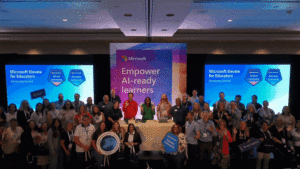
Furthermore, the integration of "Microsoft Elevate for Educators" within the toolkit creates a global network of practitioners. This community-driven approach allows a school leader in a rural district to learn from the successes and failures of a large metropolitan university. This peer-to-peer exchange is seen as vital for the "responsible and sustainable" adoption of technology that is evolving faster than traditional educational policy can be written.
Future Outlook: From Adoption to Transformation
As the educational sector moves toward the end of the decade, the focus is shifting from simply "adopting" AI to undergoing a "transformation" of the educational experience. The updated Microsoft Education AI Toolkit serves as a comprehensive manual for this journey. By addressing technical, instructional, and operational needs simultaneously, the framework seeks to create a student-centered environment where AI acts as a scaffold for human intelligence rather than a replacement for it.

The toolkit’s five core sections—Overview, AI Navigators, Plan, Implement, and Research—provide a cyclical model for growth. As institutional needs evolve, the toolkit is designed to be updated, reflecting new advancements in agentic capabilities and pedagogical research. For education leaders, the message is clear: the era of AI experimentation is concluding, and the era of coordinated, strategic transformation has begun.