
Microsoft has officially unveiled a comprehensive suite of AI-powered tools and services specifically tailored for the global education sector, aiming to address the unique challenges faced by educators, students, and institutional administrators. The announcement includes the introduction of "Teach," a platform for educators, "Study and Learn," an advanced student-facing agent, and a new $18 per-user monthly academic offering for Microsoft 365 Copilot. These developments signal a major shift in how the technology giant intends to integrate generative artificial intelligence into the classroom, moving beyond general productivity toward specialized academic workflows.
The move comes at a critical juncture for the education sector. According to Microsoft’s 2025 AI in Education Report, over 80% of respondents have already utilized AI for school-related tasks. However, the report also highlights a growing demand for purpose-built tools that go beyond simple content generation to address pedagogical needs, accessibility, and administrative efficiency. As educators juggle curriculum design, student advocacy, and frontline innovation, Microsoft’s new offerings are positioned as a "force multiplier" to reduce burnout and enhance learning outcomes.
Specialized Tools: Empowering Educators with Teach
Central to the announcement is the launch of "Teach," a specialized AI experience designed to streamline class preparation and instructional design. Teach is currently rolling out within the Microsoft 365 Copilot app and is being provided at no additional cost to existing education customers. The platform allows educators to access a centralized hub for creating lesson plans, drafting quizzes, and developing rubrics.
Unlike general-purpose AI chat tools, Teach is designed to respect the professional expertise of the educator. It offers intuitive customization features that allow teachers to modify the reading level, language, length, and difficulty of materials. Crucially, the tool can align generated content with specific educational standards, ensuring that AI-assisted materials meet state or national curriculum requirements.
Beyond lesson planning, Microsoft plans to integrate Teach directly into Learning Management Systems (LMS) and existing productivity tools like Microsoft Teams and OneNote. This integration is designed to ensure that AI capabilities are available within the "daily flow" of work, rather than requiring teachers to switch between disparate platforms.
Advancing Student Skill Growth through Study and Learn
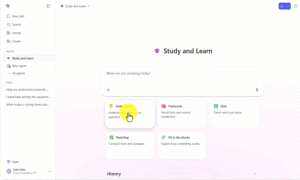
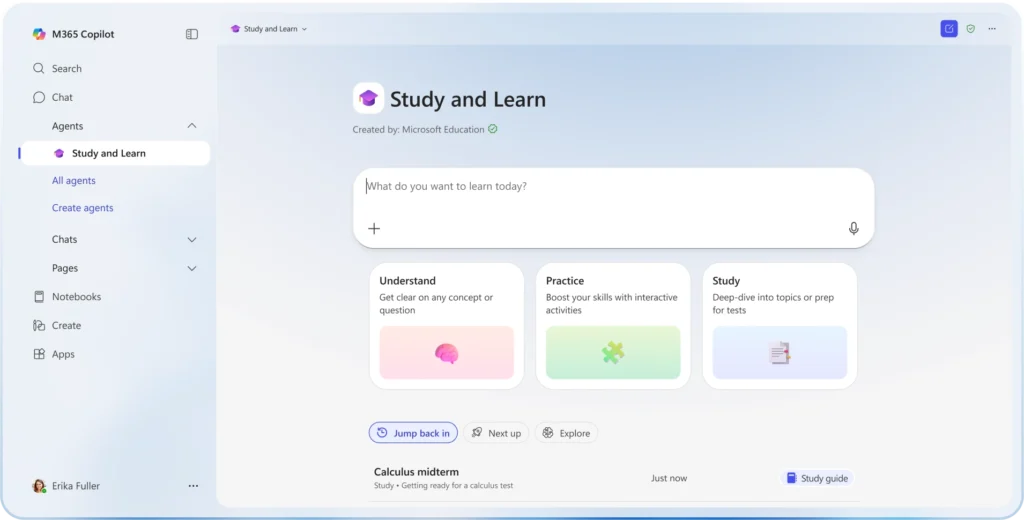
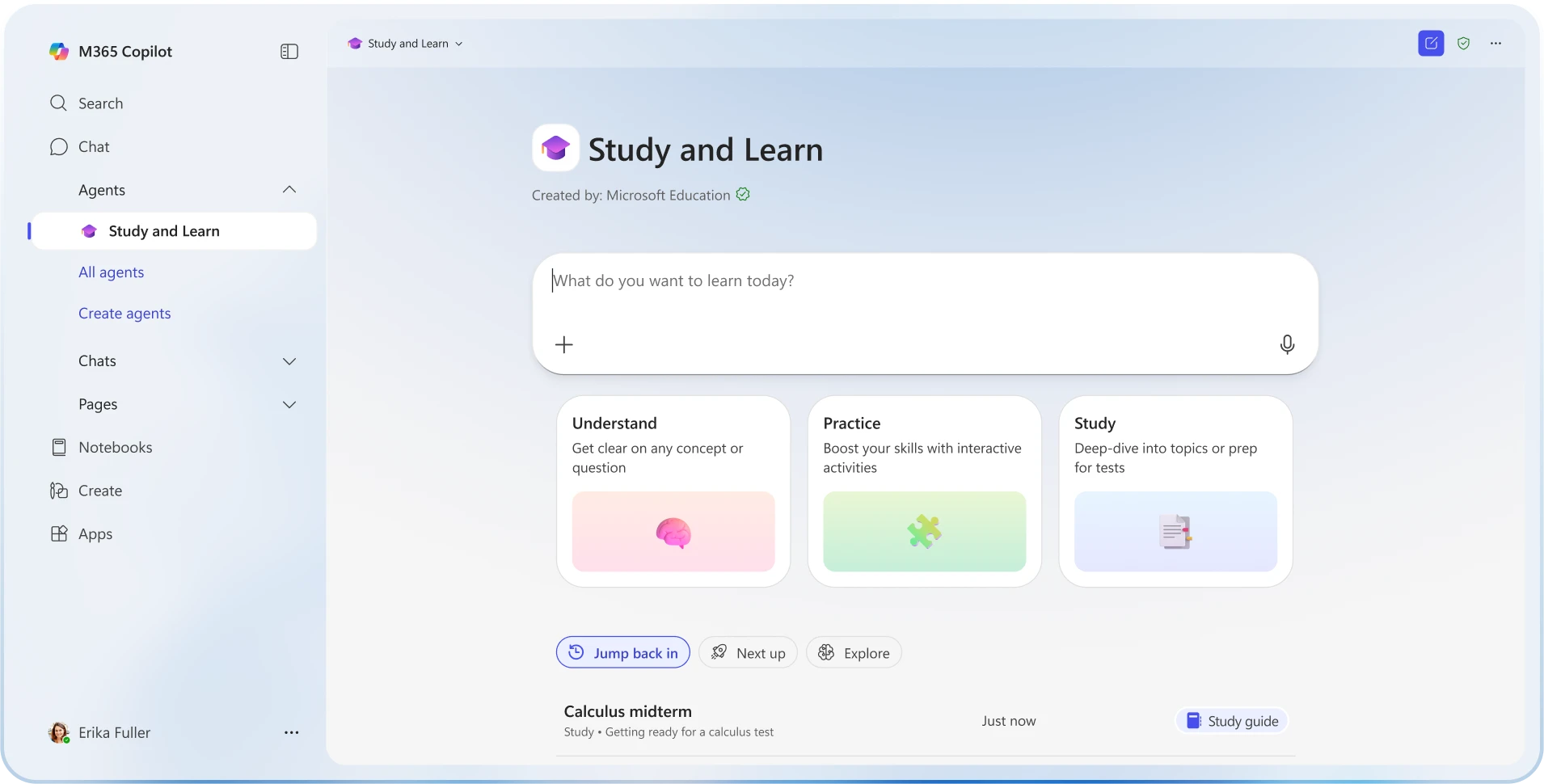
For students, Microsoft is introducing the "Study and Learn" agent, which is scheduled to enter preview in November 2025. This tool represents a shift in philosophy from AI as a "shortcut" for writing essays to AI as a "tutor" for skill acquisition. Grounded in learning science, the Study and Learn agent provides adaptive experiences that foster critical and reflective thinking.
Students can engage with the agent to practice specific exercises, study complex topics, or utilize built-in interactive activities such as digital flashcards, matching games, and fill-in-the-blank quizzes. By focusing on the process of learning rather than just the output, Microsoft aims to mitigate concerns regarding academic integrity while providing students with a personalized support system that can scale to their individual pace.

Financial and Technical Framework of the Academic Offering
In a major strategic pricing move, Microsoft announced an academic-specific offering for Microsoft 365 Copilot, set to launch in December 2025. Priced at $18 per user, per month for educators, staff, and students aged 13 and older, this offering is significantly lower than the standard enterprise pricing.
This premium tier includes "enterprise-grade" data protection and IT controls, which are essential for institutions handling sensitive student information. The package grants users access to:
- Researcher and Analyst Agents: Tools designed to synthesize vast amounts of data for academic papers or institutional reports.
- Copilot Tuning: Features that allow institutions to customize the AI’s behavior and responses.
- Copilot Control System: A governance framework designed to protect institutional data and ensure compliance with privacy regulations.
The academic offering also integrates GPT-5 capabilities, providing students and faculty with access to the most advanced large language models available. This is particularly relevant for higher education institutions where high-level data synthesis and creative problem-solving are paramount.
Institutional Success Stories: From Administrative Savings to Student Agency
To support the rollout, Microsoft highlighted several case studies demonstrating the tangible impact of AI in diverse educational settings. At Brisbane Catholic Education, Chief Information Officer Leigh Williams reported that educators and staff saved an average of nine hours per week on administrative and planning tasks. This time reclaimed from "busy work" was redirected toward student mentorship and personalizing education.
The University of South Carolina (USC) provided further data on the efficacy of Copilot. In a survey of their users, 84%—including students—reported saving between one and five hours per week. Faculty members at USC noted improvements in the quality of academic output, while administrators cited faster decision-making through the rapid synthesis of institutional data.
In the K-12 sector, Fulton County Schools and Broward County Public Schools have begun utilizing AI agents for more granular tasks. Broward County is currently building agents to facilitate contract management and an interactive quiz engine to enhance student engagement. Meanwhile, the University of South Florida (USF) has taken a decentralized approach, allowing "Student Ambassadors" to build custom agents for various departments. These student-led projects have resulted in decreased manual reporting times and expedited inventory analysis for campus operations.
Integration with the Learning Ecosystem
A key component of Microsoft’s strategy is the interoperability of its AI tools with existing educational infrastructure. Starting in December 2025, Copilot will be accessible via Microsoft 365 LTI (Learning Tool Interoperability) within major LMS platforms including Canvas, Schoology, Brightspace, Blackboard, and Moodle.
This integration is critical for adoption, as it allows students to access AI assistance directly within the environment where they receive assignments and submit work. For IT administrators, this centralized approach simplifies the deployment of AI tools across large campuses or school districts.
Broader Context: The Competitive Landscape and Future Implications
Microsoft’s aggressive expansion into the education sector is part of a broader "AI arms race" involving Google and OpenAI. Google has similarly been integrating Gemini into Google Workspace for Education, while OpenAI has launched ChatGPT Edu. Microsoft’s advantage lies in its deep-rooted presence in institutional IT stacks through Windows and Office 365.
However, the rapid deployment of AI in schools raises important questions regarding the "digital divide." While Microsoft offers several tools at no additional cost—such as Reading Coach and Minecraft AI Foundations—the $18 per month premium tier for Copilot could create a tiered system of education where wealthier institutions have access to more powerful cognitive tools.
Furthermore, the introduction of "autonomous agents"—AI systems that can perform tasks with minimal human intervention—marks a significant evolution. As seen at the University of South Florida, agents are being used for everything from IT help desks to travel policy enforcement. As these systems become more prevalent, the role of administrative staff may shift from execution to oversight.
A Timeline for Implementation
The rollout of these features follows a structured timeline:
- Current: "Teach" is rolling out in the Microsoft 365 Copilot app for education customers. Copilot Chat is available in Outlook and PowerPoint.
- November 2025: "Study and Learn" student agent enters preview.
- December 2025: The $18 per month academic offering for Microsoft 365 Copilot becomes available. Integration with LMS platforms via LTI enters preview.
Analysis: The Shift from Generative to Agentic AI
This announcement signifies a shift from "Generative AI" (which focuses on creating content) to "Agentic AI" (which focuses on performing tasks). By providing tools to build custom agents using natural language, Microsoft is democratizing software development within schools. A teacher with no coding experience can now essentially "program" an AI agent to act as a specialized tutor for a specific chemistry unit or a guide for a school’s internal policies.
For students, the focus on "Study and Learn" suggests an attempt to reconcile the use of AI with traditional pedagogical values. By providing feedback and scaffolding rather than just answers, these tools aim to support the "Zone of Proximal Development"—the space where a learner can perform a task with guidance but not yet alone.
As the 2025 school year approaches, the success of these initiatives will likely be measured by how well they alleviate the "balancing act" mentioned by Microsoft. If AI can truly save educators nine hours a week, it could represent the most significant shift in teacher productivity since the introduction of the personal computer. However, the challenge remains for institutions to ensure that these tools are used ethically, equitably, and in a manner that enhances, rather than replaces, the human element of education.