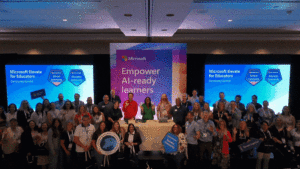

Microsoft Corporation has officially unveiled Microsoft Elevate Washington, a comprehensive statewide initiative designed to democratize access to artificial intelligence (AI) technologies and skill-building resources. The program aims to reach more than 500,000 students and 100,000 educators across Washington’s 295 public school districts and 34 community and technical colleges. By providing advanced AI tools, professional development, and financial grants free of charge, the Redmond-based technology giant seeks to address a widening "opportunity gap" between the state’s urban tech hubs and its rural communities. The initiative represents a localized extension of Microsoft’s broader $4 billion global commitment to support education and nonprofits through cloud services and cash investments over the next five years.
The launch of Microsoft Elevate Washington comes at a pivotal moment for the state’s economy. For over a century, Washington has served as a global epicenter for industrial and technological breakthroughs, from the pioneering aerospace developments of the early 20th century to the digital revolutions led by software and e-commerce titans. However, internal research conducted by Microsoft’s AI for Good Lab suggests that the benefits of the current AI transformation are not being distributed equitably across the state’s geography. The new initiative is structured as a multi-year rollout, beginning with immediate offers for community college students and scaling up to full institutional integration by mid-2026.
Statistical Disparity: The Rural-Urban AI Divide
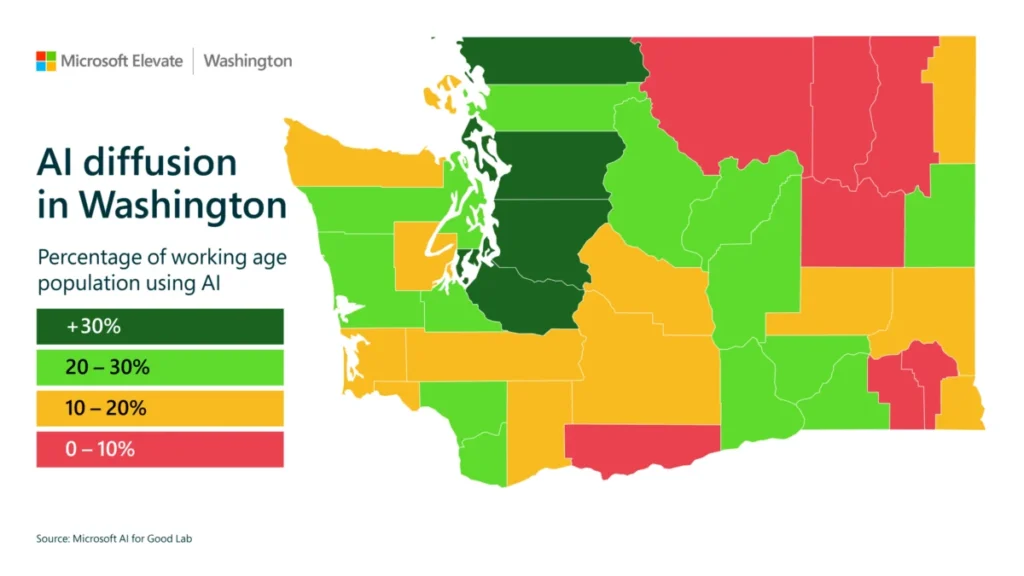
Data analysis from Microsoft’s AI for Good Lab has revealed a stark contrast in AI adoption rates across Washington’s 39 counties. In the high-density Puget Sound region—comprising Snohomish, King, Pierce, and Whatcom counties—AI utilization among the working-age population has already surpassed 30 percent. Snohomish County currently leads the state with a 35 percent adoption rate, bolstered by its proximity to major technology and aerospace corridors.
In contrast, seven rural counties in Eastern Washington report AI usage rates below 10 percent. The disparity is most pronounced in Ferry County, where only 2.5 percent of residents currently engage with AI technologies. This tenfold gap between the state’s most and least connected regions suggests that without intervention, rural students and workers may face significant disadvantages in a labor market increasingly defined by digital fluency. Microsoft executives have likened this challenge to the "broadband gap" of the previous decade, noting that access to AI is no longer a luxury but a fundamental requirement for economic mobility and academic success.
Chronology of Implementation and Rollout Phases
The Microsoft Elevate Washington initiative is structured around a phased timeline to ensure that educational institutions have the necessary infrastructure and training to support new tools.
November 2025: Community College Engagement
The first major milestone occurs on November 15, 2025, which serves as the deadline for community college students in Washington to claim 12 months of free Microsoft 365 Personal. This package includes Copilot integration across productivity apps like Word, Excel, and PowerPoint, as well as one terabyte of cloud storage. This phase is designed to provide immediate support to students currently enrolled in workforce training and degree programs.
January 2026: Institutional Empowerment
Starting in early 2026, Microsoft will provide Copilot Studio free of charge to all 295 school districts and 34 community colleges for a three-year period. Copilot Studio is a low-code platform that allows administrative staff and educators to build custom AI agents. These agents are intended to streamline internal operations, such as class scheduling, data analysis, and school year planning, thereby reducing the administrative burden on faculty.
July 2026: K-12 Student Access
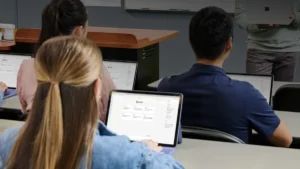
The final major phase begins in the summer of 2026, when high school students (grades 9–12) across the state will gain free access to Copilot Chat, Microsoft 365 desktop applications, and Teams for Education. This rollout will also include "Learning Accelerators," a suite of tools grounded in learning science designed to help students improve reading fluency, mathematical literacy, and critical information gathering.
Targeted Support for Educators and Administrators
Recognizing that technology is only effective when paired with competent instruction, Microsoft is dedicating significant resources to professional development. The company is collaborating with the Washington Office of Superintendent of Public Instruction (OSPI), the Washington Education Association (WEA), and the National Education Association (NEA) to create a robust training ecosystem.

A central component of this effort is the AI Innovation Summit, a combined in-person and virtual conference intended for over 1,000 educators, school board members, and administrators. The summit will focus on best practices for AI adoption, ethical implementation, and the use of generative AI to lighten the workload of teachers. Furthermore, Microsoft has pledged to deliver role-based generative AI training specifically tailored for the faculty of the state’s 34 community and technical colleges.
To catalyze these efforts, Microsoft is offering $25,000 technology consulting grants to 10 selected school districts and 10 community colleges. These grants are intended to help early adopters build bespoke AI agents that address specific local challenges. The lessons learned from these "pilot" institutions will then be documented and shared with districts statewide to create a blueprint for successful AI integration.
Strategic Partnerships and Community Involvement
Microsoft Elevate Washington is not intended to function in a vacuum; rather, it is designed to trigger a broader statewide movement involving nonprofits and community leaders. One key partnership involves Code.org, with whom Microsoft will launch the "Hour of AI." This program will see more than 50,000 Microsoft employees in Washington volunteering to lead workshops that demonstrate real-world AI applications to students.
The initiative also extends its reach to youth development workers and career navigators. By providing tailored generative AI training to these community leaders, Microsoft aims to ensure that even those outside the formal classroom setting—such as those in after-school programs or vocational centers—can provide guidance on the future of work. Additionally, the company has issued an open call for independent innovators and developers to partner with educational institutions to build scalable, AI-enabled solutions that can improve learning outcomes and career readiness.
Broader Economic Impact and Future Implications
The long-term implications of Microsoft Elevate Washington extend beyond the classroom. By equipping half a million students with AI literacy, the state is effectively future-proofing its workforce. Economic analysts suggest that as AI continues to permeate industries from agriculture in the Yakima Valley to biotechnology in Seattle, the ability to collaborate with intelligent systems will be a primary driver of wage growth and job security.
The decision to provide these tools free of charge for a three-year duration is seen as a strategic move to lower the barrier to entry for cash-strapped rural districts. By the time the initial three-year period concludes, the goal is for these districts to have integrated AI into their core curricula and administrative workflows, potentially creating a new standard for public education in the United States.
Furthermore, this initiative sets a precedent for how large technology firms might engage with their "home" territories. By prioritizing Washington state for these investments, Microsoft is reinforcing its historical ties to the region while simultaneously using the state as a laboratory for large-scale AI diffusion. If successful, the Washington model could serve as a template for similar statewide or national programs in other regions grappling with the digital divide.
Conclusion and Outlook
Microsoft Elevate Washington represents one of the most significant private-sector investments in the state’s educational history. By focusing on the "people" side of the AI equation—educators, students, and community leaders—Microsoft is attempting to ensure that the next wave of technological innovation does not leave the state’s rural or underserved populations behind.
As the program moves toward its 2025 and 2026 milestones, the focus will likely shift toward measuring the efficacy of these tools in the classroom. Success will be measured not just by the number of software licenses distributed, but by the closing of the adoption gap between counties like King and Ferry. For Washington state, a region that has long prided itself on being a launchpad for the future, the Elevate Washington initiative is a high-stakes bet that the next generation of innovators will come from every corner of the state, regardless of zip code.