



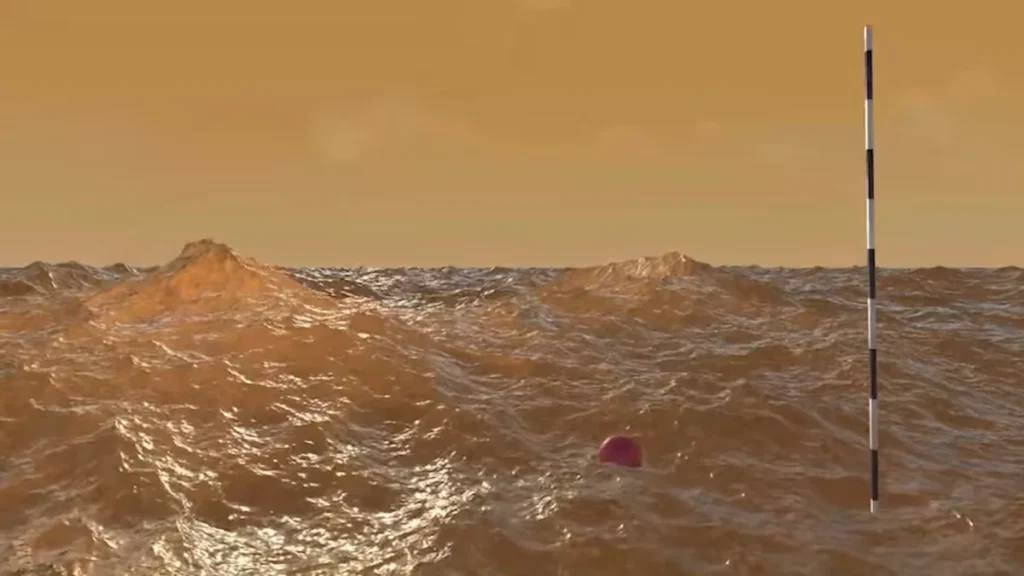
A collaborative research effort between the Massachusetts Institute of Technology (MIT) and the Woods Hole Oceanographic Institution (WHOI) has unveiled a sophisticated new modeling system that redefines our understanding of the alien landscapes on Titan, Saturn’s largest moon. The study, recently published in the Journal of Geophysical Research: Planets, introduces "PlanetWaves," an open-source simulator designed to predict how waves form and behave under varying planetary conditions. The findings suggest that Titan’s unique environmental parameters—including its low gravity, thick atmosphere, and hydrocarbon-based seas—allow even the slightest atmospheric disturbance to produce massive, slow-moving waves that would dwarf those found in similar conditions on Earth.
Titan has long occupied a central role in planetary science as the only celestial body in our solar system, other than Earth, confirmed to possess stable bodies of surface liquid. However, where Earth features a water-based hydrological cycle, Titan’s "hydrological" system is comprised of light hydrocarbons, specifically liquid methane and ethane. The new research indicates that a breeze barely perceptible to a human would be sufficient to whip these toxic seas into ten-foot-tall swells, a discovery that carries profound implications for our understanding of coastal erosion, sediment transport, and the future of robotic exploration on the moon’s surface.
The Unique Environment of Titan: A Giant Among Moons
Titan is a world of extremes. It is approximately 50 percent larger than Earth’s moon and 80 percent more massive, effectively making it larger than the planet Mercury. It is encased in a dense, nitrogen-rich atmosphere—about four times as thick as Earth’s—which has historically shielded its surface from direct observation by optical telescopes. It was not until the arrival of the Cassini-Huygens mission in 2004 that scientists were able to peer through this haze using radar imaging, revealing a complex geography of mountains, dunes, and vast northern seas.
The surface temperature on Titan averages a frigid -296.59 degrees Fahrenheit (-182.5 degrees Celsius). At these temperatures, water ice acts as a hard mineral, forming the moon’s "bedrock," while methane and ethane take on the role that water plays on Earth. These hydrocarbons exist in a triple-point state, flowing as liquids, freezing as solids, and evaporating into the atmosphere to form clouds and rain. The largest of these liquid bodies, such as Kraken Mare and Ligeia Mare, are hundreds of miles across and hundreds of feet deep.
A Chronology of Discovery: From Cassini to PlanetWaves
The quest to understand Titan’s waves began in earnest during the Cassini mission (2004–2017). While radar data confirmed the existence of the seas, the resolution was often insufficient to capture active wave motion. Some observations showed surfaces as smooth as glass, leading some scientists to wonder if the seas were perpetually calm. However, other data sets suggested "glint" or transient features—nicknamed "Magic Islands"—that appeared and disappeared, hinting at bubbles or wave activity.
Recognizing the limitations of visual confirmation from billions of miles away, the MIT and WHOI team sought to approach the problem through the lens of fluid dynamics. Lead researcher Una Schneck, an MIT planetary scientist, and co-author Andrew Ashton, a geophysicist at WHOI, developed PlanetWaves to bridge the gap between theoretical physics and planetary observation. Unlike previous models that focused almost exclusively on the role of gravity, PlanetWaves incorporates a comprehensive suite of variables, including liquid viscosity, surface tension, and density.
The development of the model marks a significant milestone in the timeline of planetary geomorphology. By applying the principles of Earth-based oceanography to the exotic chemistry of Titan, the researchers have created a tool that can retroactively explain the jagged, eroded coastlines observed by Cassini and predict the conditions that future probes will encounter.
The Physics of Hydrocarbon Seas: Why Waves Hit Different
The "PlanetWaves" simulator reveals that the behavior of waves on Titan is fundamentally counterintuitive to the human experience. On Earth, the formation of significant waves requires sustained wind speeds over a large area, known as "fetch." Because water is relatively dense and Earth’s gravity is strong, it takes considerable energy to lift the surface of the ocean into a wave.
On Titan, the situation is reversed. Liquid methane has a much lower density than water, and Titan’s surface gravity is only about 14 percent of Earth’s. This means that the "restoring force"—the gravity that pulls a wave back down—is much weaker. Consequently, once the wind begins to push against the surface of a methane sea, the liquid responds much more dramatically.
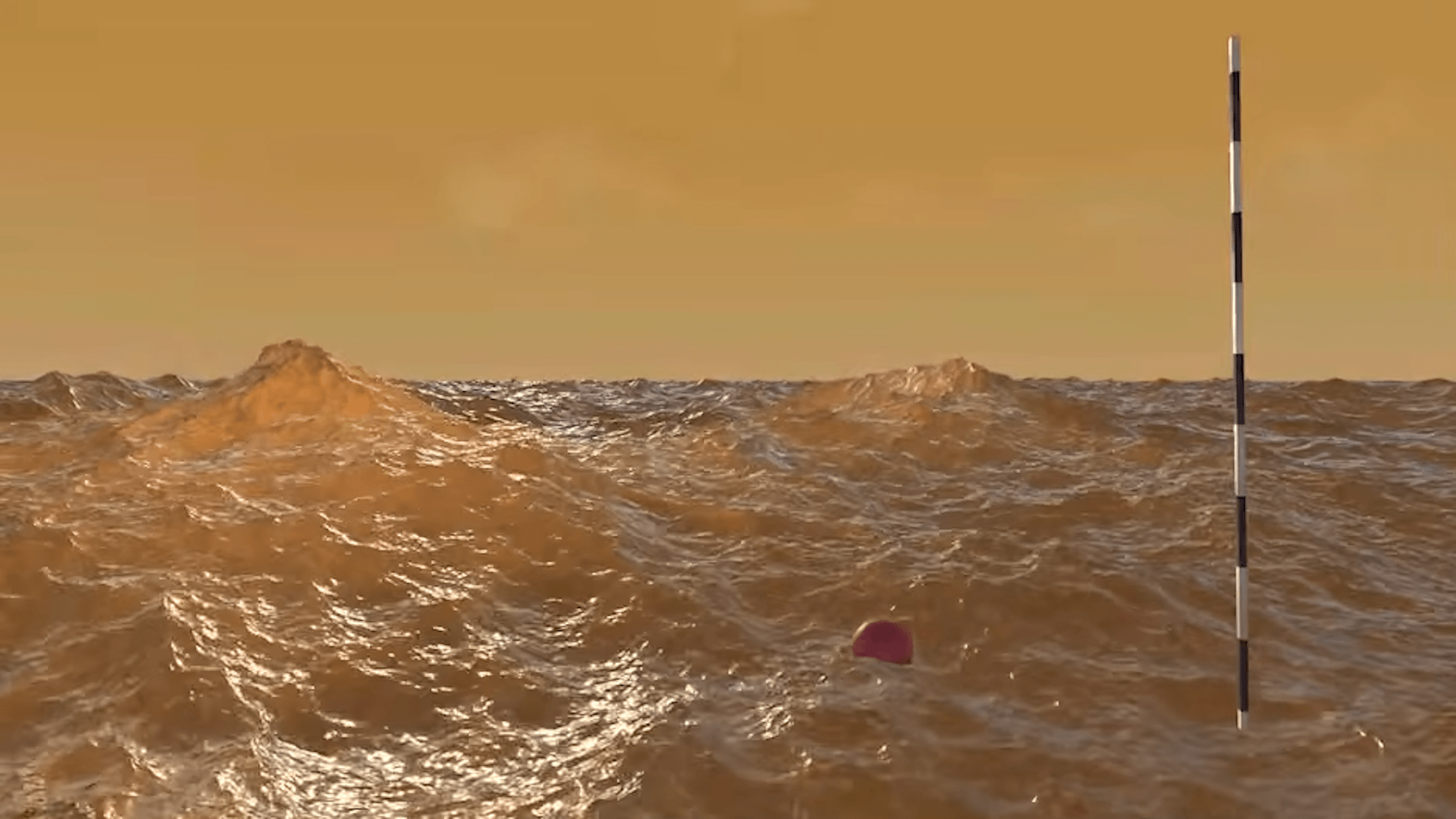
"It kind of looks like tall waves moving in slow motion," explained Schneck. "If you were standing on the shore of this lake, you might feel only a soft breeze, but you would see these enormous waves flowing toward you."
The model predicts that a wind speed of just a few miles per hour—hardly enough to rustle leaves on Earth—could generate waves on Titan that reach heights of 10 feet or more. These waves would also move significantly slower than Earth waves, creating a surreal, undulating landscape that would be both beautiful and hazardous for any landing craft.
Comparative Planetary Analysis: Beyond the Saturnian System
While Titan was the primary focus, the research team extended the application of PlanetWaves to other celestial bodies, providing a fascinating comparative study of wave dynamics across the universe. The model was tested against the conditions of ancient Mars, as well as several known exoplanets.
Ancient Mars
Billions of years ago, Mars likely hosted shallow seas of liquid water. The PlanetWaves simulation suggests that because Mars has roughly 38 percent of Earth’s gravity, waves in the Noachian period would have been larger and more erosive than those on modern Earth for a given wind speed. This helps explain the extensive sedimentary deposits and delta formations observed by NASA’s Curiosity and Perseverance rovers.
Exoplanet LHS1140b
Categorized as a "cool super-Earth," this planet is believed to possess a global ocean. However, its immense mass results in powerful surface gravity. The model shows that on LHS1140b, gravity acts as a dampener, requiring extreme hurricane-force winds to generate even modest wave activity.
Kepler 1649b
This Venus-like exoplanet is theorized to have lakes of sulfuric acid. The high viscosity and density of sulfuric acid, combined with the planet’s atmospheric pressure, create a "stubborn" liquid surface. PlanetWaves indicates that despite high temperatures and winds, the seas of Kepler 1649b would likely remain relatively flat compared to the volatile oceans of Titan.

55-Cancri e
Perhaps the most extreme case studied was 55-Cancri e, a planet so close to its host star that its surface is covered in oceans of molten lava. The model demonstrated that the incredible density of liquid rock, coupled with crushing gravity, would require cataclysmic atmospheric events to produce any discernible ripples.
Official Responses and Engineering Implications
The scientific community has responded to the PlanetWaves findings with a mixture of excitement and caution. The research is particularly timely as NASA prepares for the Dragonfly mission, an octocopter drone scheduled to launch in the late 2020s and arrive at Titan in the mid-2030s.
While Dragonfly is intended to land in the equatorial sand dunes (the "Shangri-La" region), the data provided by MIT and WHOI is vital for long-term mission planning. If future missions aim to land "splash-down" probes in the northern seas—similar to the proposed Titan Mare Explorer (TiME)—engineers must account for the 10-foot waves predicted by the new model. A probe designed for the calm, "glassy" seas once theorized by some astronomers would likely be capsized or damaged by the roiling hydrocarbon swells now predicted by PlanetWaves.
"Calculating fluid behaviors on distant planets and moons is not just an academic exercise," stated Andrew Ashton. "It informs the very architecture of the machines we send into the dark. We are trying to figure out the first puff that will make those first little tiny ripples, on up to a full ocean wave, so that we can be ready when we finally arrive."
Broader Impact: Astrobiology and Planetary Evolution
Beyond the immediate concerns of spacecraft engineering, the PlanetWaves model offers new insights into the potential for life on Titan. The moon is rich in prebiotic organic compounds, and the constant churning of its seas could facilitate the mixing of chemicals necessary for the emergence of life. Waves play a crucial role in gas exchange between the atmosphere and the liquid, as well as the mechanical breakdown of shoreline minerals.
The discovery that Titan is a geologically "active" world, where the landscape is being constantly reshaped by wind and wave, reinforces its status as the most Earth-like body in the solar system in terms of surface processes. The erosion of coastlines creates diverse habitats and niches that are of high interest to astrobiologists.
As the Artemis program works toward establishing a permanent human presence on the Moon by 2028, and as private and public agencies look toward Mars and beyond, tools like PlanetWaves represent the next generation of planetary science. They allow researchers to conduct "virtual expeditions," narrowing down the most promising sites for exploration and ensuring that when humanity finally reaches the shores of Kraken Mare, we will not be caught off guard by the waves.