


The integration of artificial intelligence into daily educational routines has evolved from a futuristic prospect into an everyday reality for millions of students worldwide. Recent findings from Microsoft’s 2026 global education research initiative indicate that an overwhelming 92 per cent of students now utilize artificial intelligence tools for school-related purposes. This widespread adoption has forced educational administrators, curriculum developers, and classroom teachers to confront a defining pedagogical dilemma: whether available technologies will function merely as shortcuts that deliver instant answers or as interactive frameworks designed to foster genuine critical thinking and long-term skill acquisition.
As learners increasingly turn to personal devices and unauthorized third-party applications to summarize dense reading materials, debug code, and brainstorm essay topics, institutions face mounting pressure to provide structured, secure alternatives. In response to this shifting landscape, Microsoft has introduced "Study and Learn," a specialized first-party agent embedded within the Microsoft 365 Copilot ecosystem. Built explicitly around established learning-science principles, the tool is designed to keep cognitive effort firmly on the student by providing step-by-step guidance, generating targeted flashcards, and offering Socratic-style prompting rather than handing over unearned solutions.
The Genesis of Educational AI Integration
The rapid ascent of generative artificial intelligence in academic settings represents one of the fastest technology adoption cycles in modern history. Following the public introduction of large language models in late 2022 and early 2023, schools initially reacted with caution, fearing widespread academic dishonesty, diminished writing skills, and the erosion of foundational math and science competencies. Many secondary schools and higher education institutions enacted blanket bans on AI platforms, restricting network access and issuing strict policy warnings against generative tools.
Despite these preventative measures, student utilization continued to climb as tools became more accessible on mobile devices and home computers. By 2024 and 2025, educational researchers noted a distinct polarization between institutional policy and student behavior. While administrators attempted to lock down campus networks, students routinely bypassed these restrictions outside of school hours, creating an unregulated digital shadow curriculum. Recognizing that prohibition was ineffective, forward-thinking institutions began pivoting toward guided integration, searching for frameworks that could harness technological efficiencies while preserving academic integrity.
By 2026, over half of education leaders reported that their institutions were actively implementing or scaling enterprise-grade AI strategies. This historical shift marked a transition from crisis management to strategic deployment, setting the stage for purpose-built educational agents like Microsoft’s Study and Learn to enter the mainstream classroom.
Global Research Findings and the Institutional Training Gap
Data compiled in the 2026 Microsoft Special Report on AI in Education highlights a profound disconnect between administrative policy, educator preparedness, and student expectations. While 92 per cent of students acknowledge using AI for academic tasks, their usage patterns vary significantly. Approximately one-third of students report using these technologies specifically to customize their study habits and adapt material to their personal learning paces.
However, a major structural vulnerability persists in institutional readiness. The global study revealed a stark gap in guidance and professional development: while four in five education leaders believe their institutions provide clear AI policies, only about half of surveyed students and teachers report receiving any such guidance. The training deficit is even more pronounced. Seventy-seven per cent of students and 53 per cent of educators indicated they have received zero formal training on how to use artificial intelligence effectively or ethically. This scarcity of instruction stands in sharp contrast to high demand, with 66 per cent of educators and 52 per cent of students requesting structured training at least quarterly.
Educational analysts point out that leaving this training gap unaddressed risks exacerbating educational inequities. When students are left to navigate complex AI algorithms entirely on their own, outcomes depend heavily on individual digital literacy, leaving vulnerable or under-resourced learners at a distinct disadvantage.
Mechanics and Pedagogy of Study and Learn
Designed specifically to bridge the gap between autonomous student habits and sound pedagogical theory, Study and Learn operates directly within the secure architecture of Microsoft 365 Education. Unlike consumer-facing AI models engineered primarily for speed and direct query resolution, Study and Learn functions as a digital tutor grounded in cognitive science.
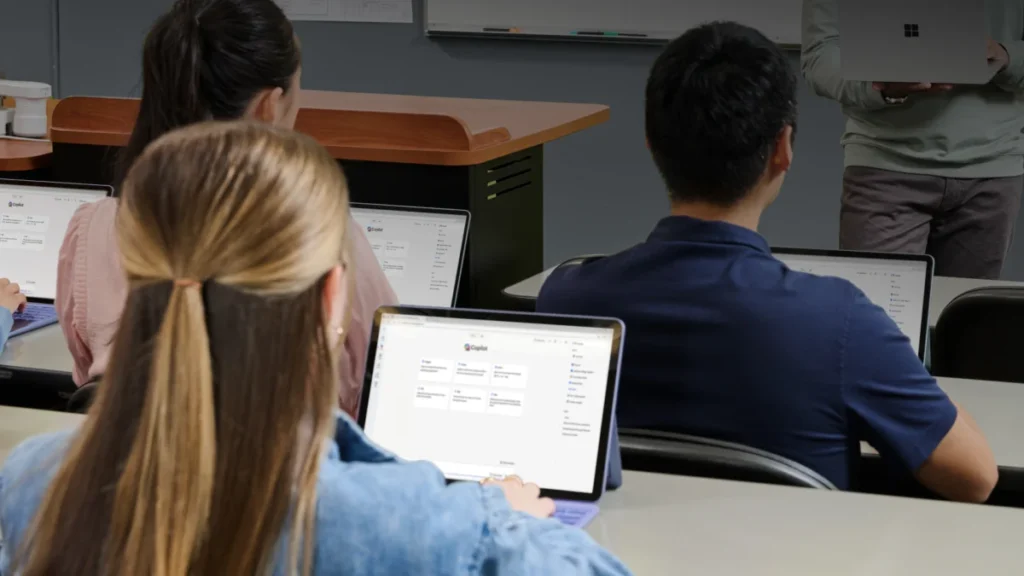
The agent interacts directly with a student’s authorized course materials—including uploaded lecture slides, PDF textbooks, and personal notes—ensuring that all interactions remain anchored to the official curriculum. When a high school student prepares for a biology examination, the tool can instantly generate customized, active-recall flashcards based strictly on the assigned chapters. For a university student tackling advanced calculus, the agent avoids providing a direct numerical answer, instead offering incremental, scaffolded hints that guide the learner through the algebraic steps necessary to solve the problem independently.
Furthermore, when applied to writing assignments, the agent engages in conversational dialogue, posing probing questions designed to help the student strengthen their argumentative thesis statement rather than drafting the prose for them. All generated outputs include precise citations referencing the original source documents, promoting academic transparency and verifiable research habits.
Administrative Controls and Licensing Requirements
Deploying Study and Learn within a school district or university requires deliberate coordination between instructional leaders and IT administrators. The agent is available through eligible Microsoft 365 Education licensing tiers, including A1, A3, and A5.
However, system architecture dictates a strict administrative prerequisite: Copilot Chat must be explicitly enabled by a network administrator. For primary and secondary education environments catering to minors, Copilot Chat remains deactivated by default. IT departments must utilize specialized age-gating controls to configure access appropriately for learners aged 13 to 17, while the tool remains inaccessible to students under the age of 13 in compliance with strict data privacy regulations.
This administrative structure turns AI adoption into a collaborative governance challenge. Educators and curriculum specialists establish the pedagogical priorities and learning objectives, while IT directors manage the technical controls and security baselines. Advocates for safe AI integration recommend that school boards review comprehensive impact reports, such as Microsoft’s AI in Education framework, before deciding on district-wide activation parameters.
Perspectives from the Classroom
Educators around the globe are already observing qualitative shifts in how students interact with AI-enabled environments when guided by structured tools. Shane Tooley, Assistant Principal of Curriculum at St. Peter Claver College in Australia, noted a notable evolution in student inquiry habits. According to Tooley, students are moving past simplistic commands seeking direct answers, instead learning how to formulate sophisticated, multi-layered prompts that reflect deeper cognitive engagement with the subject matter.
Proponents argue that this behavioral shift is essential for modern cognitive development. By teaching students how to interrogate an AI agent effectively, educators help learners transition from passive consumers of information to active directors of their own educational journeys. This perspective aligns with enterprise expectations, where the ability to collaborate intelligently with automated systems is rapidly becoming a baseline competency across industries.
Future Implications for the Global Workforce
The urgency surrounding institutional AI adoption extends far beyond current academic terms and standardized testing metrics. Labor market research underscores a profound transformation in professional skill requirements. According to data from LinkedIn cited in the 2026 Microsoft education report, approximately 70 per cent of the core skills required for most professional roles will have undergone significant change between 2015 and 2030, with artificial intelligence serving as the primary catalyst.
Concurrently, the volume of job postings explicitly requiring artificial intelligence literacy experienced a sixfold increase in a single year. Students themselves are keenly aware of this professional evolution. In global surveys, 79 per cent of students maintain that understanding how to utilize AI effectively and responsibly is crucial for their future career prospects—a sentiment echoed by 87 per cent of educators and institutional leaders.
By integrating learning-first environments like Study and Learn into daily academic routines, educational institutions can provide a controlled, ethical laboratory where students master the technical fluency and critical judgment required in a digital economy. As classrooms continue to navigate the complexities of the digital age, the successful deployment of tools that prioritize active cognitive effort over effortless answers may well determine how effectively the next generation adapts to an increasingly automated world.