



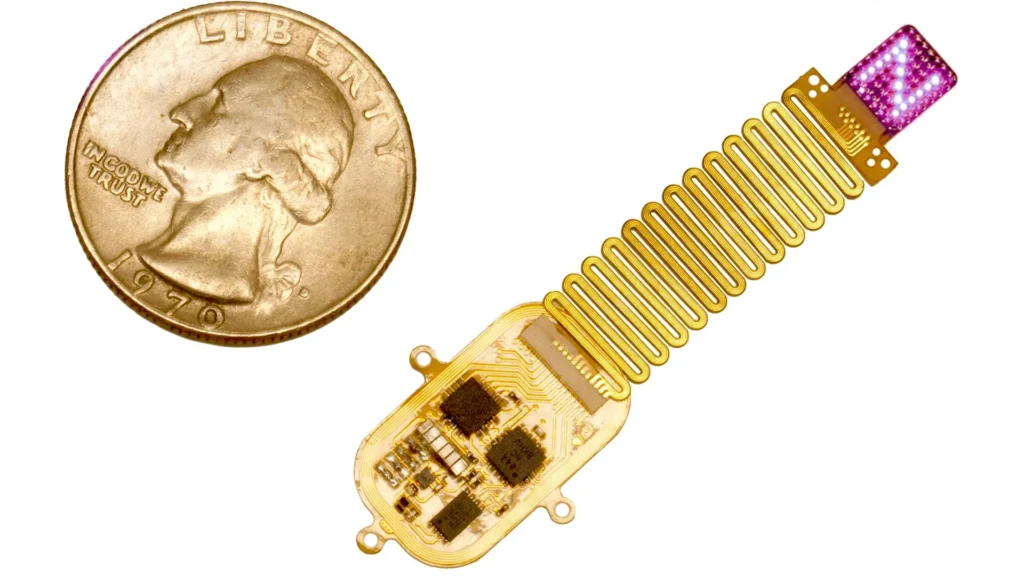
In a monumental leap forward for neurobiology and bioelectronics, researchers at Northwestern University have engineered a groundbreaking wireless device capable of transmitting information directly into the brain using precisely controlled light patterns. This innovative technology effectively circumvents the body’s conventional sensory pathways, delivering signals straight to neurons and opening unprecedented avenues for understanding and interacting with the central nervous system. The work, which promises to revolutionize areas from prosthetic control to rehabilitation, was published on Monday, December 8, in the prestigious journal Nature Neuroscience.
A New Paradigm in Brain-Machine Interface
The core of this breakthrough lies in a soft, flexible device designed for minimal invasiveness. Unlike previous brain-interface technologies that often required rigid implants or cumbersome wired connections, this new system fits subtly beneath the scalp, resting gently on the surface of the skull. From this strategic position, it projects carefully modulated light patterns through the cranial bone, activating specific clusters of neurons across the cerebral cortex. This trans-cranial approach significantly reduces the risks associated with direct brain penetration, representing a major advancement in the quest for safer and more accessible neurotechnologies.
The implications of this direct neural communication are vast, offering a pathway to restore lost sensory functions, enhance rehabilitation processes, and potentially modulate perception. By bypassing the traditional sensory organs—eyes, ears, skin—the device creates a direct channel for input, allowing the brain to interpret entirely novel signals.
Light-Based Brain Signals: From Concept to Artificial Perception
During extensive preclinical testing, the research team utilized mouse models genetically engineered with neurons sensitive to light, a technique known as optogenetics. These neurons, once exposed to specific light wavelengths, could be precisely activated or inhibited. The researchers delivered tiny, meticulously timed bursts of light to stimulate targeted populations of these modified neurons deep within the mice’s brains.
Remarkably, the animal models swiftly learned to interpret these light patterns as meaningful cues. Even in the absence of any auditory, visual, or tactile input, the mice effectively used the incoming light-based information to make informed decisions and successfully complete complex behavioral tasks. This demonstrated the brain’s extraordinary plasticity and its capacity to integrate and make sense of entirely synthetic sensory data. For instance, mice were trained to associate a particular light pattern with a reward located at a specific port in a testing chamber, consistently navigating to the correct location when the pattern was delivered. This behavioral response served as undeniable proof that the animals were receiving and interpreting the artificial signals.
A Broad Spectrum of Potential Medical Applications
The long-term vision for this technology encompasses a wide array of transformative medical applications. One of the most immediate and impactful uses could be in providing sophisticated sensory feedback for prosthetic limbs. Current prosthetics, while mechanically advanced, often lack the nuanced tactile and proprioceptive feedback that natural limbs provide, limiting their utility and natural feel for users. By delivering artificial sensory inputs directly to the brain, this device could imbue prosthetics with a sense of touch, pressure, and position, making them feel more like extensions of the user’s own body.
Beyond prosthetics, the technology holds promise for future hearing or vision prostheses, potentially offering more granular and naturalistic sensory experiences than current devices. It could also enable more intuitive control over robotic limbs and exoskeletons, improve rehabilitation outcomes for individuals recovering from injury or stroke by stimulating neural pathways, and even offer non-pharmacological methods for modifying chronic pain perception. The ability to directly influence neural activity related to pain could provide a revolutionary alternative to opioid-based treatments.
Leadership and Expertise Behind the Breakthrough
The collaborative effort behind this innovation was spearheaded by two eminent figures at Northwestern University. Neurobiologist Yevgenia Kozorovitskiy, the Irving M. Klotz Professor of Neurobiology in Weinberg College of Arts and Sciences and a member of the Chemistry of Life Processes Institute, led the experimental portion of the study. Her expertise was critical in understanding how the brain processes and learns from these novel signals.
John A. Rogers, a leading figure in the field of bioelectronics and director of the Querrey Simpson Institute for Bioelectronics, oversaw the technology development. Rogers, who holds appointments in materials science and engineering, biomedical engineering, and neurological surgery, is renowned for his pioneering work in soft, conformable electronics. The study’s first author was postdoctoral researcher Mingzheng Wu, whose meticulous work was instrumental in the device’s design and testing.
Professor Kozorovitskiy articulated the profound implications of their work: "Our brains are constantly turning electrical activity into experiences, and this technology gives us a way to tap into that process directly. This platform lets us create entirely new signals and see how the brain learns to use them. It brings us just a little bit closer to restoring lost senses after injuries or disease while offering a window into the basic principles that allow us to perceive the world."
Professor Rogers further emphasized the engineering challenges and successes: "Developing this device required rethinking how to deliver patterned stimulation to the brain in a format that is both minimally invasive and fully implantable. By integrating a soft, conformable array of micro-LEDs — each as small as a single strand of human hair — with a wirelessly powered control module, we created a system that can be programmed in real time while remaining completely beneath the skin, without any measurable effect on natural behaviors of the animals. It represents a significant step forward in building devices that can interface with the brain without the need for burdensome wires or bulky external hardware. It’s valuable both in the immediate term for basic neuroscience research and in the longer term for addressing health challenges in humans."
Advancing Earlier Optogenetics Breakthroughs: A Chronology of Innovation
This latest achievement builds directly upon the team’s prior groundbreaking work in bioelectronics and optogenetics. In 2021, the same group reported the development of the first fully implantable, programmable, wireless, and battery-free device capable of controlling neurons with light. That earlier system, a significant innovation in itself, utilized a single micro-LED probe to influence specific social behaviors in mice. Crucially, it overcame a major limitation of traditional optogenetics, which often relied on restrictive fiberoptic wires tethered to external equipment, thereby impeding natural animal movement. The wireless design of their 2021 device allowed mice to behave normally within their social environments, providing unprecedented insights into neural circuits underlying complex behaviors.
The new device represents a substantial evolution of this earlier platform, dramatically extending its capabilities for complex communication with the brain. Instead of stimulating a single, isolated region, the updated system incorporates an array of up to 64 programmable micro-LEDs. Each of these miniature light emitters can be controlled independently and in real time, enabling researchers to deliver intricate sequences of light patterns. These sequences are designed to mimic the distributed activity patterns that the brain naturally produces during sensory experiences. Because real-world sensations typically activate broad, interconnected networks of neurons rather than isolated points, this multi-site approach provides a much more faithful representation of how the cortex normally functions and processes information.
As postdoctoral researcher Mingzheng Wu explained, "In the first paper, we used a single micro-LED. Now we’re using an array of 64 micro-LEDs to control the pattern of cortical activity. The number of patterns we can generate with various combinations of LEDs — frequency, intensity, and temporal sequence — is nearly infinite." This exponential increase in signal complexity is critical for generating rich, meaningful artificial perceptions.
A Soft, Less Invasive Design: Engineering for Comfort and Efficacy
Despite its enhanced capabilities, the new device maintains a remarkably compact and user-friendly form factor. It is approximately the size of a postage stamp and thinner than a standard credit card, minimizing its physical footprint. A key design innovation is its non-penetrating nature. Instead of requiring a probe to be inserted directly into the brain tissue, the new version gently conforms to the skull’s surface, shining light through the bone.
Professor Kozorovitskiy elaborated on the choice of light: "Red light penetrates tissues quite well. It reaches deep enough to activate neurons through the skull." This property of red light, combined with the device’s close proximity to the cortex, allows for effective stimulation without invasive surgery to the brain itself. The soft, conformable nature of the implant further ensures that it integrates seamlessly with biological tissues, reducing inflammation and enhancing long-term biocompatibility.
Training the Brain to Recognize Synthetic Patterns: Evidence of Artificial Perception
To rigorously evaluate the system’s effectiveness, the research team conducted a series of carefully designed experiments with their light-responsive mouse models. The animals were trained to associate a specific, defined pattern of cortical stimulation with a reward, typically dispensed at a particular port within a specialized testing chamber. The implant delivered a unique sequence of light across four distinct cortical regions, functioning akin to tapping a coded message directly into the brain’s processing centers.
Over repeated trials, the mice progressively learned to identify this target pattern amidst a variety of alternative, non-rewarding stimulation sequences. When they successfully detected the correct artificial signal, they consistently navigated to the appropriate port to receive their reward. This consistent selection behavior served as empirical evidence that the animals were not only receiving the light-based messages but also actively interpreting them as meaningful information.
"By consistently selecting the correct port, the animal showed that it received the message," Wu stated. "They can’t use language to tell us what they sense, so they communicate through their behavior." This behavioral validation is a crucial step, demonstrating that the brain can indeed form new associations and build ‘artificial perceptions’ from directly transmitted optogenetic signals.
Broader Impact and Future Development: Charting the Course for Neurotechnology
The success of this study marks a pivotal moment in neurobiology and bioelectronics, demonstrating the feasibility of creating entirely new forms of sensory input for the brain. Now that the team has conclusively shown that the brain can interpret patterned light stimulation as meaningful information, their future research will focus on exploring more sophisticated patterns and determining the maximum number of distinct signals the brain can reliably learn and differentiate.
Future iterations of the device are envisioned to incorporate even more LEDs, potentially with smaller spacing between them to achieve higher spatial resolution. Larger arrays covering more extensive cortical regions are also on the horizon, as are investigations into different wavelengths of light that may penetrate deeper into brain tissue, enabling stimulation of subcortical structures. These advancements could unlock even more complex and nuanced forms of brain-computer communication.
Beyond the immediate scientific applications, this technology has significant implications for the broader neurotech landscape. The global neurotechnology market is projected to grow substantially in the coming years, driven by increasing prevalence of neurological disorders, demand for advanced prosthetics, and research into brain-computer interfaces. This wireless, minimally invasive approach addresses many of the limitations of existing technologies, potentially accelerating the development of clinically viable neuroprosthetics and therapeutic devices.
However, as with all powerful new technologies that directly interface with the brain, ethical considerations must be carefully addressed. Discussions around the long-term safety of optogenetic stimulation, data privacy, the potential for cognitive enhancement, and the societal implications of "designer perceptions" will be paramount as the technology progresses toward human trials. Researchers and policymakers will need to work collaboratively to establish robust ethical frameworks to guide responsible development and deployment.
This groundbreaking study, titled "Patterned wireless transcranial optogenetics generates artificial perception," received substantial support from a consortium of prestigious organizations. These include the Querrey Simpson Institute for Bioelectronics, the NINDS/BRAIN Initiative, the National Institute of Mental Health, the One Mind Nick LeDeit Rising Star Research Award, the Kavli Exploration Award, the Shaw Family Pioneer Award, the Simons Foundation, the Alfred P. Sloan Foundation, and the Christina Enroth-Cugell and David Cugell Fellowship. This broad funding base underscores the scientific community’s recognition of the immense potential and significance of this pioneering research.