



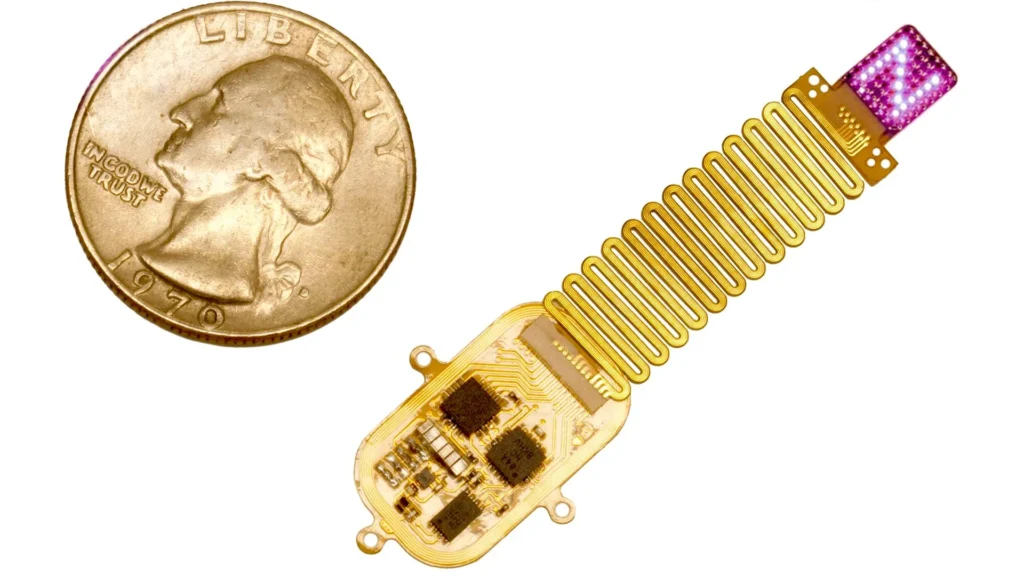
In a significant stride for the fields of neurobiology and bioelectronics, scientists at Northwestern University have engineered a groundbreaking wireless device capable of transmitting information directly into the brain using light. This innovative technology circumvents the body’s conventional sensory pathways, instead delivering precise signals directly to neurons, thereby opening new avenues for understanding and interacting with the central nervous system. The research, which marks a pivotal advancement in the development of brain-computer interfaces (BCIs), was published on Monday, December 8, in the esteemed journal Nature Neuroscience.
The newly developed device is characterized by its soft, flexible, and ultra-thin design, allowing it to be comfortably fitted beneath the scalp, resting gently on the surface of the skull. From this position, it projects meticulously controlled patterns of light through the cranial bone, activating specific groups of neurons across the cerebral cortex. This minimally invasive approach represents a crucial departure from previous, more intrusive brain interfacing technologies, promising enhanced patient comfort and reduced risks associated with implantation.
A Leap in Bioelectronic Interface Design
The core innovation lies in the device’s ability to create entirely new forms of communication with the brain. Unlike traditional sensory inputs that rely on external stimuli to generate electrical activity, this system directly introduces patterned signals. "Our brains are constantly turning electrical activity into experiences, and this technology gives us a way to tap into that process directly," stated Northwestern neurobiologist Yevgenia Kozorovitskiy, who spearheaded the experimental phase of the study. "This platform lets us create entirely new signals and see how the brain learns to use them. It brings us just a little bit closer to restoring lost senses after injuries or disease while offering a window into the basic principles that allow us to perceive the world."
The physical design of the device is a testament to sophisticated engineering. It is remarkably small, approximately the size of a postage stamp and thinner than a standard credit card. This compact form factor is crucial for its intended sub-scalp placement. Rather than requiring a probe to be inserted into brain tissue, the device gently conforms to the skull’s surface, leveraging the penetrating properties of red light to reach deep enough to activate neurons through the bone. Kozorovitskiy elaborated on this, noting, "Red light penetrates tissues quite well. It reaches deep enough to activate neurons through the skull."
From Single LED to Cortical Arrays: The Evolution of Optogenetics
This latest breakthrough builds upon years of foundational research and recent advancements in optogenetics and bioelectronics at Northwestern. The team, led by Kozorovitskiy and John A. Rogers, a preeminent figure in bioelectronics, has been at the forefront of developing wireless, implantable technologies for neural modulation.
The concept of optogenetics itself, which involves genetically modifying neurons to make them light-sensitive and then controlling their activity with light, has revolutionized neuroscience research since its emergence in the early 2000s. However, traditional optogenetic setups often relied on bulky fiberoptic wires directly implanted into the brain, severely restricting the natural movement and behavior of animal models. This limitation hampered studies requiring free-ranging behavior or long-term observation.
In 2021, the same Northwestern team achieved a significant milestone by reporting the first fully implantable, programmable, wireless, and battery-free device capable of controlling neurons with light. That pioneering system utilized a single micro-LED probe to influence social behavior in mice. The wireless design allowed the animals to behave normally in complex social environments, overcoming the limitations of wired systems.
The new device represents a substantial evolution of this earlier technology. Instead of a single micro-LED, the updated system incorporates an array of up to 64 independently programmable micro-LEDs. Each light source, as small as a single strand of human hair, can be controlled in real-time, enabling researchers to deliver intricate sequences of light patterns. This multi-site approach is critical because real sensory experiences activate broad, distributed networks of neurons across the cortex, rather than isolated regions. By mirroring these natural patterns, the device offers a more physiologically relevant means of interacting with the brain.
John A. Rogers, who led the technology development, emphasized the engineering challenges overcome. "Developing this device required rethinking how to deliver patterned stimulation to the brain in a format that is both minimally invasive and fully implantable," he explained. "By integrating a soft, conformable array of micro-LEDs with a wirelessly powered control module, we created a system that can be programmed in real time while remaining completely beneath the skin, without any measurable effect on natural behaviors of the animals. It represents a significant step forward in building devices that can interface with the brain without the need for burdensome wires or bulky external hardware. It’s valuable both in the immediate term for basic neuroscience research and in the longer term for addressing health challenges in humans."
Decoding Artificial Perceptions: Insights from Animal Models
To rigorously evaluate the efficacy of the new system, the research team conducted a series of sophisticated experiments using mouse models. These mice were genetically engineered to have light-responsive neurons specifically within their cerebral cortex, a common and necessary approach for current optogenetic studies.
During testing, researchers applied tiny, precisely timed bursts of light to stimulate targeted populations of these light-sensitive neurons deep within the mouse brains. The animals were then trained to associate specific patterns of this artificial light stimulation with a reward, typically located at a designated port within a testing chamber.
The implant delivered a defined light pattern across four distinct cortical regions, functioning akin to tapping a coded message directly into the brain. The mice quickly demonstrated their ability to interpret these incoming light patterns as meaningful cues, even in the complete absence of traditional sensory inputs like sound, sight, or touch. They learned to identify the target pattern among various alternatives and, when they detected the correct artificial signal, navigated to the appropriate port to receive their reward.
Mingzheng Wu, the study’s first author and a postdoctoral researcher, highlighted the significance of these behavioral outcomes. "In the first paper, we used a single micro-LED," Wu noted. "Now we’re using an array of 64 micro-LEDs to control the pattern of cortical activity. The number of patterns we can generate with various combinations of LEDs — frequency, intensity, and temporal sequence — is nearly infinite." He added, "By consistently selecting the correct port, the animal showed that it received the message. They can’t use language to tell us what they sense, so they communicate through their behavior." This behavioral validation underscores the brain’s remarkable plasticity and capacity to learn and integrate novel forms of sensory information.
Revolutionizing Medical Applications and Neuroscience
The potential applications of this wireless, light-based brain interface are vast and transformative, spanning both fundamental neuroscience research and a wide array of clinical interventions.
In the realm of medical applications, this technology could offer unprecedented solutions for individuals facing sensory loss or motor impairments. For instance, it could provide sophisticated sensory feedback for prosthetic limbs, allowing users to "feel" touch, pressure, or temperature directly in their minds, thereby enhancing the dexterity and naturalness of robotic prostheses. Current prosthetic limbs often lack this crucial sensory feedback, limiting their functional integration. Similarly, the device could deliver artificial inputs for future hearing or vision prostheses, bypassing damaged sensory organs and directly stimulating the cortical regions responsible for perception. Imagine a visual prosthesis that sends light patterns directly to the visual cortex, creating a perception of light and form for the blind, or an auditory prosthesis that generates sound perceptions for the deaf.
Beyond sensory restoration, the technology holds promise for controlling robotic limbs with greater precision and intuition, improving rehabilitation outcomes after severe injuries or stroke by stimulating neural pathways and promoting plasticity, and even modifying pain perception without relying on medications. Chronic pain, affecting an estimated 20-30% of the global adult population, remains a significant challenge, and non-pharmacological interventions that directly modulate pain signals in the brain could dramatically improve quality of life for millions.
From a neuroscience perspective, the device offers an unparalleled tool for understanding the brain’s fundamental operations. Researchers can now precisely control and observe how the brain processes novel information, forms perceptions, and adapts to new sensory inputs. This capability could lead to deeper insights into learning, memory, and the neural basis of consciousness, ultimately advancing our understanding of neurological and psychiatric disorders. The ability to generate sequences that mimic the distributed activity patterns naturally produced during sensory experiences allows for a detailed exploration of how the cortex functions and integrates information.
Navigating the Future: Challenges and Ethical Considerations
While the immediate potential is immense, the path to widespread human application involves significant challenges. A key aspect of the current research is the reliance on genetically modified neurons in animal models. Translating this directly to humans would necessitate similar genetic interventions, which are currently complex, highly regulated, and ethically charged for broad application. Future research will need to explore alternative methods for making human neurons light-sensitive without genetic modification, or focus on specific patient populations where such interventions might be considered in the distant future for life-altering conditions.
Regulatory hurdles for implantable medical devices are also substantial, requiring extensive preclinical testing, clinical trials, and rigorous safety and efficacy evaluations before approval. The long-term biocompatibility and stability of such a device, along with its wireless power delivery system, will need thorough investigation.
Furthermore, the ethical implications of directly interfacing with the brain, creating synthetic perceptions, and potentially influencing decision-making warrant careful consideration. Discussions around data privacy, cognitive enhancement, and the potential for misuse will be crucial as the technology matures. The scientific community, policymakers, and the public will need to engage in thoughtful dialogue to establish responsible guidelines for its development and deployment.
Despite these challenges, the team is optimistic about future developments. Now that they have demonstrated the brain’s capacity to interpret patterned light stimulation as meaningful information, they plan to test more sophisticated patterns and ascertain the maximum number of distinct signals the brain can reliably learn. Future iterations of the device may incorporate an even greater number of LEDs, smaller spacing between them for higher resolution, larger arrays covering more extensive cortical areas, and wavelengths of light designed to penetrate even deeper into brain tissue.
Funding and Collaborative Excellence
This groundbreaking research was supported by a diverse consortium of funding bodies, underscoring its broad scientific interest and potential impact. Key support came from the Querrey Simpson Institute for Bioelectronics, the NINDS/BRAIN Initiative, the National Institute of Mental Health, the One Mind Nick LeDeit Rising Star Research Award, the Kavli Exploration Award, the Shaw Family Pioneer Award, the Simons Foundation, the Alfred P. Sloan Foundation, and the Christina Enroth-Cugell and David Cugell Fellowship.
Yevgenia Kozorovitskiy holds the Irving M. Klotz Professorship of Neurobiology in Northwestern’s Weinberg College of Arts and Sciences and is a member of the Chemistry of Life Processes Institute. John A. Rogers holds appointments in materials science and engineering, biomedical engineering, and neurological surgery, and directs the Querrey Simpson Institute for Bioelectronics. This interdisciplinary collaboration, drawing expertise from neurobiology, materials science, engineering, and medicine, exemplifies the synergistic approach required to push the boundaries of bioelectronic innovation.
The successful development of this wireless optogenetic device marks a monumental step towards a future where neurological conditions are managed with highly advanced, seamless bioelectronic interfaces, offering renewed hope for restoring lost senses, enhancing function, and deepening our understanding of the human mind.