



Nutanix has officially announced a sweeping series of enhancements to the Nutanix Cloud Platform, specifically tailored to accelerate and secure the deployment of production-grade agentic artificial intelligence in enterprise environments. Revealed on August 26, the sweeping product update introduces the general availability of Nutanix Enterprise AI 2.8, while simultaneously laying the groundwork for the upcoming release of the Nutanix Kubernetes Platform 2.19. Furthermore, the virtualization and cloud-native computing giant rolled out Service Provider Central, a comprehensive multitenant control plane designed to streamline infrastructure, application, and AI service management across distributed deployments.
The core objective of these platform updates is to empower organizations to run sophisticated AI workloads seamlessly alongside their traditional virtualized and containerized applications. By utilizing a unified management and governance framework, IT leaders can bypass the traditional operational hurdles associated with siloed infrastructure. As enterprises race to transition from experimental AI proofs-of-concept to robust, scalable production environments, the demand for dual-native architectures that treat virtual machines and containers as first-class infrastructure has never been more urgent.
Background Context and Strategic Vision
The rapid evolution of generative AI and autonomous agentic systems has created profound architectural challenges for enterprise IT departments. Historically, organizations attempting to deploy large language models and machine learning pipelines were forced to establish isolated, specialized infrastructure silos. These segregated environments frequently introduced significant overhead, complicated compliance efforts, and hindered data sharing between legacy business logic and modern AI systems.

Nutanix has sought to counter this fragmentation through a "dual-native" architectural model. This strategy ensures that virtual machines and containers coexist naturally on the same foundational layer, allowing AI workloads to operate in close physical proximity to existing corporate data repositories and transactional applications.
"Enterprise AI should not require customers to rebuild the systems that already run their business," said Thomas Cornely, executive vice president of product management at Nutanix, emphasizing the company’s commitment to friction-free integration.
By eliminating the necessity to migrate core business applications into a single, restrictive deployment model, Nutanix aims to lower the total cost of ownership for enterprise AI while maintaining rigorous corporate compliance and security postures.
Chronology of Recent AI and Governance Releases
The latest August 26 announcements represent the culmination of a targeted product roadmap executed throughout the late summer. The sequence of releases underscores Nutanix’s methodical approach to bridging infrastructure management with advanced AI tooling:
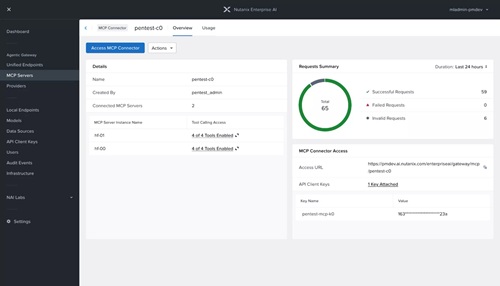
- August 10: Nutanix releases an open-source Model Context Protocol (MCP) server designed specifically for the Nutanix Cloud Platform. This software utilizes the Nutanix Prism v4 API to establish secure communication channels between developer tooling, AI assistants, and enterprise infrastructure.
- August 26: Nutanix formally announces the general availability of Nutanix Enterprise AI 2.8, introducing comprehensive MCP server management within the Nutanix Agent Gateway.
- August 26: The company announces Service Provider Central (SP Central) for general availability, establishing a unified multitenant control plane.
- Late August/Upcoming: Nutanix previews and prepares the rollout of Nutanix Kubernetes Platform 2.19, expanding container orchestration across bare-metal servers and hypervisors while introducing specialized AI application catalogs.
Deep Dive Into Nutanix Enterprise AI 2.8 and MCP Governance
As developers increasingly rely on autonomous AI agents to execute complex, multi-step workflows, the security and governance of these systems have become paramount. Nutanix Enterprise AI 2.8 addresses this vulnerability head-on by introducing generally available Model Context Protocol (MCP) server management directly within the Nutanix Agent Gateway.
Acting as a centralized mediation and connection point, the Agent Gateway bridges autonomous AI agents with local or remotely deployed MCP servers. IT administrators can leverage this interface to enforce granular access controls, assigning specific tool permissions to individual users or distinct API keys. Additionally, locally deployed MCP servers within the NAI 2.8 framework fully support rolling updates, minimizing downtime during software maintenance windows.
This governance functionality builds directly upon the August 10 introduction of the open-source NCP MCP server. By harnessing the capabilities of the Nutanix Prism v4 API, the server enables popular developer assistants and AI tooling—including GitHub Copilot, Claude Code, and Cursor—to interact safely with underlying cloud infrastructure. The built-in Prism v4 API Gateway acts as an enforcer of enterprise-grade security policies, managing critical functions such as role-based access control, request throttling, transaction metering, and comprehensive audit logging.
Expanding Private Inference and Technical Previews

Beyond governance, NAI 2.8 significantly extends the capabilities of Nutanix Private Inference. The updated platform introduces robust fine-tuning support for smaller foundational models featuring fewer than 8 billion parameters, enabling organizations to customize models securely on-premises without exposing sensitive intellectual property to third-party public cloud providers. Furthermore, NAI 2.8 facilitates the deployment of NVIDIA NIM microservices within fully air-gapped environments, addressing the strict security mandates of highly regulated industries such as finance, healthcare, and government defense.
To accommodate larger, more complex workloads, Nutanix has introduced several advanced features currently designated as technical previews. Multi-node and multi-GPU inference—engineered to support massive language models exceeding 100 billion parameters—is now available for testing. Additionally, Key-Value (KV) cache offloading from expensive GPU memory to more cost-effective CPU host memory has entered the tech preview phase. Nutanix officials have explicitly cautioned enterprise customers against deploying these tech preview features in mission-critical production environments until they achieve general availability status.
Nutanix Kubernetes Platform 2.19: Targeting AI and Bare-Metal Workflows
Complementing the software updates in NAI 2.8, the forthcoming Nutanix Kubernetes Platform (NKP) 2.19 aims to redefine containerized infrastructure management across both virtualized and physical bare-metal deployments. NKP 2.19 is designed to extend enterprise-grade container orchestration to environments where hypervisor overhead is either undesirable or unnecessary.
A central component of the upcoming release is NKP Metal, which extends the familiar Nutanix operational model directly onto physical servers. Utilizing built-in Nutanix Foundation and Lifecycle Manager capabilities, NKP Metal automates complex administrative tasks, including bare-metal node deployment, operating system provisioning, and firmware lifecycle management.
For organizations utilizing traditional virtualization, NKP on the AHV hypervisor can be tightly integrated with Nutanix Flow. This integration enables sophisticated network-level micro-segmentation, ensuring that autonomous AI agents operate within isolated security zones to prevent lateral movement in the event of a security compromise.
Furthermore, NKP 2.19 introduces a curated AI Applications Catalog designed to simplify the deployment of validated machine learning frameworks and data engineering tools. The catalog features native support for industry-standard software packages, including Kubeflow, the Milvus vector database, and the Slurm workload manager. Highlighting its commitment to open standards, Nutanix recently confirmed that NKP has earned official CNCF Kubernetes AI Conformant Platform certification.
Industry Implications and Future Outlook
The strategic convergence of enterprise cloud infrastructure and autonomous AI management systems highlights a profound shift in enterprise IT purchasing criteria. As agentic AI transitions from experimental novelty to core operational engine, organizations can no longer afford the inefficiencies and security vulnerabilities associated with fragmented, single-purpose AI clusters.
By embedding governance, multitenant control planes, and robust bare-metal container management directly into the fabric of the Nutanix Cloud Platform, the company is positioning itself as a comprehensive operating system for the modern, AI-driven enterprise. The ability to govern model access via MCP servers while simultaneously orchestrating large-scale inference workloads near existing data stores addresses the primary friction points inhibiting enterprise AI adoption.

While technical preview features such as multi-GPU inference and KV cache offloading mature over the coming quarters, the immediate availability of NAI 2.8 and the impending rollout of NKP 2.19 provide IT leaders with a scalable, secure blueprint for production-grade agentic AI. As these technologies permeate the enterprise market, organizations equipped with unified dual-native architectures will likely achieve faster time-to-value while maintaining the stringent regulatory compliance demanded by modern digital economies.