



The German verb haben, translating to "to have," serves as the foundational pillar of the German language, functioning not merely as a verb of possession but as the primary auxiliary engine for the majority of the language’s temporal constructions. For learners and linguists alike, the mastery of haben is considered the "gateway" to syntactic fluency. Its versatility allows it to bridge the gap between simple declarations of ownership and complex compound tenses, including the Perfekt (present perfect) and Plusquamperfekt (past perfect). Understanding the mechanics of haben—specifically its irregular conjugations and its role in distinguishing between state-of-being and action-oriented verbs—is essential for any serious study of Germanic linguistics.
The Historical and Linguistic Foundation of Haben
To understand haben, one must first recognize its status as a "mixed" or irregular verb. The verb’s evolution mirrors that of its English cognate "have." In the Middle High German period, the verb underwent significant phonetic erosion. Because haben is one of the most frequently used words in daily communication, it became subject to the linguistic law of frequency, which dictates that highly common words often contract or simplify over centuries of use.
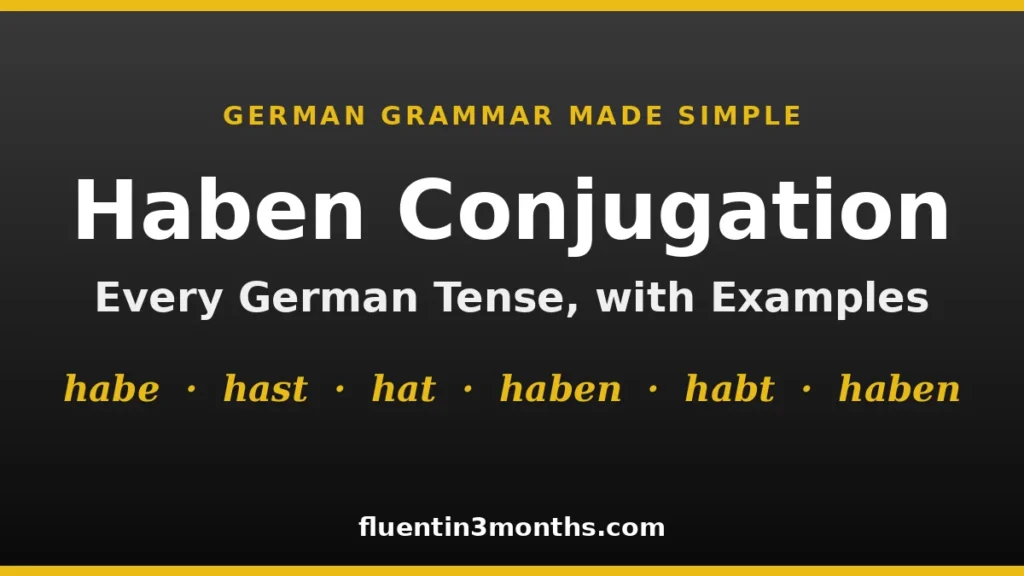
The most prominent example of this is the present tense (Präsens) conjugation. While a regular weak verb would maintain a consistent stem, haben sheds its final consonant in the second and third-person singular forms. The stem hab- is effectively truncated to ha- when paired with the suffixes -st and -t, resulting in du hast and er/sie/es hat. This shift is not a stylistic choice but a historical byproduct of speech efficiency. When learners attempt to use "habst" or "habt" (in the third person), they are applying regular grammatical logic to an irregular, high-frequency exception. Recognizing this pattern early is widely considered by language acquisition experts to be the single most important "hack" for preventing common beginner errors.
Comparative Tense Analysis and Usage
German employs two simple tenses—the Präsens and the Präteritum—and four compound tenses. The auxiliary nature of haben is most visible in the latter. In the Perfekt tense, haben is combined with the Partizip II (past participle), such as gehabt.
Data from pedagogical studies in German as a Second Language (GSL) indicate that while the Perfekt is the standard for spoken past tense in the majority of German verbs, haben and its counterpart sein act as the primary exceptions. In standard conversation, German speakers overwhelmingly prefer the Präteritum form ich hatte over the compound ich habe gehabt. This preference is rooted in the efficiency of the Präteritum for high-frequency verbs, allowing for smoother narrative flow.
Chronology of Verb Complexity
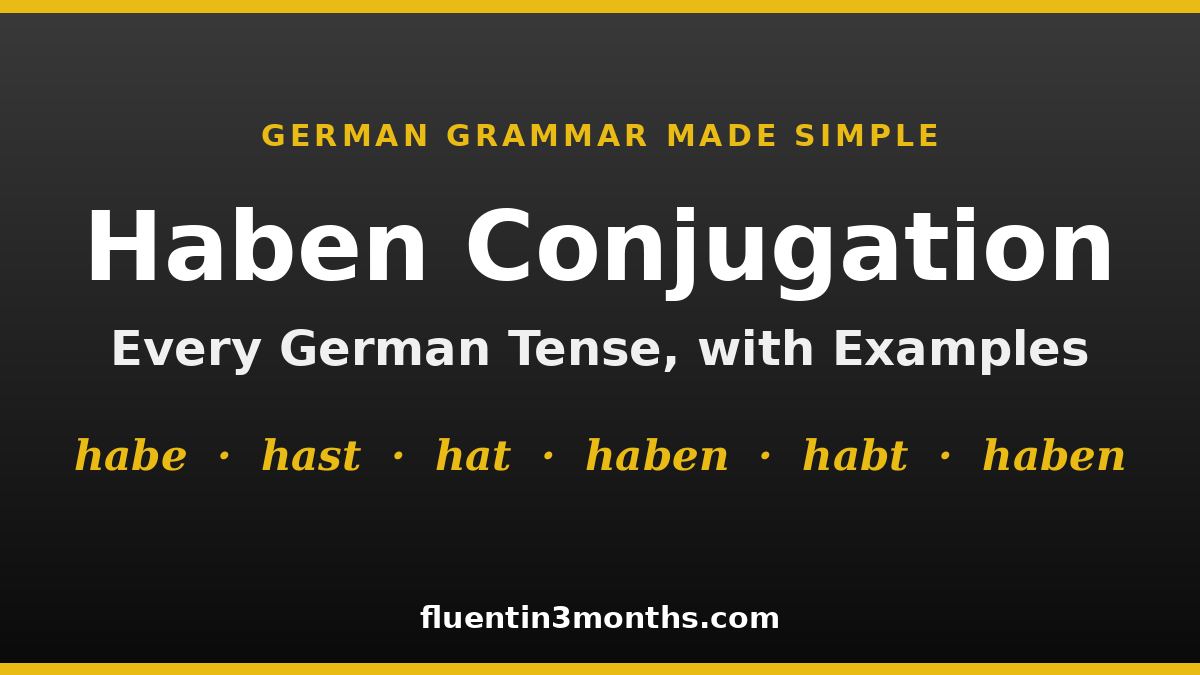
- The Present Tense Foundation: Mastery of habe, hast, hat, haben, habt, haben serves as the baseline for all subsequent tense mastery.
- The Präteritum Shift: Transitioning to hatte allows for the expression of narrative past events, essential for historical or storytelling contexts.
- Compound Integration: Once the student masters the Perfekt (using haben as the auxiliary) and the Futur I (using werden + haben), the student gains the ability to articulate complex conditional and future-oriented thoughts.
The Dichotomy of Haben and Sein
A critical area of linguistic analysis involves the selection of the auxiliary verb. German distinguishes between haben and sein as auxiliary verbs based on the semantic nature of the main verb. Haben acts as the default auxiliary for transitive verbs and most intransitive verbs. Conversely, sein is strictly reserved for verbs indicating motion (e.g., gehen, fahren) or a change of state (e.g., werden, aufwachen).
This binary creates a distinct divide for learners. Data suggests that approximately 80% to 90% of verbs in the German language utilize haben as their Perfekt auxiliary. Therefore, the "default to haben" rule is statistically the most effective heuristic for speakers navigating uncertain verb choices. However, the exception of age—where German utilizes sein (Ich bin 25 Jahre alt)—remains a major point of interference for speakers of Romance languages, where the concept of age is typically expressed using the "to have" equivalent.
Functional Applications in Formal and Informal Contexts
The utility of haben extends into the Konjunktiv moods, specifically Konjunktiv II, which is indispensable for hypothetical statements and polite requests. The form ich hätte gern ("I would like") is the standard socio-linguistic marker for politeness in service encounters. Unlike ich will ("I want"), which is often perceived as demanding or blunt, ich hätte gern functions as a linguistic buffer, softening the request and aligning with German cultural norms regarding formal interaction in commerce and hospitality.
The Konjunktiv I, meanwhile, is largely relegated to the realm of journalism and official reporting. It is used to convey reported speech—the "he said that he has…" structure—without the speaker endorsing the factual accuracy of the statement. For a newsroom or professional correspondent, the ability to correctly utilize Konjunktiv I is a mark of high-level proficiency and journalistic integrity.
Strategic Implications for Language Acquisition
For the student of the German language, the study of haben provides more than just a conjugation table; it provides a structural map of the entire language. Because every compound tense in German relies on the auxiliary-plus-participle structure, learning the mechanics of haben is essentially learning the architecture of the German tense system.
Academic analysis suggests that learners who focus on the "mixed" nature of haben—its regular dental suffix -te but irregular stem change hab- to hatt-—are better prepared to tackle other irregular verbs like kennen (kannte), bringen (brachte), and wissen (wusste). These verbs form a specific class of "mixed" verbs that bridge the gap between weak and strong conjugation patterns.
Official Guidelines for Usage
In professional communication, clear usage of haben is paramount to avoid ambiguity. The following table summarizes the core usage requirements based on linguistic standards:
| Context | Verb Requirement | Rationale |
|---|---|---|
| Possession | Literal haben | Establishes ownership. |
| Past Action | Haben + Participle | Standard for most non-motion verbs. |
| Hypothetical | Konjunktiv II (hätte) | Essential for polite, indirect communication. |
| Reported Speech | Konjunktiv I (habe) | Standard for journalistic attribution. |
Broader Linguistic Impact
The influence of haben extends beyond basic grammar. It serves as an indicator of the language’s historical development and its continued evolution toward efficiency. As German continues to interact with global languages, the pressure on haben to remain consistent is high. It remains the most resilient verb in the language, resisting the simplifications that often degrade other, less frequent verbs.
In summary, the verb haben is the backbone of German syntax. Its role as an auxiliary, its status as a high-frequency irregular verb, and its usage in both hypothetical and reported speech make it the most vital subject of study for the proficient German speaker. Whether in the context of a casual request at a café or a formal report in a major publication, haben is the primary instrument by which the German language conveys possession, history, and intent. By mastering its various tenses, conjugations, and stylistic nuances, learners do not merely memorize a word; they acquire the tools necessary to construct the vast majority of the German verbal landscape.