





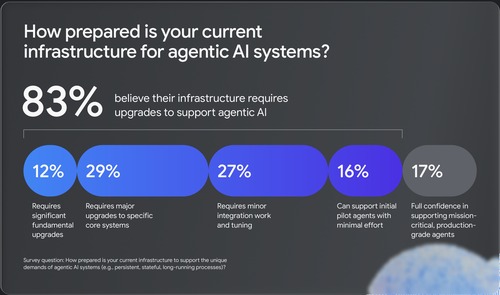
As enterprises transition artificial intelligence strategies from isolated testing environments to fully integrated commercial deployments, a staggering infrastructure gap threatens to derail progress. According to the latest comprehensive research released by Google Cloud, approximately 83 percent of surveyed organizations believe their current technological frameworks require significant upgrades before they can successfully support production-grade agentic AI systems. This revelation underscores a profound evolution in corporate technology adoption, signaling that the primary bottleneck in artificial intelligence has decisively shifted from algorithmic development to foundational backend infrastructure.
The findings, published in the 2026 State of Infrastructure in the Agentic AI Era report, shed light on the unique operational pressures introduced by autonomous agents. Unlike traditional generative artificial intelligence models that respond to isolated prompts with static text or images, agentic AI systems are designed to operate independently. A single prompt given to an autonomous agent can effortlessly trigger hundreds of complex, downstream actions. These systems actively browse databases, issue queries, make API calls, and execute multi-step workflows across disparate enterprise software ecosystems without continuous human oversight. Consequently, production-grade agentic workloads are inherently persistent, stateful, and potentially long-running, demanding a robust infrastructure capable of sustaining continuous execution, ironclad security, and rigorous governance over extended periods.
Evolution of the Enterprise AI Strategy: A Historical Timeline

To fully understand the weight of the 2026 findings, it is helpful to examine the rapid evolution of enterprise artificial intelligence over recent years. The journey from experimental chatbot deployments to autonomous multi-system agents has occurred at a breakneck pace, reshaping enterprise priorities annually.
In 2023, the generative artificial intelligence boom was primarily defined by exploration and proof-of-concept projects. Organizations rushed to experiment with foundation models, testing large language models for basic copywriting, summarization, and brainstorming tasks. Infrastructure considerations during this initial wave were largely secondary, as most projects were sandboxed and handled by dedicated innovation teams rather than core IT infrastructure units.
By 2024, the landscape matured as companies sought to move beyond basic chatbots toward Retrieval-Augmented Generation (RAG) and domain-specific applications. Enterprises began recognizing that data silos and legacy architectures posed severe hurdles. Google Cloud’s landmark 2025 infrastructure research subsequently identified infrastructure as the missing piece in enterprise GenAI strategy. That report revealed near-universal experimentation but highlighted critical gaps in data governance, multi-cloud integration, cost optimization, and edge computing readiness.
Entering 2026, the technological paradigm shifted once more with the advent of agentic systems. Rather than merely generating content, artificial intelligence began taking independent actions. This evolution rendered the 2025 infrastructure frameworks insufficient. The 2026 research shifted the industry spotlight squarely onto the intense demands of autonomous agents, emphasizing the urgent need for structural overgrades, continuous inference MLOps, edge-distributed execution, and power-efficient hardware selection.
Breaking Down the Readiness Gap
The headline figure of 83 percent expressing an urgent need for infrastructure updates is further illuminated by a granular breakdown of organizational readiness levels contained within the Google Cloud study. When surveyed on the precise scope of work required to ready their systems for autonomous agents, respondents painted a sobering picture of enterprise technological debt.
Only 17 percent of organizations reported full confidence that their existing infrastructure is adequately prepared to support mission-critical, production-grade agentic workloads. At the opposite end of the spectrum, 12 percent of respondents admitted that their underlying architecture requires significant, fundamental overhauls before they can even contemplate deploying agents at scale. Furthermore, 29 percent indicated that major upgrades to specific core systems—such as legacy enterprise resource planning (ERP) platforms and customer relationship management (CRM) software—are mandatory.
Meanwhile, 27 percent reported that they require moderate integration work and system tuning to bridge current gaps. A final 16 percent stated that while their infrastructure can comfortably support preliminary pilot agents with minimal effort, scaling those pilots into fully operational, production environments remains a bridge too far without further investment.

This widespread readiness gap is directly attributed to the stark operational differences between legacy applications, traditional cloud workloads, and autonomous agents. Traditional software executes predictable, deterministic code paths defined rigidly by human engineers. In contrast, agentic AI relies on probabilistic reasoning, dynamic planning, and continuous decision-making loops.
To function effectively, these agents must maintain contextual awareness across wildly disparate workflows and vast data repositories. They must seamlessly interface with foundational business systems, retain long-term memory across days or weeks of operation, and sustain complex chains of actions without crashing or hallucinating critical parameters. Furthermore, enterprise infrastructure must enforce strict security boundaries and data residency compliance across hybrid environments spanning on-premises data centers, edge computing nodes, and multiple public clouds.
Industry Perspectives and Strategic Imperatives
Technology leaders and enterprise architects are increasingly recognizing that the success of artificial intelligence initiatives relies entirely on the strength of the underlying technical foundation. Commenting on the release of the new research, Nirav Mehta, Vice President of Product Management at Google Cloud, emphasized the transformative nature of the study.

"This report isn’t just a survey of the landscape; it’s a roadmap for establishing the new standard for production-grade autonomous systems," Mehta stated. His remarks reflect a broader industry consensus that treating agentic AI as a simple software plugin is a recipe for operational failure.
For developer communities and platform engineering teams, the 2026 report serves as a stark warning regarding the types of tooling that must be prioritized in upcoming budget cycles. Specifically, the research highlights an acute need for advanced orchestration and observability platforms. Developers require sophisticated tools capable of coordinating multi-step agentic workflows, managing high-volume data movement between autonomous agents and fragile legacy systems, monitoring real-time agent activity for anomalous behavior, and seamlessly facilitating human-in-the-loop interventions when an agent encounters ambiguous operational scenarios.
Broader Implications and Economic Impact
The implications of the Google Cloud infrastructure study extend far beyond corporate IT departments, touching upon global energy markets, hardware manufacturing supply chains, and macroeconomic productivity trends.

As organizations rush to modernize their data centers to support continuous inference and stateful agentic workloads, demand for specialized hardware—such as advanced graphics processing units (GPUs), tensor processing units (TPUs), and high-bandwidth memory—is expected to remain exceptionally high. However, the report’s inclusion of power consumption as a primary factor in hardware selection highlights an emerging crisis within the technology sector. The relentless computational demands of long-running, autonomous agents risk straining corporate sustainability goals and local power grids, forcing enterprises to prioritize energy-efficient silicon and green data center initiatives.
Moreover, the financial implications are profound. Organizations that fail to bridge the infrastructure readiness gap risk watching their artificial intelligence investments stall in eternal pilot phases, yielding little to no return on investment. Conversely, enterprises willing to commit the necessary capital to overhaul their core systems, enhance data governance, and deploy robust MLOps pipelines will likely capture significant competitive advantages. By successfully integrating production-grade agentic AI, these forward-thinking organizations can automate complex business processes, accelerate decision-making cycles, and redefine operational efficiency in the digital economy.
Ultimately, the 2026 State of Infrastructure in the Agentic AI Era report marks a turning point for enterprise technology. The era of casual artificial intelligence experimentation has officially drawn to a close. As autonomous agents prepare to take center stage in corporate operations, the message to enterprise leadership is unmistakably clear: the future of artificial intelligence will not be decided solely by the brilliance of the algorithms, but by the resilience, scalability, and intelligence of the infrastructure upon which they run.







