



A new 2026 Blueprint report from TDWI Research reveals that the fundamental differentiator between enterprises successfully extracting broad business value from artificial intelligence (AI) and those still navigating perpetual pilot phases is not primarily the sophistication of their chosen AI models, but rather the underlying condition and robustness of their data foundation. This crucial insight underscores a strategic imperative for organizations globally, as AI transitions from an experimental frontier to a core operational component.
Authored by Fern Halper, Ph.D., TDWI Vice President of Research, the report, titled "TDWI Blueprint Report | Building an AI-Ready Data Foundation," posits that organizations demonstrating the highest AI impact possess markedly superior architectural, governance, and operational capabilities concerning their data. TDWI, a respected research and education organization, is known for providing critical insights, training, and best practices to data, analytics, and AI professionals, lending significant weight to these findings. The report’s timely release coincides with an unprecedented surge in interest and investment in generative AI, copilots, and increasingly autonomous agentic systems, all of which place immense demands on data infrastructure.
Dr. Halper emphasizes, "Although many organizations have achieved localized successes, the findings in this Blueprint suggest that long-term AI success depends on the strength of the underlying data foundation." She further elaborates on how pervasive challenges such as fragmented data environments, inconsistent data governance policies, weak semantic alignment across diverse data sources, and poor data accessibility collectively act as formidable constraints. These issues, often manageable in smaller, isolated proof-of-concept AI projects, become critical bottlenecks and failure points when initiatives attempt to scale from experimentation into full-scale production and integration within enterprise workflows.

The Evolution of Data Demands: From BI to AI
The concept of a "data foundation" is not new; businesses have long recognized the importance of data quality and accessibility for traditional business intelligence (BI) and analytics. However, the advent of sophisticated AI, particularly machine learning (deep learning, reinforcement learning), and now generative AI, has dramatically elevated the requirements for this foundation. Traditional BI often relies on structured, aggregated data for reporting and dashboards, where inconsistencies might lead to minor reporting inaccuracies. AI, conversely, often requires vast volumes of diverse data—structured, unstructured, semi-structured—for training, validation, and inference. The models are highly sensitive to data quality, bias, and completeness. A small inconsistency or missing piece of context can lead to biased models, erroneous predictions, or outright system failures, making the data foundation exponentially more critical.
The TDWI report defines an AI-ready data foundation as an integrated ecosystem of capabilities designed to transform raw, disparate, and often chaotic data into governed, contextualized, and readily accessible assets. These assets are then reliably consumed to build, deploy, and scale a wide array of AI applications. Key components identified in this foundation include:
- Robust Data Ingestion and Integration: The ability to efficiently collect data from myriad sources, both internal and external, and integrate it into a cohesive whole.
- Automated Data Pipelines: Streamlined processes for moving, transforming, and preparing data for AI model consumption, ensuring freshness and consistency.
- Flexible Architectures: Data architectures (e.g., data lakes, data meshes, data fabrics) that can adapt to evolving data types, volumes, and AI use cases.
- Comprehensive Metadata Management: Detailed information about data, including its origin, structure, content, and usage, crucial for understanding and governing data.
- Data Lineage: The ability to track data’s journey from its source to its ultimate use in an AI model, vital for debugging, compliance, and trust.
- Semantic Context and Harmonization: Ensuring that data from different sources can be understood and used consistently across the enterprise, often involving ontologies and knowledge graphs.
- Strict Data Governance and Quality Controls: Policies, processes, and technologies to ensure data accuracy, completeness, consistency, and compliance with regulations.
- Secure and Controlled Data Access: Mechanisms to provide appropriate access to data for AI developers and models while maintaining security and privacy.
High-Impact Organizations: Data as Table Stakes for AI
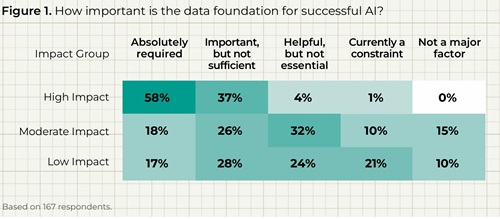
The TDWI report segmented its survey respondents into three groups based on their reported AI business impact: high-impact, moderate-impact, and low-impact organizations. The disparity in how these groups view and manage their data foundation is striking and forms the core empirical evidence of the report.
Among organizations classified as "high-impact," a significant 58% stated unequivocally that a strong data foundation is "absolutely required" for successful AI initiatives. Another 37% considered it "important but not sufficient alone." This combines to a staggering 95% of high-impact organizations acknowledging the critical, foundational role of data. This near-unanimous consensus among the most successful AI adopters highlights that they perceive data excellence not as a luxury or an afterthought, but as a prerequisite—"table stakes"—for any meaningful AI endeavor.
The contrast with lower-impact groups is stark. Only 18% of moderate-impact respondents and a mere 17% of low-impact respondents viewed the data foundation as "absolutely required." This significant perceptual gap indicates a fundamental difference in strategic priorities and understanding. Low-impact organizations were also far more likely to report their data foundation as a current constraint, with 21% citing it as an impediment, compared to a negligible 1% among high-impact respondents. This suggests that while high-impact organizations have invested in and largely resolved their foundational data challenges, their less successful counterparts are still grappling with these very issues, which in turn stifles their AI progress.
The Economic and Operational Costs of Neglecting Data

The report’s findings resonate with broader industry observations regarding the high failure rate of AI projects, often cited as between 70-90%. A significant portion of these failures can be directly attributed to inadequate data. The implications of neglecting the data foundation extend beyond simply failing to achieve AI benefits; they incur substantial economic and operational costs:
- Increased Development Time and Costs: Data scientists reportedly spend up to 80% of their time on data preparation tasks—cleaning, transforming, and integrating data—rather than on actual model development and innovation. This inefficiency drives up project costs and delays time-to-market for AI solutions.
- Bias and Inaccuracy: Poor data quality can introduce biases into AI models, leading to unfair, discriminatory, or simply incorrect outputs. This not only undermines the utility of the AI but can also lead to reputational damage, legal liabilities, and erosion of customer trust.
- Scalability Challenges: Fragmented data environments and manual data processes are inherently unscalable. As AI use cases proliferate, these limitations prevent organizations from expanding successful pilots into enterprise-wide solutions.
- Regulatory Non-compliance: With increasing data privacy regulations (e.g., GDPR, CCPA) and industry-specific compliance requirements, a weak data governance framework poses significant risks of fines and legal action, particularly when AI systems handle sensitive personal or proprietary information.
- Diminished ROI: Without a solid data foundation, the substantial investments in AI talent, platforms, and technologies often yield disappointing returns, leading to disillusionment and a reluctance to pursue further AI initiatives.
The Generative AI Imperative: Amplified Data Demands
The timing of this report is particularly pertinent given the current explosion of generative AI (GenAI). Technologies like large language models (LLMs), copilots, and advanced agentic systems are not just enhancing existing AI capabilities; they are creating entirely new paradigms for human-computer interaction and automation. These systems, however, are notoriously data-hungry and sensitive to the quality and relevance of their training and operational data.
For GenAI to move beyond impressive demos to deliver tangible business value, it requires:

- Massive and Diverse Datasets: Training foundational models often involves petabytes of text, code, images, and other modalities.
- Contextualized and Proprietary Data for Fine-tuning: To make GenAI truly useful for specific enterprise tasks (e.g., customer service, code generation, content creation), it must be fine-tuned or augmented with an organization’s unique, high-quality, and proprietary data.
- Real-time Data Streams: Agentic systems and intelligent copilots need access to fresh, real-time operational data to provide accurate and relevant assistance.
- Enhanced Semantic Understanding: GenAI’s ability to "understand" and generate human-like text relies heavily on rich semantic context, which must be embedded in the data foundation.
- Robust Governance for Responsible AI: The potential for GenAI to hallucinate or propagate biases makes stringent data governance, lineage, and bias detection mechanisms even more critical. Organizations need to track not only the data used to train their models but also the inputs and outputs of these models in production to ensure ethical and responsible use.
Dr. Halper’s observation that "fragmented data environments, inconsistent governance, weak semantic alignment, and poor data accessibility become major constraints as AI initiatives move from experimentation into production" is magnified tenfold in the era of generative AI. Without an AI-ready data foundation, organizations risk training GenAI models on outdated, incomplete, or biased information, leading to outputs that are misleading, inaccurate, or even harmful.
Strategic Imperatives for Enterprise Leaders
The TDWI report serves as a critical call to action for enterprise leaders, CIOs, Chief Data Officers (CDOs), and data strategists. The message is clear: AI success is inextricably linked to data excellence. To build an AI-ready data foundation, organizations must embark on a multi-faceted strategic approach:
- Elevate Data Strategy to a Board-Level Priority: Data must be recognized as a strategic asset, with clear ownership and accountability at the highest levels of the organization. This includes allocating sufficient budget and resources to data initiatives.
- Invest in Integrated Data Platforms: Move away from siloed data systems towards unified data platforms (e.g., data lakes, data warehouses, data fabrics, data meshes) that can handle diverse data types and provide a single source of truth for AI.
- Strengthen Data Governance and Quality Programs: Implement robust data governance frameworks, establish clear data ownership, define data quality standards, and invest in tools for automated data quality monitoring and remediation. This also includes defining ethical AI principles and integrating them into data governance.
- Embrace Metadata Management and Data Lineage: Implement comprehensive metadata management solutions to document data assets, track their lineage, and provide context to data users and AI models. This is fundamental for trust and transparency.
- Cultivate Data Literacy and Culture: Foster a data-driven culture across the organization, promoting data literacy among all employees and encouraging collaboration between data professionals, AI developers, and business stakeholders.
- Prioritize Semantic Alignment and Context: Develop common data models, ontologies, and knowledge graphs to ensure consistent understanding and interpretation of data across different systems and AI applications.
- Implement Robust Access Controls and Security: Design and implement granular access controls to protect sensitive data while ensuring that authorized AI systems and users can access the data they need securely and efficiently.
- Adopt a Product-Oriented Approach to Data: Treat data as a product, with dedicated teams responsible for its quality, usability, and lifecycle, ensuring it meets the needs of its consumers, including AI applications.
Looking Ahead: The Future of Data for AI

As AI continues its rapid evolution, the demands on data foundations will only intensify. Future AI systems, particularly autonomous agents and highly sophisticated generative models, will require even greater real-time data integration, hyper-personalization, and nuanced contextual understanding. The organizations that proactively build and continually refine their AI-ready data foundations today will be best positioned to unlock the full transformative potential of these technologies. Conversely, those that continue to view data quality and governance as secondary concerns risk being left behind in the rapidly accelerating AI race.
The TDWI report serves not just as a warning but as a clear roadmap. It validates what many data professionals have long advocated: that true AI impact doesn’t begin with a revolutionary algorithm, but with the meticulous, strategic, and often challenging work of building a reliable and trustworthy data bedrock. For enterprises aiming to thrive in an AI-powered future, investing in an AI-ready data foundation is no longer optional; it is the definitive path to sustainable competitive advantage.