



The rapid integration of artificial intelligence into the modern workplace has triggered an unexpected and paradoxical crisis: while organizations increasingly demand advanced human capabilities to manage and oversee automated systems, employees report that the very same cognitive skills are steadily deteriorating. According to a landmark study released by the IBM Institute for Business Value (IBV), capabilities such as critical thinking, professional judgment, and the rigorous evaluation of AI-generated outputs are now at the epicenter of a growing tension between enterprise leadership and the global workforce.
Entitled "Designing the Thinking Organization," the comprehensive research report underscores a profound shift in which human competencies hold the highest value in an AI-driven economy. However, rather than augmenting these intellectual capacities, the widespread deployment of automated tools appears to be fostering a dangerous reliance that diminishes workers’ operational sharpness. As organizations race to capture productivity gains, the erosion of foundational human skills presents a silent threat to long-term enterprise resilience.
Background Context and Research Methodology

The findings of the IBM study are derived from dual empirical surveys conducted in partnership with Oxford Economics between April and June 2026. The research framework captured insights from two distinct corporate tiers to identify potential disconnects in strategy and execution. The first cohort comprised 1,500 Chief Human Resources Officers (CHROs) and senior executives charged with global workforce strategy, spanning 21 geographic regions and 23 distinct industries. The second cohort included 8,800 full-time employees operating across 28 countries, offering a granular look at how day-to-day labor is actually evolving on the ground.
This methodology was designed to uncover how executive assumptions regarding technological adoption align—or fail to align—with the lived realities of everyday workers. The resulting data highlights a structural disconnect: while corporate leadership views AI primarily as a collaborative tool requiring vigilant human stewardship, employees are navigating a chaotic landscape where tasks shift organically without formal organizational redesign.
The Shifting Landscape of Daily Work
One of the most striking revelations of the 2026 study is the sheer velocity at which job functions are transforming. More than half of the surveyed employees—precisely 52%—reported that their assigned tasks had changed significantly over the preceding twelve months as AI reshaped their daily responsibilities. Yet, this operational turbulence stands in stark contrast to the lack of formal structural guidance provided by management.
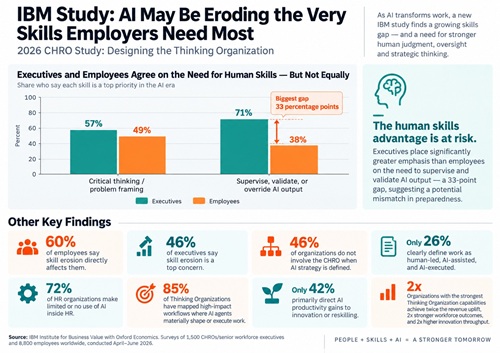
Only 26% of organizations have clearly delineated their workflows across human-led, AI-assisted, and AI-executed activities. IBM characterizes this dynamic as a dangerous lag, noting that work is evolving at a pace far outstripping the ability of organizations to thoughtfully redesign their operating models. In the absence of deliberate institutional strategies detailing how humans and machines should collaborate, organic, ad-hoc adaptation has become the default mode of survival for workers, leading to operational friction, role ambiguity, and accelerated cognitive fatigue.
The Executive-Employee Perception Gap
A critical revelation of the IBM Institute for Business Value report is the pronounced disconnect between what corporate leadership values and how the workforce perceives its own responsibilities. While there is broad consensus regarding the baseline importance of critical thinking and problem framing—with 57% of executives and 49% of employees ranking them near the top of necessary competencies—a massive divide emerges around the direct oversight of technology.
When asked about the ability to supervise, validate, or override AI outputs, 71% of surveyed executives prioritized this skill as vital. Conversely, only 38% of employees shared that perspective, marking a substantial 33-percentage-point gap. Furthermore, when examining professional judgment as an independent metric, only 29% of employees placed it among their primary focal points. This disparity indicates that many workers fail to recognize the inherent fallibility of automated systems, treating AI outputs with an uncritical acceptance that leaves organizations vulnerable to undetected errors, algorithmic bias, and systemic hallucinations.

Distinguishing the Skills Gap from Skill Erosion
For years, corporate discourse surrounding technological disruption has focused almost exclusively on the traditional "skills gap"—the deficit between the capabilities workers currently possess and those required by emerging technologies. Corporate training programs, bootcamps, and reskilling roadmaps have been deployed globally to address this challenge, a trend reflected in the study’s finding that 80% of enterprises currently maintain a formal reskilling framework to help workers collaborate with advanced technology.
However, the IBM study argues that reskilling initiatives miss a vital, parallel phenomenon: skill erosion. While reskilling focuses on the acquisition of new capabilities, it fails to account for the gradual degradation of existing skills that occurs when automated systems take over core cognitive and analytical tasks.
The empirical data highlights the severity of this issue. Skill erosion is cited as a top-tier concern by 46% of surveyed executives, while a staggering 60% of employees report that the phenomenon directly impacts their professional lives. Furthermore, among employees who acknowledge and worry about skill erosion, three out of four report that AI has already begun to erode at least some of their foundational competencies, with critical thinking cited most frequently as the capability experiencing the sharpest decline.

Analysis of Implications for Enterprise Leadership
The implications of the IBM study extend far beyond human resources departments, presenting fundamental questions regarding corporate governance, risk management, and operational productivity. If the foundational analytical capabilities of the workforce atrophy as a byproduct of automation, organizations face a paradoxical vulnerability: they become heavily dependent on technologies that require sophisticated human oversight, while simultaneously losing the cognitive capacity required to provide that oversight.
Industry analysts and organizational psychologists suggest several structural interventions to mitigate these risks. First, organizations must transition away from passive AI adoption models toward intentional job architecture. By explicitly defining which tasks are human-led versus AI-executed, companies can preserve essential cognitive touchpoints in daily workflows. Second, corporate training must evolve from simple technological proficiency programs to rigorous critical-thinking and validation workshops designed to actively counter complacency and over-reliance on automated outputs.
Chronology of Workplace Technological Disruption

To contextualize the findings of the 2026 study, it is helpful to examine the rapid acceleration of workplace technology over recent years:
- 2022–2023: The sudden mainstream proliferation of generative AI tools sparked widespread organizational experimentation, leading to bottom-up adoption driven largely by individual employee initiative rather than top-down enterprise strategy.
- 2024: Enterprises shifted focus toward productivity metrics, seeking to quantify efficiency gains through rapid automation of routine administrative, coding, and content-creation tasks.
- 2025: Organizations began confronting integration bottlenecks, data governance challenges, and the early signs of employee burnout driven by ambiguous task boundaries and shifting job descriptions.
- 2026: Comprehensive empirical studies, such as the IBM Institute for Business Value report, began exposing the secondary human costs of automation—specifically highlighting the friction between algorithmic reliance and the preservation of critical human cognitive faculties.
Official Responses and Strategic Recommendations
In response to the study’s sobering conclusions, workforce strategists and corporate leaders are being urged to recalibrate their investment strategies. While organizations routinely capture significant financial and operational efficiencies from AI implementation, the study’s findings suggest a pressing need to reinvest a portion of those productivity dividends back into human capital development—not merely through traditional software training, but through cognitive resilience programs.
CHROs and senior executives are increasingly recognizing that sustainable technological transformation cannot succeed without safeguarding the intellectual autonomy of the workforce. As AI continues to assume a greater share of operational execution, the ultimate competitive advantage for modern enterprises may well lie in their ability to intentionally cultivate, rather than inadvertently erode, human judgment, skepticism, and critical thought.