



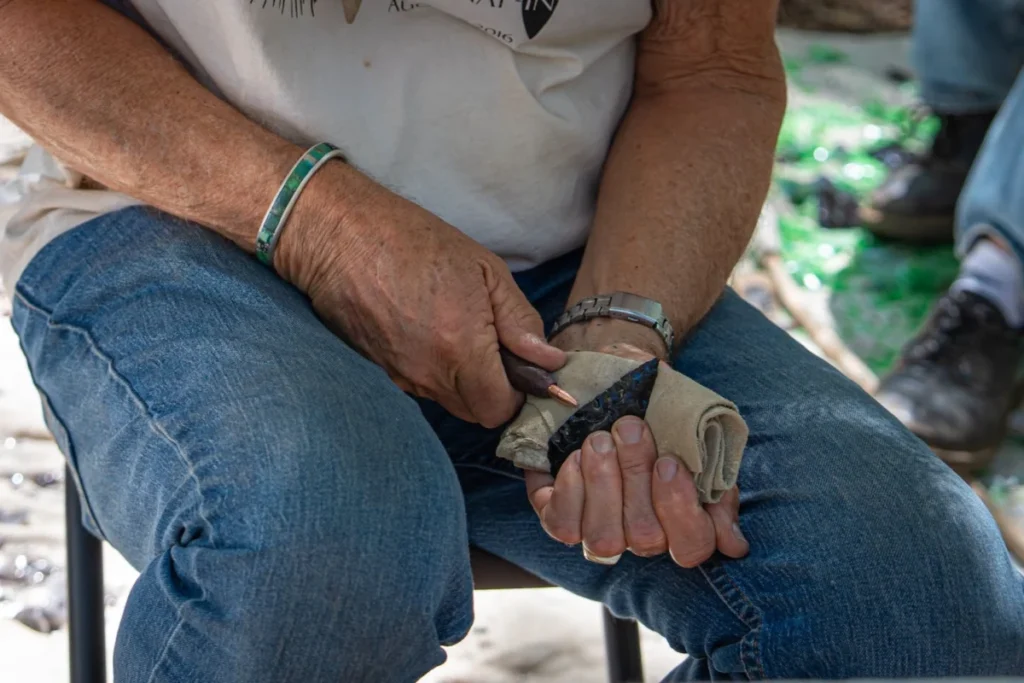
The foundational mechanics of arrow-making have changed remarkably little over tens of thousands of years, driven by a simple functional truth: when an ancient technology works with absolute lethal precision, it endures. The earliest known archaeological examples of sophisticated projectile points date back approximately 74,000 years to the Middle Stone Age in what is now Ethiopia. Yet, the craft of transforming raw stone into razor-sharp hunting implements is not merely an extinct historical curiosity; it remains a living tradition practiced today by cultural preservationists, historians, and trained artisans worldwide.
As recent educational outreach by Yosemite National Park officials highlights, the creation of these tools requires far more than brute force or the random shattering of rocks. It is a precise, highly skilled subtractive manufacturing process known as flintknapping. At its core, successful knapping relies on a deep understanding of mineralogy—specifically the selection of cryptocrystalline and volcanic stones that fracture via conchoidal breakage. This unique physical property allows artisans to control how the material breaks down to the millimeter, producing edges that can be sharper than modern surgical steel.
The Mineralogy of Knapping: Selecting the Right Stone
To understand the complexity of the craft, one must first examine the raw materials. Flintknappers traditionally rely on specific stones that possess uniform, fine-grained structures capable of responding predictably to applied force. Among the most common are chert, flint, jasper, and chalcedony. However, the undisputed gold standard for both ancient and modern knappers is obsidian—a naturally occurring volcanic glass formed when felsic lava extruded from a volcano cools rapidly with minimal crystal growth.
When subjected to controlled percussion—striking the stone with a hammerstone made of denser rock or an antler billet—obsidian shatters in a conchoidal fracture pattern. This means the shockwave travels through the material in smooth, curved concentric ripples, leaving behind sharp, concave scars and razor-thin edges. Artisans use a multi-stage process, beginning with hard-hammer percussion to rough out the initial bifacial blank, transitioning to soft-hammer percussion for thinning, and finishing with pressure flaking. Using tools crafted from bone, antler, or copper, the knapper pushes small, precise flakes off the edge of the stone to hone the final symmetry, notches, and aerodynamic profile required for an effective arrow, spear point, knife, or scraper.
Prehistoric Trade Networks in the Sierra Nevada
While obsidian yields the ultimate cutting edge, it is a localized resource tied strictly to volcanic activity. In the case of Yosemite National Park and the surrounding Sierra Nevada mountain ranges, raw obsidian is notably absent from the immediate local geology. Despite this geographical constraint, Indigenous communities inhabiting the Yosemite region have prized obsidian for millennia, incorporating it deeply into their material culture, economy, and daily survival.

To secure this vital material, ancient Indigenous societies relied upon vast, sophisticated trade networks that spanned hundreds of miles. The primary source for the obsidian utilized in the Yosemite region was located near Mono Lake, situated in the Eastern Sierra near the modern-day Nevada border. Through inter-tribal exchange systems, Mono Basin obsidian was traded westward across treacherous mountain passes.
These ancient commercial pathways formed the backbone of regional economies. Tribes separated by immense geographic distances engaged in complex barter systems. Yosemite-area groups—including ancestors of the Ahwahneechee people—swapped forest resources, specialized animal skins, medicinal plants, and calorie-dense staples like acorns and nutrient-rich pine nuts in exchange for the coveted volcanic glass from the Great Basin. This exchange underscores a high level of regional economic integration long before European contact.
Technological Evolution: From Atlatls to Bows
The application of this traded obsidian shifted alongside major technological milestones in human prehistory. Archaeological records from the Yosemite region demonstrate a clear evolutionary trajectory in projectile technology over thousands of years.
During the early and middle Holocene periods, Yosemite’s earliest Indigenous hunters utilized heavy, large-format stone points attached to darts launched via atlatls—ancient wooden spear-throwers that leveraged mechanical advantage to increase velocity and distance. Because these weapons targeted larger game and required structural durability upon impact, the obsidian points produced during this era were correspondingly large and heavy.
However, around 1,500 to 2,000 years ago, a major technological shift swept across North America with the widespread adoption of the bow and arrow. This innovation revolutionized hunting strategies, offering greater accuracy, higher rates of fire, and enhanced portability. As regional communities transitioned to bows, knappers adapted their craft. The obsidian points shrank dramatically in size and weight, evolving into smaller, highly aerodynamic triangular notches and stemmed points designed to stabilize the arrow in flight while maximizing penetration upon impact.
Preserving the Craft: Modern Interpretations and Public Education
Today, public land management agencies and cultural preservation groups work diligently to keep these ancient techniques alive, ensuring that the historical memory of Indigenous craftsmanship is not lost to industrialization. National parks, museums, and historical societies regularly host educational gatherings known as "Knap-Ins."

Yosemite National Park frequently highlights these traditions through public demonstrations, workshops, and interpretive programs. While the park’s flagship annual Yosemite Knap-In event typically takes place in late summer, similar gatherings are held across the United States throughout the calendar year, organized by groups such as the Flintknappers’ Guild. These events serve as living classrooms where modern audiences can observe master knappers at work, understand the physics of conchoidal fracture, and appreciate the ecological and geological knowledge embedded in Native American history.
Broader Implications and Cultural Heritage Management
The study and celebration of obsidian knapping carry profound implications for modern archaeology, cultural anthropology, and public land stewardship. From an archaeological perspective, obsidian sourcing has become a cornerstone of modern scientific analysis. Through a process called obsidian hydration dating and geochemical sourcing (such as X-ray fluorescence, or XRF), researchers can chemically fingerprint an artifact to pinpoint its exact volcanic origin quarry. This allows archaeologists to map ancient trade routes with startling precision, revealing the social dynamics, migration patterns, and trade relationships of prehistoric populations.
Furthermore, highlighting these traditions shifts the public narrative surrounding national parks like Yosemite. Historically, early conservation efforts in the United States often romanticized wilderness as pristine landscapes untouched by human hands. Modern historical consensus, supported by park interpretation programs, recognizes that parks like Yosemite were actively managed, cultivated, and inhabited by Indigenous stewards for thousands of years. Practices like flintknapping demonstrate an advanced, sustainable mastery of local ecosystems, proving that human presence and environmental stewardship were historically intertwined.
As modern society grapples with sustainability and the loss of traditional knowledge systems, the enduring craft of the flintknapper stands as a testament to human ingenuity. By transforming raw volcanic glass into tools of survival, ancient artisans shaped the human history of the Sierra Nevada—a legacy that continues to be studied, respected, and celebrated today.