



The Greek language, a primary branch of the Indo-European family with a documented history spanning over 3,400 years, utilizes a sophisticated system of endearment that serves as a cornerstone for social cohesion and familial intimacy. In contemporary Hellenic society, the use of affectionate terminology is not merely a linguistic preference but a vital component of the "parea"—the social circle—and the deeply rooted "philoxenia," or hospitality toward others. Researchers in sociolinguistics note that the Greek system of endearment is characterized by its heavy reliance on possessive pronouns and diminutive suffixes, which transform standard nouns into vessels of emotional proximity. This linguistic framework allows speakers to navigate complex social hierarchies, from the intense romantic bonds of partners to the protective nurturing of the family unit and the egalitarian camaraderie of friends.
The Structural Foundation of Hellenic Affection
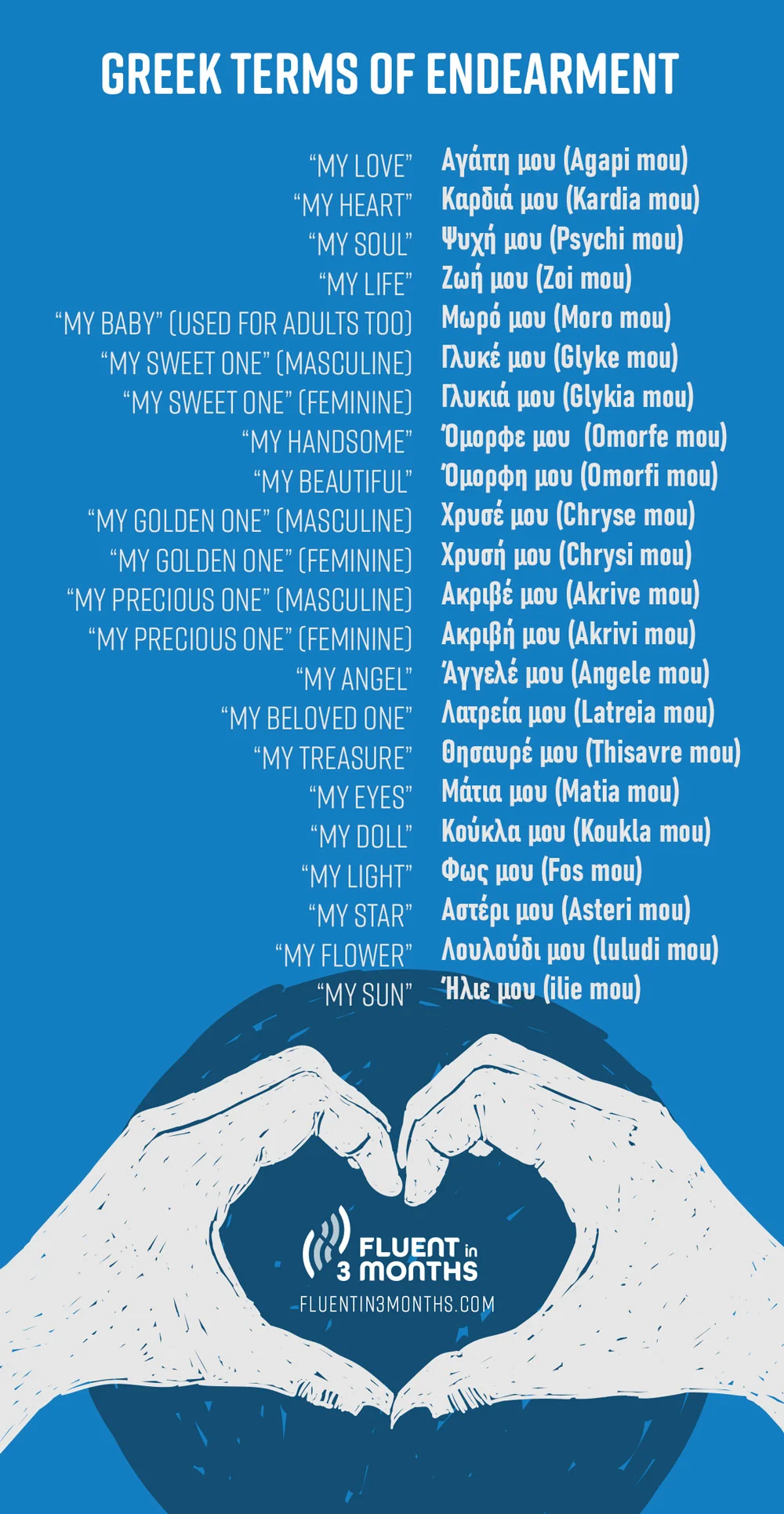
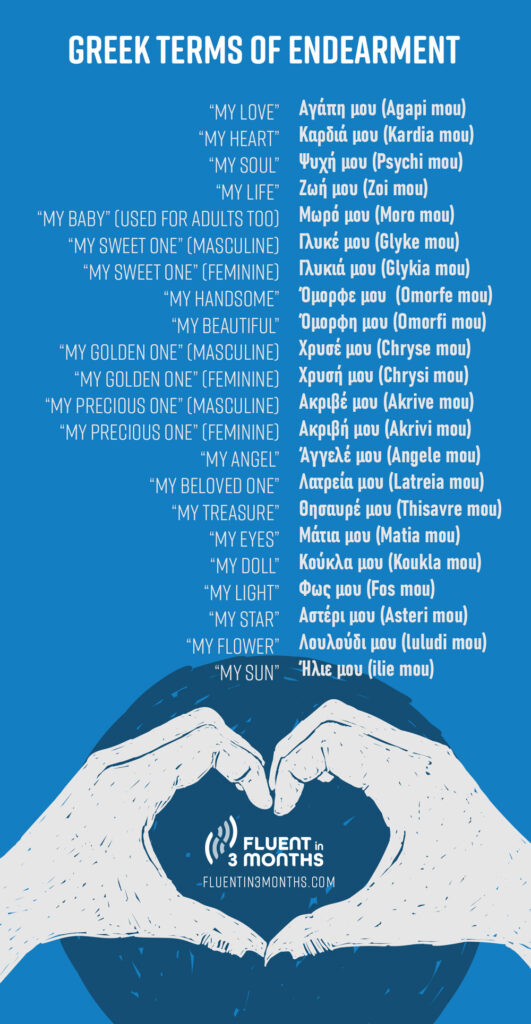
At the core of Greek endearment lies the possessive pronoun "mou" (μου), meaning "my." Unlike English, where possessives often precede the noun, the Greek structure dictates that "mou" follows the term of affection, creating a rhythmic and phonetic emphasis on the relationship between the speaker and the subject. Grammatically, this placement reinforces the concept of belonging and personal connection. For instance, the phrase "Agapi mou" (Αγάπη μου), translated as "my love," is the most ubiquitous term of endearment in the Greek-speaking world, utilized across various levels of intimacy.
Data from linguistic surveys indicate that the Greek language is among the most "affection-dense" languages in Europe, frequently utilizing metaphors involving vital organs and celestial bodies. The term "Kardia mou" (Καρδιά μου), meaning "my heart," and "Psychi mou" (Ψυχή μου), meaning "my soul," are not reserved solely for romantic poetry but are integrated into daily discourse. This highlights a cultural tendency to equate loved ones with the very biological and spiritual essences required for life. Other high-frequency terms include "Zoi mou" (Ζωή μου), meaning "my life," and "Fos mou" (Φως μου), meaning "my light," further illustrating the elevated status of the person being addressed.
The Morphological System of Diminutives
A distinctive feature of Modern Greek is its extensive use of diminutive suffixes to create endearing nicknames. This morphological process involves adding specific endings to proper names or common nouns to denote smallness, youth, or affection. According to linguistic analysis, the most common suffixes include "-aki" (-άκι), "-itsa" (-ίτσα), "-oulis" (-ούλης), and "-oula" (-ούλα).
The application of these suffixes is gender-specific and follows strict phonetic rules:

- -aki (-άκι): A neuter suffix used for both male and female names, such as "Yiorgaki" (from Yiorgos) or "Annaki" (from Anna). It is often perceived as the most playful and innocent form.
- -itsa (-ίτσα): Predominantly used for female names, such as "Elenitsa" (from Eleni), conveying a sense of daintiness.
- -oulis / -oula (-ούλης / -ούλα): Masculine and feminine versions used to express warmth and tenderness, often applied to family members or close friends.
Beyond proper names, these suffixes are applied to common nouns to heighten emotional resonance. "Manna" (mother) becomes "Manoula" (mommy), and "Paidi" (child) becomes "Paidaki" (little child). This system allows for a high degree of linguistic flexibility, enabling speakers to adjust the "temperature" of a conversation based on the suffix chosen.
Philosophical Origins: The Eight Greek Concepts of Love
To understand the modern application of endearment, one must examine the ancient philosophical underpinnings of "love" in the Greek tradition. Classical scholars identified eight distinct types of love, many of which remain visible in contemporary terminology:
- Eros: Passionate, romantic love.
- Philia: Deep friendship and loyalty.
- Storge: Familial love and the bond between parents and children.
- Agape: Unconditional, selfless love for all.
- Ludus: Playful, flirtatious love.
- Pragma: Long-standing, practical love.
- Philautia: Self-love and self-care.
- Mania: Obsessive or possessive love.
Modern endearments like "Latreia mou" (Λατρεία μου), which translates literally to "my worship," echo the intensity of Eros and Mania, while the common "File mou" (Φίλε μου), or "my friend," serves as a direct descendant of Philia. The survival of these distinctions allows Greek speakers to categorize their relationships with a level of precision that is often lost in translation to other languages.
Societal Context and Regional Variations
The use of endearment is also subject to regional nuances, particularly when comparing Mainland Greece to the Republic of Cyprus. In Cyprus, the dialect often retains more archaic structures and unique phonetic qualities, yet the core endearments remain consistent. Social observers note that in both regions, endearments are used by all age groups and genders. It is not uncommon for a male shopkeeper to address a customer as "Agapi mou" or "Koukla mou" (my doll) in a non-romantic, hospitable context, a practice that can sometimes confuse those from more linguistically reserved cultures.
The family unit, or "oikogeneia," remains the primary site for these linguistic exchanges. Because Greek culture is traditionally collectivist, the preservation of familial bonds through language is paramount. Terms like "Agori mou" (my boy) and "Koritsi mou" (my girl) are used by parents well into their children’s adulthood, reinforcing a lifelong sense of protection and belonging.
Implications for Language Acquisition and Cultural Integration
For non-native speakers and students of the Greek language, mastering terms of endearment is often cited as a critical step toward achieving "cultural fluency." While formal grammar and vocabulary provide the skeletal structure of communication, endearments provide the emotional "flesh." Educators suggest that the correct use of "mou" and diminutives signals a respect for Greek social etiquette and an understanding of the importance of warmth in interpersonal interactions.
Furthermore, the prevalence of these terms in popular media—including Greek "laïko" music and television dramas—serves as a primary vehicle for the global dissemination of the Greek language. As the Greek diaspora continues to maintain strong ties to their ancestral homeland, these endearments act as a linguistic bridge, preserving cultural identity across generations in countries like Australia, the United States, and Germany.
Chronology of Linguistic Development
The evolution of these terms can be traced through several distinct historical phases:
- Archaic and Classical Period (800–323 BCE): Development of the philosophical categories of love and the initial use of affectionate address in poetry and drama.
- Hellenistic and Roman Period (323 BCE–330 CE): The spread of Koine Greek, which simplified many linguistic structures and made endearments more accessible to the common populace.
- Byzantine Era (330–1453 CE): Integration of religious terminology into endearment, where "soul" and "angel" became more prominent.
- Modern Era (1821–Present): The standardization of Modern Greek and the explosion of diminutive usage in urban centers, reflecting a shift toward more informal and expressive social norms.
Analysis of Broader Linguistic Impact
The richness of the Greek endearment system reflects a broader linguistic phenomenon known as "affective language." In a globalized world where communication is increasingly digital and transactional, the Greek model offers an alternative focused on emotional presence. Sociologists argue that the frequent use of terms like "Matia mou" (my eyes) or "Asteri mou" (my star) fosters an environment of psychological safety and mutual validation.
Data suggests that speakers of languages with high affective density, such as Greek, Italian, and Spanish, may experience different patterns of social bonding compared to speakers of "colder" languages. In the Greek context, the language itself acts as a buffer against social isolation. By constantly reaffirming the value of the "other" through affectionate address, the speaker reinforces their own place within the community.
Conclusion and Future Outlook
As the Greek language continues to evolve in the 21st century, the core tenets of its endearment system appear remarkably resilient. While technology has introduced new slang and abbreviated forms of communication, the fundamental use of "mou" and the traditional terms of the heart, soul, and life remain unchanged. The enduring popularity of these expressions serves as a testament to the Greek people’s commitment to emotional transparency and the celebration of human connection. For the global community, the Greek lexicon of love provides a valuable blueprint for how language can be used not just to exchange information, but to build and sustain the bonds of the human spirit.