
The groundbreaking research, published in the esteemed journal Science on June 4, 2026, significantly challenges long-standing assumptions about the cognitive capabilities of insects. It presents compelling evidence that bumblebees, despite their minute neural architecture, are capable of spontaneous problem-solving, a cognitive trait previously thought to be the exclusive domain of large-brained vertebrates, including primates and some birds. This discovery opens new avenues for understanding the evolution of intelligence and the diverse mechanisms through which complex cognition can emerge in the animal kingdom.
A Novel Challenge Met with Unprecedented Ingenuity
The core of the study involved subjecting bumblebees (specifically Bombus terrestris, a common and widely studied species) to an entirely novel problem that required innovative object manipulation. Researchers from a collaborative effort spanning the University of Oulu, the University of Helsinki, and the University of Turku in Finland meticulously designed an experiment to test the bees’ ability to adapt and devise a solution without prior instruction.
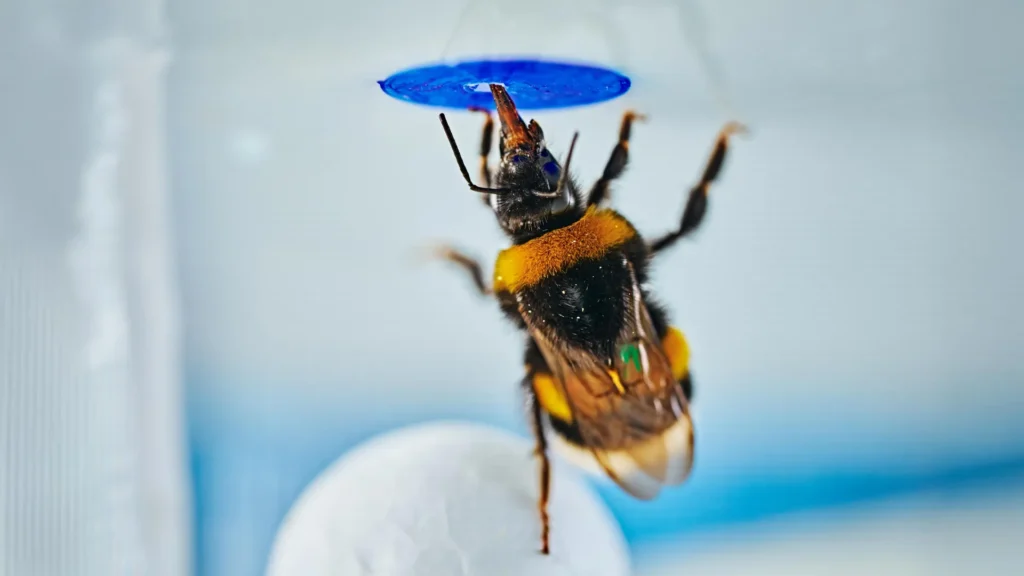
The experimental setup was elegantly simple yet profoundly revealing. Bees were initially trained on two separate, distinct tasks. First, they learned to associate a blue artificial flower with a reward, thereby establishing a clear motivational goal. Second, they were familiarized with small, movable balls within their environment, learning that these objects were harmless and could be shifted. Crucially, at no point were the bees taught to combine these two pieces of information or to use the balls as tools to reach the flower.
When the critical test phase began, the blue artificial flower, now containing the reward, was strategically placed on the ceiling of a transparent arena, rendering it inaccessible to the bees in their natural flight or walking patterns. The small balls, meanwhile, remained on the floor. To successfully retrieve the reward, the bumblebees had to spontaneously conceptualize and execute a complex sequence of actions: they needed to roll a ball beneath the overhead flower, then climb onto the ball, thereby gaining the necessary elevation to reach their goal. This sequence, never before performed or trained, emerged as the bees’ innovative solution.
Dr. Olli Loukola, a Senior Researcher at the University of Turku and senior author of the study, highlighted the parallel to a classic cognitive experiment. "This is essentially an insect version of the classic ‘box-and-banana’ problem," Loukola stated, referring to psychologist Wolfgang Köhler’s seminal work with chimpanzees. "The animal must realize that an object can be repositioned and then used as a tool to reach an otherwise inaccessible goal. What stands out about the result is that this kind of spontaneous problem-solving is now demonstrated in an insect."
Akshaye Bhambore, the lead author from the University of Oulu, further emphasized the remarkable nature of the bees’ behavior. "What makes this behavior especially remarkable is that the bees had never been trained to roll the ball. This was a completely new challenge. Their behavior appeared goal-directed with successful individuals showing more directed movement patterns." This observation suggests a level of cognitive flexibility and foresight not commonly attributed to insects.
A Century of Insight: From Chimpanzees to Bumblebees
The concept of "insight" or spontaneous problem-solving has a rich history in animal cognition research, largely dominated by studies on mammals and birds. More than a century ago, during the 1910s, German Gestalt psychologist Wolfgang Köhler conducted his pioneering experiments on the island of Tenerife. Working with chimpanzees, Köhler famously demonstrated that these primates could suddenly solve unfamiliar problems by combining objects in novel ways. His subjects, notably a chimpanzee named Sultan, would stack boxes to reach a banana hanging overhead or use sticks to pull food closer. These experiments became foundational examples of insight and spontaneous problem-solving, establishing a benchmark for complex cognitive abilities in animals.
For decades, the scientific consensus held that such sophisticated problem-solving, requiring mental representation and the ability to combine disparate pieces of knowledge into a novel solution, was intrinsically linked to the presence of a relatively large and complex brain, particularly a neocortex, which is absent in insects. The prevailing view was that the sheer number of neurons and the intricate connectivity found in vertebrate brains were prerequisites for such advanced cognitive functions.
The bumblebee study directly challenges this long-standing paradigm. It suggests that the capacity for insight may not be solely dependent on brain size or specific brain structures, but rather on computational efficiency and neuronal organization, even in vastly smaller neural networks. This necessitates a re-evaluation of how intelligence is defined, measured, and understood across the evolutionary spectrum.
Rigorous Controls Bolster the Findings
To ensure the observed behaviors were indeed instances of spontaneous problem-solving and not attributable to simpler mechanisms, the researchers implemented an unusually stringent set of control experiments. This meticulous approach was crucial for ruling out alternative explanations such as accidental success, simple trial-and-error learning, or direct visual guidance.
"Another important aspect is that our bees were fully naive," Dr. Loukola stated. "In many previous studies of insight-like problem-solving, the animals have had extensive experience with objects, test environments, or other problem-solving tasks. Here, the bees had never been trained to use the ball to reach the flower, and they had no previous experience with this kind of solution. We also designed the experiments to rule out simpler explanations such as accidental success, play behavior, trial-and-error learning, or direct visual guidance."
One of the most compelling control conditions involved situations where the reward-bearing flower was hidden from the bees’ direct view as they manipulated the ball. This critical test prevented the bees from simply steering the ball towards a visible target. Remarkably, many bees continued to roll the ball to the correct, inferred location beneath the hidden flower, demonstrating an internal representation of the goal and the means to achieve it.
"By analyzing the bees’ behavior across unusually stringent control experiments, we could show that they were not simply reacting to visual stimuli or moving the ball randomly," explained lead author Bhambore. This level of control significantly strengthens the claim that the bees were engaging in genuine, goal-directed problem-solving rather than exhibiting simpler learned or reflexive behaviors. The consistency and efficiency with which the successful bees executed the task, often after initial exploration, further supported the interpretation of insight.
The "Tiny Brain" Revolution: Expanding Our Understanding of Cognition
The findings of this study contribute significantly to a growing body of evidence that highlights the sophisticated cognitive abilities of insects, particularly bees. While a bumblebee’s brain contains approximately one million neurons and is roughly the size of a poppy seed, compared to a chimpanzee’s brain with billions of neurons, bees have repeatedly demonstrated surprising intellectual prowess.
Previous research has revealed that bees are capable of a wide array of complex behaviors:
- Social Learning: They can learn new foraging techniques by observing their peers. For instance, bees have been shown to learn "tool use" by watching other bees manipulate objects to obtain a reward.
- Numerical Cognition: Bees can count up to at least four and understand the concept of zero.
- Abstract Concepts: They can learn abstract rules and categories, such as "same" and "different."
- Cooperation: Bees exhibit complex cooperative behaviors within their colonies, including intricate communication through waggle dances.
- Adaptive Behavior: They can rapidly adapt their behavior to changing environmental conditions and learn complex routes.
- Puzzle Solving: Bees have been observed solving puzzle-like tasks in laboratory settings that require multiple steps.
Ece Nur Akmeşe from the University of Helsinki, a co-author of the study, shared the scientists’ own astonishment at the bees’ performance. "One moment the animal is exploring seemingly without direction, and the next it performs a highly efficient sequence of actions leading directly to the solution," Akmeşe remarked. "Watching the bees solving the task was genuinely fascinating."
Despite these revelations, the researchers are careful to temper interpretations. Dr. Loukola explicitly stated, "We are not claiming that bees think like humans." He emphasized that the findings should not be misconstrued as evidence of human-like consciousness or thought processes in insects. Instead, the study powerfully demonstrates that "miniature brains can generate flexible solutions to novel problems in ways we are only beginning to understand." This distinction is crucial, as anthropomorphizing animal behavior can obscure the unique mechanisms at play. The focus remains on the flexibility and novelty of the solution, irrespective of the underlying subjective experience.
Broader Implications and Future Directions
The implications of this study are far-reaching, touching upon fundamental questions in biology, cognitive science, and even artificial intelligence.
Evolution of Intelligence: The most significant implication is the challenge it poses to the long-held assumption that complex cognitive functions like spontaneous problem-solving require large brains. This research suggests that such abilities might have evolved convergently across vastly different taxa, driven by environmental pressures rather than solely by brain volume. It opens up new avenues for exploring the minimal neural architecture required for specific cognitive feats and how intelligence can be optimized within severe size and energy constraints. Future research may delve into the specific neural circuits and mechanisms within the bee brain that facilitate this type of flexible cognition.
Animal Welfare and Conservation: A deeper understanding of insect intelligence inevitably influences our perception of these creatures. Recognizing that insects possess sophisticated problem-solving abilities could foster greater appreciation for their complexity and, by extension, strengthen arguments for their conservation. Bumblebees, in particular, are vital pollinators facing global declines due to habitat loss, pesticide use, and climate change. Demonstrating their advanced cognitive capacities underscores their intrinsic value and the ecological services they provide.
Artificial Intelligence and Robotics: The efficient problem-solving capabilities observed in tiny bee brains offer tantalizing insights for fields like artificial intelligence and robotics. How can a system with limited computational resources achieve such adaptive and novel solutions? Studying the principles of insect neurobiology could inspire the development of more efficient, robust, and adaptable AI algorithms or small-scale autonomous robots that operate with minimal energy consumption. The concept of distributed intelligence within a small network, or novel approaches to neural processing, could be derived from these biological models.
Comparative Cognition: This study will undoubtedly spur more research into the cognitive abilities of other invertebrates. If bumblebees can demonstrate insight, what about other insects, cephalopods, or even crustaceans? Expanding the scope of comparative cognition beyond the traditional vertebrate focus promises to uncover a richer tapestry of intelligence across the tree of life.
Ultimately, the results suggest that spontaneous, goal-directed problem-solving is not an exclusive club for animals with large brains. "For over a century, spontaneous object-based problem-solving has mostly been studied in vertebrates," Dr. Loukola concluded. "Our study suggests insects may belong in that conversation too." This bold statement encapsulates the paradigm shift initiated by the diligent work of Bhambore, Akmeşe, Hämäläinen, Jussila, Kantola, and Loukola, published on June 4, 2026, in Science, under the title "Spontaneous problem-solving in bumble bees." It heralds a new era in understanding the intricate minds of the smallest among us.