




Microsoft has announced the general availability of its Discovery platform, marking a significant milestone in its strategic push to embed agentic artificial intelligence into the core processes of scientific and industrial research and development. Unveiled at Build 2026, this production-ready environment is designed to empower scientists and researchers by orchestrating complex research workflows, from initial data analysis and hypothesis generation to experimentation and comprehensive knowledge management, all powered by a collection of specialized AI agents. This move is a direct response to the escalating demands for accelerated innovation across various sectors, where traditional research cycles often prove lengthy, resource-intensive, and prone to bottlenecks.
The Dawn of Agentic AI in Scientific Discovery
The launch of Microsoft Discovery arrives amidst a broader paradigm shift in how artificial intelligence is leveraged in scientific endeavors. While AI has long played a role in data processing and pattern recognition, agentic AI represents an evolution, enabling systems to not only answer specific queries but also to plan, reason, execute multi-step processes, and utilize external tools autonomously or semi-autonomously. This capability is particularly transformative for R&D, where iterative cycles of hypothesis, experimentation, validation, and review are the norm. The global R&D expenditure, which surpassed $2.4 trillion in 2020 and continues to grow, underscores the immense financial and intellectual investment in discovery, making any tool that promises efficiency and acceleration highly coveted.
Microsoft’s broader strategy, often termed "AI Everywhere," has seen agentic capabilities integrated across its diverse portfolio, from Azure’s cloud services to GitHub Copilot and Microsoft 365. The Discovery platform extends this vision to a specialized, high-stakes domain. It aims to bridge the chasm between vast, disparate datasets – ranging from proprietary institutional knowledge to the ever-expanding universe of external scientific literature – allowing AI agents to reason across complex relationships, evaluate competing findings, and support more robust, iterative research processes. This integration is crucial, as researchers grapple with an explosion of scientific data, making it increasingly challenging for human researchers to synthesize information comprehensively.

Core Mechanics: The Microsoft Discovery Engine
At the heart of the platform lies the Microsoft Discovery Engine, a sophisticated graph-based knowledge engine designed to support the fundamental loop of scientific work. This engine facilitates the journey from raw evidence to testable hypotheses, then through execution, rigorous analysis, and subsequent iterations. By mapping relationships between diverse data points – including experimental results, literature reviews, chemical structures, biological pathways, and simulation outputs – the engine creates a dynamic, interconnected web of knowledge. This allows AI agents to traverse and analyze information in ways that would be prohibitively time-consuming for human researchers alone.
The specialized AI agents within the Discovery platform are engineered for distinct roles within the research workflow. For instance, some agents might excel at autonomously sifting through millions of research papers to identify emerging trends or previously overlooked correlations, while others could be tasked with designing optimal experimental parameters based on historical data and theoretical models. Another class of agents might focus on analyzing complex simulation outputs, extracting meaningful insights that inform the next phase of experimentation. This modular, agent-based approach ensures that specific, computationally intensive tasks can be offloaded to AI, freeing human researchers to focus on higher-level strategic thinking, problem formulation, and critical interpretation.
A critical design principle emphasized by Microsoft is the platform’s commitment to keeping "human judgment" at the center of research decisions. Recognizing the inherent need for oversight, ethical considerations, and expert intuition in scientific discovery, Discovery is built with robust governance features. For enterprise IT and research organizations, this translates into a system that can connect to institutional knowledge, domain-specific data, and simulation tools while ensuring that AI-generated outputs are reviewable, workflows are reproducible, and intellectual property remains secure. This focus on transparency and control is paramount for adoption in highly regulated and IP-sensitive fields like pharmaceuticals and advanced materials.
Lowering the Barrier: The Microsoft Discovery App Preview
To democratize access to agentic AI in scientific research, Microsoft simultaneously launched a preview of the Microsoft Discovery app. This local desktop experience is tailored for individual researchers, students, academic labs, and smaller scientific teams who may not yet be ready for a full enterprise-scale deployment of the broader Discovery platform. The app is readily accessible, downloadable from GitHub, and integrates seamlessly with a GitHub Copilot account, leveraging familiar developer tools to bring advanced AI capabilities to a wider audience.
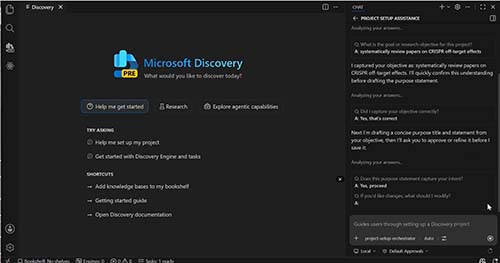
The Discovery app preview allows users to begin exploring fundamental AI-assisted research tasks, such as automated literature review, hypothesis generation, and scientific reasoning, within an iterative experimentation framework. It serves as an entry point, enabling smaller groups to experience the benefits of agentic AI in a controlled, accessible environment before potentially scaling their operations to the comprehensive Microsoft Discovery platform. This strategy acknowledges that while large enterprises are the primary target for the full platform, fostering grassroots adoption among individual researchers and smaller teams is crucial for long-term ecosystem development and innovation. The preview status also allows Microsoft to gather crucial feedback from a diverse user base, ensuring that the final release aligns closely with the practical needs of the scientific community.
Real-World Applications and Early Successes
The utility of Microsoft Discovery is already being demonstrated through collaborations with leading research institutions and industry partners, showcasing its versatility across diverse scientific domains. These early use cases underscore the platform’s potential to accelerate discovery, reduce costs, and tackle previously intractable challenges.
Yale Engineering has leveraged the Discovery Engine in its groundbreaking work on small molecule design for grid-scale aqueous organic redox flow batteries. Professor David Kwabi highlighted how this collaboration effectively combines human-led experimentation with the AI’s unparalleled ability to explore vast chemical design spaces. In materials science, the combinatorial explosion of possible chemical compounds makes traditional experimental methods prohibitively slow. Agentic AI, by intelligently navigating these immense design landscapes, can identify promising candidates much faster, potentially shaving years off development cycles for next-generation energy storage solutions. This synergy exemplifies the platform’s promise: augmenting human ingenuity with AI’s computational power.
The Pacific Northwest National Laboratory (PNNL) is deploying Microsoft Discovery in critical areas such as energy storage and biosystems engineering. A particularly innovative application involves "self-driving scientific workflows," where AI agents are directly integrated with laboratory automation systems. This represents a significant leap towards autonomous laboratories, where AI can not only design experiments but also control robotic systems to execute them, collect data, and adapt subsequent experimental designs in real-time. Such systems hold the potential to dramatically accelerate the pace of scientific inquiry, particularly in high-throughput screening and complex biological research.

Ginkgo Bioworks, a leading organism company, is collaborating with Microsoft on biological discovery. Specialized AI agents are being developed to analyze massive biological datasets, generate novel hypotheses about genetic interactions or metabolic pathways, and design intricate experiments. In synthetic biology, where the design-build-test-learn cycle is central, AI agents can rapidly iterate through design possibilities, predict outcomes, and optimize experimental protocols, moving beyond manual trial-and-error to more intelligent, data-driven approaches.
Beyond academic and national labs, commercial and industrial applications are also emerging. BHP, a global mining company, is utilizing Discovery to study advanced copper leaching methods. Optimizing mineral extraction processes has immense economic and environmental implications, and AI agents can analyze geological data, chemical reactions, and process parameters to identify more efficient and sustainable techniques. Syensqo, a materials science company, is employing agentic AI in its work on next-generation heat transfer fluids for semiconductor manufacturing, a field critical to advancing computing power. By simulating molecular interactions and predicting material properties, AI can accelerate the development of materials essential for cooling high-performance microprocessors.
Perhaps one of the most impactful areas is drug development, where GSK is exploring Discovery workflows. The pharmaceutical industry faces extraordinary costs and lengthy timelines for bringing new drugs to market. AI agents can contribute across multiple stages, from target identification and lead optimization to predicting drug efficacy and toxicity, potentially reducing the financial burden and accelerating the availability of life-saving medicines. The ability of AI to analyze vast repositories of genomic, proteomic, and clinical data can uncover novel therapeutic targets and design drug candidates with higher probabilities of success.
Strategic Implications and Future Outlook
Microsoft Discovery’s general availability signifies a calculated move by the tech giant to solidify its position as a crucial enabler in the burgeoning market for AI-driven scientific research. Industry analysts suggest this move positions Microsoft as a key player alongside specialized AI platforms, offering an integrated, enterprise-grade solution that leverages its existing cloud infrastructure and AI services. The scientific AI market is projected to grow significantly in the coming years, driven by the increasing complexity of research problems and the undeniable need for faster, more efficient discovery processes.

For R&D organizations, the platform represents a potential paradigm shift. It promises to democratize access to advanced AI tools, allowing institutions of varying sizes to harness capabilities previously only available to elite, well-funded labs. This could lead to a more equitable and distributed acceleration of scientific progress globally. However, adoption will also require significant investment in data infrastructure, upskilling researchers to effectively collaborate with AI agents, and establishing robust ethical frameworks for AI-driven discovery. The "reproducibility crisis" in scientific research, where many published findings cannot be replicated, is another area where AI-driven workflows, with their emphasis on systematic data management and transparent process logging, could offer a significant solution.
The broader impact extends beyond mere efficiency gains. By fostering a collaborative ecosystem where humans and AI agents work in tandem, Microsoft Discovery could fundamentally alter the nature of scientific inquiry. Researchers may transition from manually sifting through data to curating AI-generated hypotheses and designing critical validation experiments. This shift could free up intellectual capital, allowing scientists to focus on higher-level conceptual challenges and creative problem-solving rather than rote data processing.
As agentic AI continues to mature, the capabilities of platforms like Microsoft Discovery are expected to expand further, integrating with even more sophisticated simulation environments, robotic laboratories, and real-time sensor networks. The ethical implications of increasingly autonomous AI agents in research will also remain a critical area of focus, necessitating ongoing dialogue about accountability, bias mitigation, and the ultimate goals of AI-driven discovery.
Microsoft Discovery is generally available now, marking a new chapter in the convergence of AI and scientific exploration. The Microsoft Discovery app, currently in preview, offers an accessible entry point for individual researchers and smaller teams, with Microsoft noting that preview features may evolve before the final release. For more comprehensive information and detailed insights, interested parties are directed to the official Microsoft blog, which provides further context on this pivotal development in the landscape of AI-powered scientific innovation.







