



Humanity has spent millennia observing the atmospheric conditions that dictate agricultural yields, travel safety, and daily attire. From ancient agrarian societies watching the horizons for signs of impending drought to modern urbanites scrolling through high-resolution radar apps on cellular devices, the compulsion to forecast and understand the weather remains a cornerstone of civilization. Yet, as meteorological science has advanced from simple folk wisdom to complex satellite-based modeling, a constellation of persistent weather myths has managed to survive in the cultural consciousness. Modern scientific investigation reveals that while some time-tested adages hold grains of physical truth, others are fundamentally flawed misunderstandings of microbiology, atmospheric physics, and fluid dynamics. By examining three of the most pervasive weather myths—that cold temperatures directly cause the common cold, that lightning never strikes the same place twice, and that red skies can reliably predict tomorrow’s weather—scientists and meteorologists can separate folklore from empirical reality.
The Historical Context of Weather Folklore and Human Observation
Long before the invention of the barometer in 1643 by Evangelista Torricelli or the establishment of national meteorological services in the 19th century, human survival depended on immediate, localized environmental cues. Ancient civilizations, lacking thermodynamic equations or satellite telemetry, relied heavily on pattern recognition. Proverbs, rhyming couplets, and oral traditions were passed down across generations to codify survival strategies. These cultural artifacts were not entirely arbitrary; they represented humanity’s earliest attempts at empirical data collection. However, because early observers could only correlate visible phenomena with subsequent events without understanding microscopic pathogens or upper-atmosphere jet streams, causation was frequently confused with correlation.
The Persistence of the Cold Weather Illness Myth
Perhaps the most ubiquitous weather-related fallacy is the admonition from parents and grandparents to bundle up lest one "catch a cold" from the chilling embrace of winter air. For generations, the seasonal surge in viral illnesses has been casually attributed to low outdoor temperatures, damp clothing, and frosty winds. However, medical microbiologists and infectious disease specialists emphasize that thermal conditions alone do not spawn pathogens.
Dr. Manal Mohammed, a senior lecturer in medical microbiology at the University of Westminster, has extensively analyzed the mechanics behind seasonal illness surges. In recent evaluations of respiratory infections, she notes that cold temperatures do not directly generate viral infections. Instead, thermodynamic and meteorological shifts construct the precise biological, environmental, and social ecosystems that allow respiratory pathogens—including rhinoviruses, influenza, and coronaviruses—to proliferate with maximum efficiency.

A deeper examination of the physiological and sociological factors at play reveals a multi-layered explanation for why winter remains illness season. Socially, falling temperatures force populations indoors into enclosed, poorly ventilated spaces. This dramatic increase in human-to-human proximity drastically elevates aerosolized viral transmission rates. Furthermore, indoor heating systems drastically reduce relative humidity. When individuals inhale this dry air, the mucous membranes inside the nasal passages and upper respiratory tract dry out, compromising the body’s primary mechanical defense barrier against foreign particulates and infectious agents.
Physiologically, inhaling freezing air triggers localized physical reactions within the respiratory tract. Cold air causes vasoconstriction—the narrowing of blood vessels—in the lining of the nose and airways. This localized reduction in blood flow can temporarily depress the immune system’s cellular response within the nasal cavity, making it easier for a pathogen that has entered the body to establish an infection. Nevertheless, medical institutions such as Johns Hopkins Medicine reiterate that exposure to cold air in the complete absence of a viral pathogen will never result in a cold. The virus, not the thermometer, is the indispensable prerequisite for illness.
The Mechanics of Lightning and the Fallacy of the Unique Strike
Another deeply ingrained cultural idiom is the phrase "lightning never strikes the same place twice," which has long served as a poetic shorthand for an exceptionally rare or improbable event. In everyday parlance, people invoke this saying to reassure themselves during severe thunderstorms or to dismiss the likelihood of a catastrophic misfortune repeating itself. From a strictly technical and physical perspective, however, this popular saying is entirely false.
Lightning is an electrostatic discharge that occurs when negative charges (electrons) in the lower regions of a cumulonimbus cloud accumulate and seek out positive charges on the Earth’s surface. Because electricity always follows the path of least resistance through the atmosphere, electrical discharges naturally gravitate toward elevated, conductive structures that shorten the physical distance between the cloud base and the ground. Consequently, tall skyscrapers, communication towers, and isolated mountain peaks are struck by lightning with astonishing regularity.
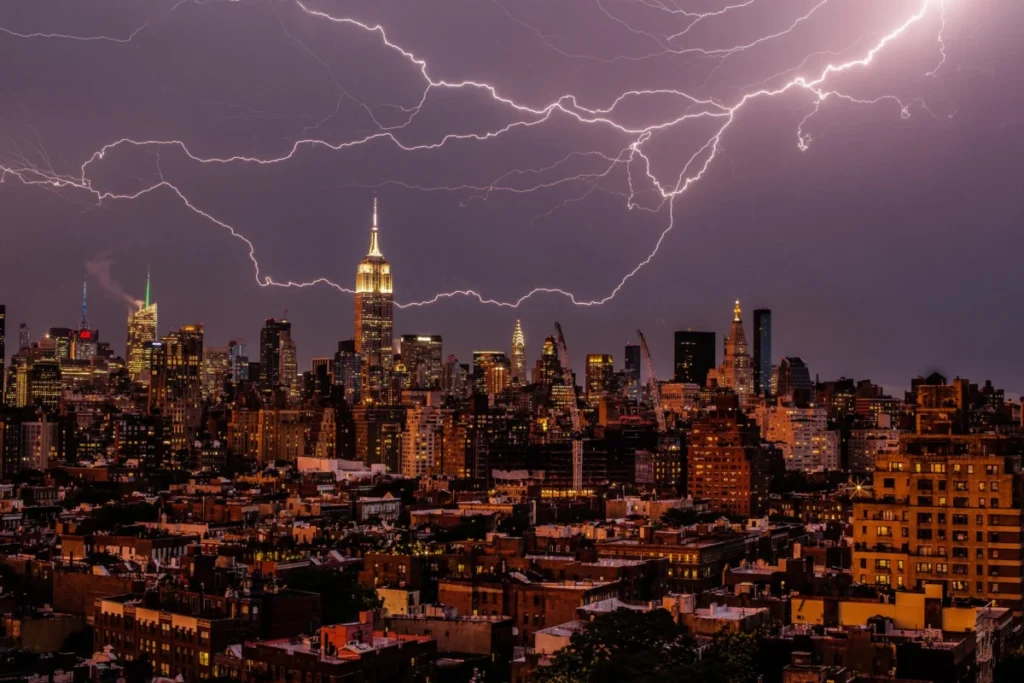
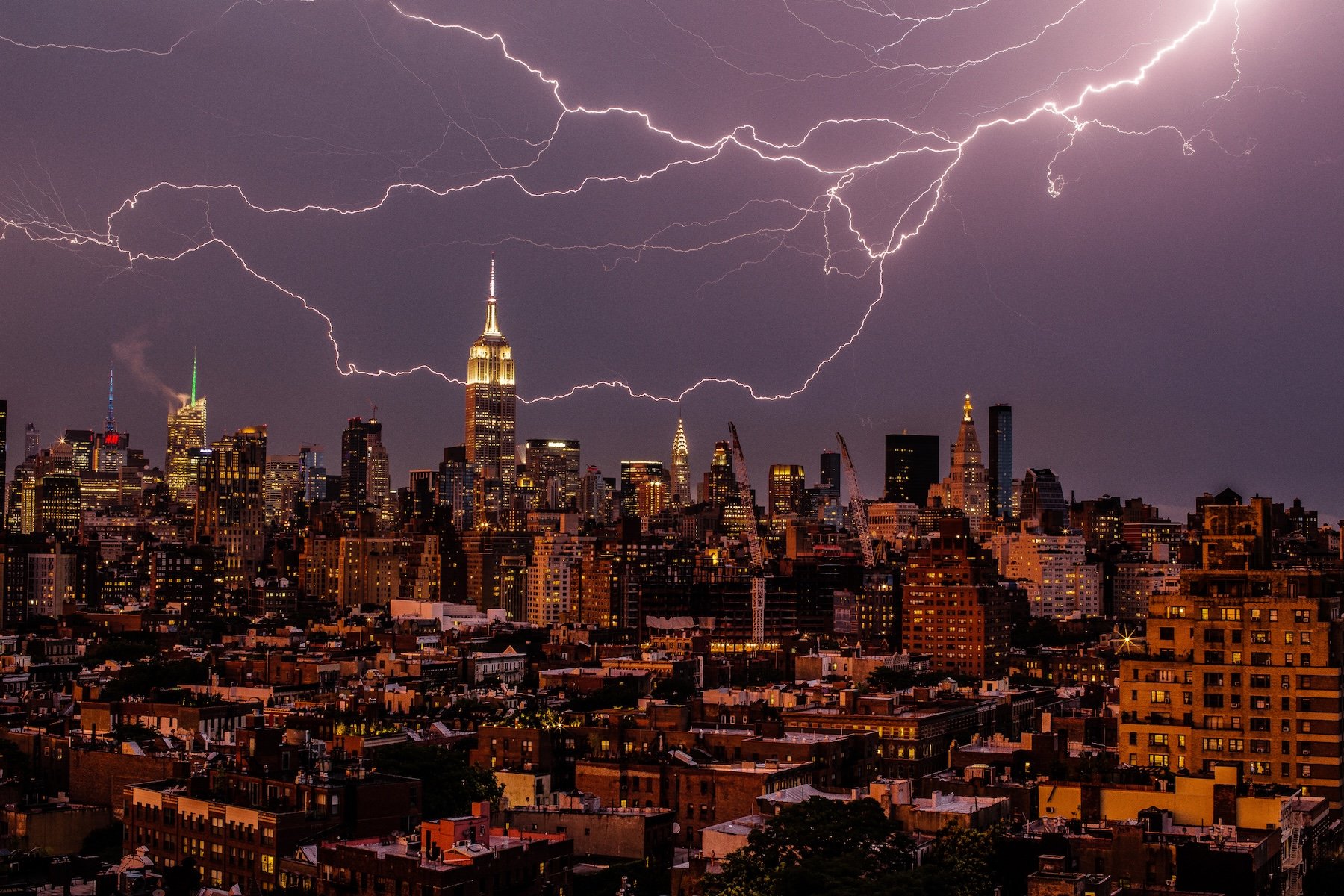
Empirical data compiled by emergency management agencies and national weather authorities demystify the frequency of these strikes. The Empire State Building in New York City, standing at 1,454 feet to its tip, serves as a prime example of urban lightning attraction. According to New York City Emergency Management records, the iconic skyscraper is struck by lightning approximately 25 times every single year. Moving further north, the CN Tower in Toronto, Canada—soaring to a height of 1,815 feet—draws an even greater volume of electrical activity, absorbing roughly 75 lightning strikes annually, as documented by the tower’s operational history and science divisions.
These frequent strikes do not render these architectural landmarks hazardous to the public; rather, they demonstrate modern engineering triumph over natural phenomena. Both the Empire State Building and the CN Tower are equipped with sophisticated lightning protection systems, including heavy copper grounding conductors and lightning rods that safely channel millions of volts of electrical current directly into the earth. According to the National Severe Storms Laboratory (NSSL) under the National Oceanic and Atmospheric Administration (NOAA), while lightning preferentially targets high-altitude conductors, complex atmospheric dynamics mean that multiple strikes within a localized zone are a routine meteorological reality rather than a statistical anomaly.
Decoding the Skies: The Science Behind Red Sunsets and Sunrises
Few weather proverbs have endured as universally as the nautical rhyme: "Red sky at night, sailor’s delight; red sky in the morning, sailors take warning." Documented extensively in historical texts, including biblical references in the Gospel of Matthew, this adage posits that the coloration of the morning and evening sky holds predictive power over forthcoming meteorological conditions. Unlike the myth of catching a cold from chill air, modern meteorological science validates this ancient observation—provided it is applied within the correct geographic and atmospheric framework.
The physical phenomenon responsible for red skies is Rayleigh scattering, combined with the presence of aerosols, dust particles, and water vapor suspended in the troposphere. According to the United Kingdom’s Met Office, a vivid red sky materializes when high atmospheric pressure traps particulate matter and dust close to the Earth’s surface. As sunlight passes through this dense layer of suspended particles during sunrise or sunset, shorter wavelengths of light—such as blue and violet—are scattered in all directions by gas molecules and aerosols. This scattering leaves predominantly longer wavelengths, such as red and orange, to penetrate through to the observer’s eyes.
Because the sun sets in the west and rises in the east, the visual appearance of a red sky provides directional data regarding atmospheric pressure systems. A red sky at night indicates that a high-pressure system—which typically brings stable, dry, and fair weather—is positioned to the west of the observer. Conversely, a red sky in the morning signifies that high pressure has passed to the east, leaving the western horizon open to approaching low-pressure storm fronts.
Implications of Latitude and Regional Variability in Weather Forecasting
The predictive utility of the red sky proverb is fundamentally dictated by global wind patterns and planetary latitude. In the mid-latitudes of both the Northern and Southern Hemispheres—regions situated between 30 and 60 degrees latitude, encompassing the continental United States, Europe, southern Australia, and Japan—the prevailing winds blow predominantly from west to east. Known scientifically as the prevailing westerlies, these massive atmospheric currents sweep weather systems across the globe in a predictable west-to-east trajectory.
Therefore, for populations residing within the mid-latitudes, a red sky at night signals that a stable high-pressure system to the west is being carried directly toward them by the prevailing westerlies, fulfilling the promise of a "sailor’s delight." A red sky in the morning, by contrast, indicates that the high-pressure system has moved eastward, allowing an upwind low-pressure disturbance to march in from the west, justifying the warning to sailors.

However, this forecasting method collapses when applied to tropical regions near the equator. In the tropics, weather patterns are driven by localized thermodynamic heating, convective thunderstorm development, and trade winds rather than mid-latitude westerly jet streams. In these equatorial zones, a red sunrise or sunset yields little to no reliable data regarding the trajectory of incoming weather fronts, as atmospheric conditions build and dissipate locally rather than arriving from predictable upwind corridors.
Broader Impacts and the Value of Scientific Literacy in Modern Meteorology
The endurance of these weather-related myths highlights a broader challenge in public scientific literacy: the human mind’s persistent desire to find simple, linear explanations for complex, multi-variable natural systems. While colloquial weather sayings served vital survival functions for agrarian and maritime ancestors, relying on them in an era of advanced climate science and hyper-local forecasting can lead to misplaced precautions.
Understanding the true mechanics behind respiratory illnesses, lightning attraction, and atmospheric scattering does more than merely debunk old wives’ tales; it empowers communities to make informed decisions regarding public health and safety. As climate variability intensifies globally, moving beyond folk wisdom toward empirically verified meteorological science remains essential for navigating an increasingly dynamic and unpredictable environment.