



As enterprises transition artificial intelligence strategies from isolated pilot projects and exploratory sandbox environments into core production workflows, a profound technical reality is coming to light. According to comprehensive infrastructure research released by Google Cloud, a staggering 83% of organizations worldwide must undertake substantial infrastructure modernizations before they can successfully support production-grade agentic AI systems.
The findings, published in the 2026 State of Infrastructure in the Agentic AI Era report, shed light on an escalating architectural divide. While executive boards and chief technology officers have spent the past several years aggressively pursuing generative artificial intelligence (GenAI) capabilities, the underlying data centers, hybrid cloud networks, and developer toolchains are frequently ill-equipped to handle the rigorous demands of autonomous digital agents. Unlike traditional software applications or even standard large language model (LLM) implementations, agentic AI introduces dynamic, multi-step operational loops that require continuous reasoning, persistent state management, and real-time integration with legacy enterprise software.
Understanding the Evolution: From Static GenAI to Autonomous Agents
To fully grasp the gravity of the current enterprise infrastructure shortfall, industry observers must look back at the trajectory of corporate AI adoption over the past few years. In the formative stages of the generative AI boom, organizations focused primarily on proof-of-concept deployments, creative assistance tools, and localized productivity boosters. Google Cloud’s preceding 2025 infrastructure research underscored that era, revealing near-universal experimentation with GenAI but identifying glaring deficiencies in foundational architecture. That 2025 benchmark highlighted data governance gaps, cost efficiencies, edge deployments, and integration hurdles as the missing pieces in early corporate AI strategies.

However, the technological leap from static generative AI—where a user inputs a single prompt and receives a single generated output—to agentic AI has completely rewritten the rulebook for enterprise IT. Agentic systems are designed to operate autonomously, driven by goals rather than step-by-step human programming. When a user issues a prompt to an agentic system, that single initial interaction can effortlessly trigger hundreds of downstream automated actions. Independent agents browse external databases, query multiple internal repositories, and execute complex logic across disparate software platforms without continuous human intervention.
Consequently, production-grade agentic workloads are inherently persistent, stateful, and potentially long-running. They demand resilient infrastructure capable of securely bridging multi-cloud environments, on-premises datacenters, and edge computing nodes while sustaining unbroken chains of execution.
Breaking Down the Infrastructure Readiness Gap
The empirical data compiled in the 2026 Google Cloud report illustrates the widespread nature of this architectural deficit. Rather than painting a uniform picture of corporate unpreparedness, the survey data disaggregates the 83% readiness gap into distinct tiers of required remediation, revealing varying degrees of technical debt across the enterprise landscape.
Only a tiny fraction of surveyed organizations—precisely 17%—reported full confidence in their existing infrastructure’s ability to support mission-critical, production-grade agents without friction. For the remaining 83%, the path forward requires targeted interventions of varying scales.
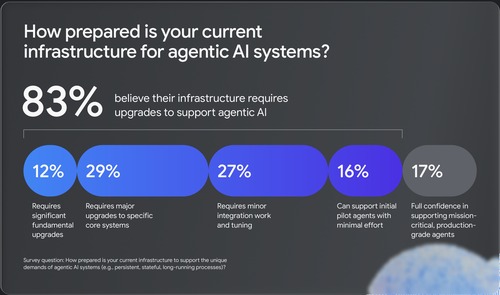
At the most critical end of the spectrum, 12% of respondents admitted that their enterprise infrastructure requires significant, fundamental upgrades from the ground up. These organizations are typically hampered by legacy hardware, outdated networking topologies, and rigid data silos that are fundamentally incompatible with real-time, high-velocity agentic workflows.
Furthermore, 29% of participating organizations reported that they must implement major overhauls to specific core systems, such as enterprise resource planning (ERP) platforms and customer relationship management (CRM) databases, to allow safe, authorized interaction by autonomous agents. Another 27% indicated a need for targeted minor integration work and system tuning to achieve baseline stability. Finally, 16% of enterprises stated that while their current setup can comfortably support initial pilot agents with minimal upfront effort, scaling those systems to enterprise-wide production demands will require substantially more robust engineering.
"This report isn’t just a survey of the landscape; it’s a roadmap for establishing the new standard for production-grade autonomous systems," noted Nirav Mehta, Vice President of Product Management at Google Cloud.
Unique Architectural Demands of Autonomous Agents
The root cause of this widespread readiness gap lies in the fundamentally unique operational requirements of autonomous agents compared to legacy enterprise software and earlier iterations of artificial intelligence.

Traditional applications rely on deterministic logic, executing pre-written code paths triggered by direct user inputs. Standard GenAI models, while probabilistic, generally operate on a request-and-response model where the interaction concludes once the inference is delivered. Agentic AI shatters this traditional paradigm by introducing cyclical workflows of perception, reasoning, decision-making, and action.
To function effectively in a corporate environment, agents must maintain deep contextual awareness across extended workflows and disparate data sources. They must securely read from and write to mission-critical systems of record, retain long-term memory across days or weeks of execution, and sustain complex chains of logical actions at enterprise scale.
From an infrastructure perspective, this level of autonomy imposes rigorous demands on orchestration and observability tools. Platform and developer engineering teams are now tasked with building sophisticated control planes capable of coordinating multi-step workflows, managing high-volume data movement between autonomous agents and legacy infrastructure, and continuously monitoring agent behavior for compliance and safety anomalies. Additionally, because agents often operate continuously, infrastructure must support persistent MLOps pipelines designed for continuous inference rather than batch processing.
Security, Governance, and Compliance Challenges
As agents are granted the autonomy to execute transactions, modify records, and interact directly with sensitive corporate assets, security and governance have emerged as paramount concerns for chief information security officers (CISOs).

The 2026 infrastructure research highlights that modern enterprise architectures must provide robust security and data residency controls spanning hybrid environments, including on-premises facilities, edge computing devices, and public cloud infrastructure. Ensuring that an autonomous agent operates strictly within authorized corporate boundaries requires sophisticated role-based access controls (RBAC), immutable audit logging, and real-time guardrails to prevent unintended data exposure or accidental system disruption.
Moreover, the report emphasizes the necessity of human-in-the-loop oversight mechanisms. As enterprises scale their agentic deployments, platform teams must engineer systems that allow human operators to gracefully intervene, override, or halt agent execution when anomalous behaviors or unexpected edge cases arise. This balance between total autonomy and reliable human governance remains one of the most pressing engineering challenges for modern IT departments.
Power Consumption and Hardware Selection Factors
Beyond software orchestration and data governance, the operational realities of running continuous, resource-intensive agentic workloads are forcing enterprise hardware strategists to reckon with physical constraints, most notably power consumption and thermal efficiency.
Unlike episodic computing tasks, production-grade agentic systems require sustained computational power to support continuous reasoning loops and real-time multi-system interactions. Consequently, power consumption has elevated from a secondary operational consideration to a primary factor in modern hardware selection and datacenter capacity planning. Organizations are increasingly evaluating energy-efficient specialized accelerators, advanced cooling technologies, and sustainable power sources to offset the escalating carbon and financial footprints of large-scale agentic deployments.

Broader Industry Implications and Future Outlook
The release of Google Cloud’s 2026 infrastructure findings serves as a clear market signal that the enterprise AI journey has entered a more mature, pragmatic phase. The era of superficial experimentation, where organizations could claim AI adoption through isolated chatbot pilots, has given way to an era of rigorous systems engineering.
For technology vendors, system integrators, and enterprise IT leaders, the message is unequivocal: software innovation in artificial intelligence can no longer outpace physical and architectural infrastructure. Companies that fail to address the underlying readiness gap risk stalling their AI initiatives in perpetual pilot purgatory, unable to scale autonomous systems safely or efficiently.
Conversely, enterprises that proactively invest in modernizing their cloud, edge, and on-premises architectures to support stateful, persistent, and secure agentic workloads will unlock unprecedented levels of operational efficiency and automated productivity. As the market continues its rapid evolution toward fully autonomous enterprise ecosystems, bridging the infrastructure gap will determine which organizations successfully capture the long-term value of agentic AI and which are left behind by architectural obsolescence.